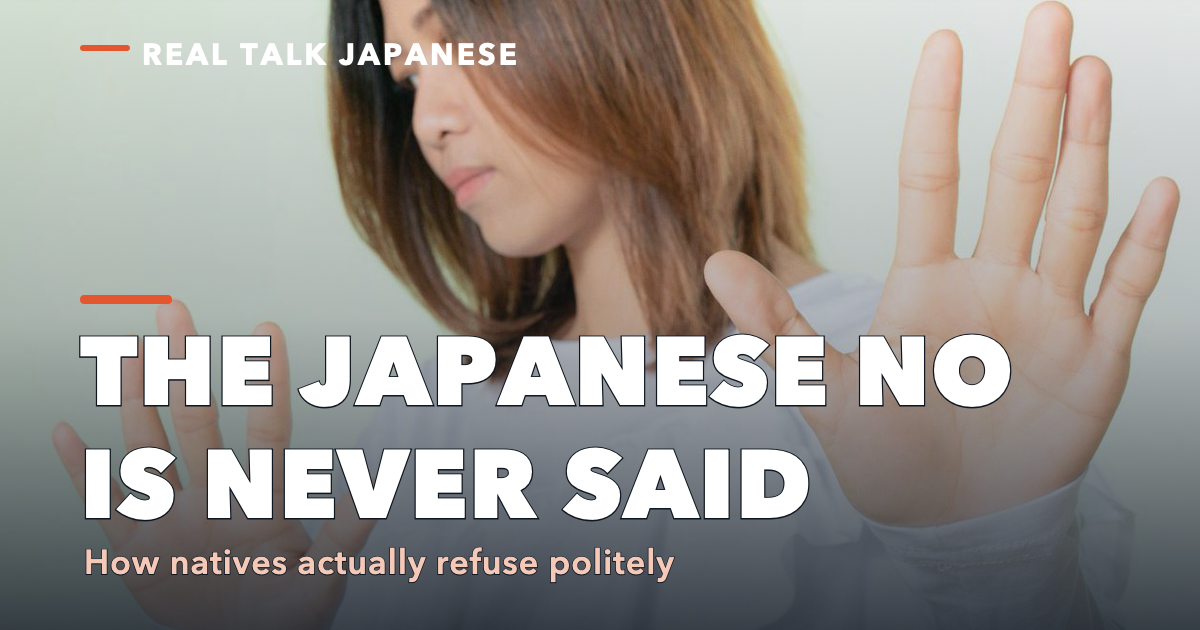
Your textbook taught you that “no” in Japanese is いいえ (iie). Here’s the real-talk truth from a native speaker:
I almost never say いいえ. Neither does anyone I know.
In actual Japanese life, いいえ is mostly a formal checkbox word — the “no” you circle on a form, or the polite denial when someone compliments you (いえいえ, “oh no no, I’m nothing special”). As an actual refusal — “no, I won’t,” “no, I don’t want to” — it’s so blunt we reach for almost anything else.
This article is the guide I wish learners got on day one: how Japanese people actually decline things, the exact phrases we use, and how to hear a “no” that’s never spoken.
Why Japanese Avoids the Direct No
Quick cultural mechanics, no mysticism: Japanese conversation runs on preserving the other person’s face. A direct refusal forces the other person to absorb rejection in real time. So the language evolved a rich toolkit for signaling no while leaving the sentence technically unfinished — the listener completes it in their head, and nobody has to say the harsh word out loud.
This isn’t dishonesty. Every Japanese adult decodes these signals instantly. It’s a compression format — the “no” is fully transmitted, just not fully pronounced.
The Phrases We Actually Use
1. ちょっと… (chotto…) — the king of Japanese refusals
Literally “a little…” — and then the sentence just stops.
明日飲みに行かない? — “Wanna grab drinks tomorrow?”
あー、明日はちょっと… — “Ah, tomorrow’s a little…”
That’s it. That’s the whole refusal. The trailing-off IS the no. No native will ever ask “a little what?” — the sentence is complete in its incompleteness.
Learner power move: master the art of stopping mid-sentence. It feels unnatural in English; in Japanese, it’s fluency.
2. 大丈夫です (daijōbu desu) — the soft “I’m good”
The modern everyday no, especially for offers:
袋いりますか? — “Do you need a bag?”
大丈夫です — “I’m good.”
Exactly like English “I’m good, thanks.” Warm, closes the topic, zero friction. (It also means “are you OK?” and “it’s fine” — context decides, as always.)
3. 結構です (kekkō desu) — the firm, formal no
“No thank you” with the temperature turned down. Polite on paper, but noticeably firmer than 大丈夫です — this is what I use with pushy salespeople and phone solicitors. Between friends it would sound cold; at your door, it’s exactly right.
4. 難しいですね… (muzukashii desu ne…) — “that would be difficult”
The business classic. When a Japanese client says your proposal is difficult, they are not describing a challenge to overcome. 難しい in business Japanese means no. Full no. Final no.
Entire international deals have died because one side heard “difficult” and started problem-solving.
5. 考えておきます (kangaete okimasu) — “I’ll think about it”
Sibling of #4. Sometimes it genuinely means “let me think” — but attached to a sales pitch or an invitation you’ve hesitated on, it usually means the thinking is already done, and the answer is no. Watch for it paired with the apologetic head-tilt and the sucked-in breath (below).
6. 遠慮しておきます (enryo shite okimasu) — “I’ll hold back”
The graceful decline for invitations and offers: “I’ll refrain (this time).” It thanks the inviter by treating the offer as valuable while still closing the door. The しておきます ending softens it into “for now,” even when everyone knows “for now” means forever.

The Nonverbal No: Signals You Must Learn to Hear
Half of Japanese refusal happens outside the words. The big four:
- The sucked-in breath — that “sssss” sound through the teeth while tilting the head? That’s a no forming. It buys time before delivering the refusal
- The head tilt + うーん — visible reluctance is itself the message
- The unfinished sentence — それはですね… (well, about that…) followed by silence
- The counter-offer that isn’t one — また今度 (next time) and 機会があれば (if there’s a chance) are polite conversation-closers, not scheduling commitments
The golden rule: in Japan, hesitation is an answer. If the yes doesn’t come immediately and warmly, you’ve usually already received your no — everything after is packaging.
How YOU Should Say No (Without Offending Anyone)
The learner-safe toolkit, by situation:
| Situation | Say this | Feels like |
|---|---|---|
| Declining an offer (bag, refill, help) | 大丈夫です | “I’m good, thanks” |
| Declining an invitation | すみません、その日はちょっと… | “Sorry, that day’s a bit…” |
| Declining firmly (sales, strangers) | 結構です | “No thank you.” |
| Declining something you’d genuinely enjoy another time | 行きたいんですけど、ちょっと都合が… | “I’d love to, but…” |
| Business pushback | それはちょっと難しいかもしれません | “That may be difficult” (= likely no) |
Three native tips that upgrade all of these:
- Add the apology-cushion: すみません before, or ごめんなさい after, softens any refusal — you’re apologizing for the situation, not confessing guilt
- Blame circumstances, not preference: 都合が悪くて (“the timing doesn’t work”) spares feelings in a way “I don’t want to” never can. This is expected, not deceptive
- Offer warmth at the close: また誘って!(“invite me again!”) — if you mean it — turns a no into relationship maintenance
What NOT to Say
- ❌ いや / だめ / 無理 as refusals to non-close-friends — these are blunt instruments. (Between close friends, 無理むり! is fine and common — friendship changes the physics)
- ❌ いいえ to decline invitations — grammatically correct, socially like answering “will you come to my party?” with “negative.”
- ❌ Over-explaining. A long detailed excuse sounds less sincere in Japanese, not more. ちょっと予定があって (“I have something”) is a complete, respectable excuse
FAQ
Does いいえ mean no in Japanese?
Formally yes, but natives rarely use it as an actual refusal. It survives mostly on forms, in formal Q&A, and in the humble いえいえ (“oh, not at all”) response to compliments.
How do Japanese people say no politely?
By softening (すみません、ちょっと…), deferring (考えておきます), reframing (難しいですね), or declining the offer’s necessity (大丈夫です) — usually with apologetic body language doing half the work.
What does ちょっと mean when refusing?
Literally “a little,” but as a refusal it means “that doesn’t work for me.” The sentence intentionally trails off, and the listener understands the no without it being spoken.
Is it rude to say no directly in Japan?
To strangers and in business — it lands harshly. Among close friends, direct refusals (無理!) are normal. The closer the relationship, the more direct you can be.
What does 難しい mean in business Japanese?
When attached to your request or proposal: no. It signals refusal while sparing you public rejection. Hearing “difficult” as an invitation to problem-solve is a classic cross-cultural mistake.
💬 One Honest Tip From a Native
Reading this gives you the map — but hearing a real 考えておきます and feeling the no inside it takes practice with actual Japanese speakers. The trailing ちょっと…, the breath, the tilt: these are rhythms you learn by conversation, not flashcards.
That’s exactly the kind of thing 30 minutes with a native tutor teaches faster than a month of apps.
→ How to find a Japanese tutor online (a native’s honest guide)
Written by Rei — native Japanese speaker who has said 考えておきます and meant it… maybe twice, ever.
Last updated: July 2026
Turn what you learned into practice.
Find an app for your next learning goal, or a tutor to help you use these expressions in conversation.