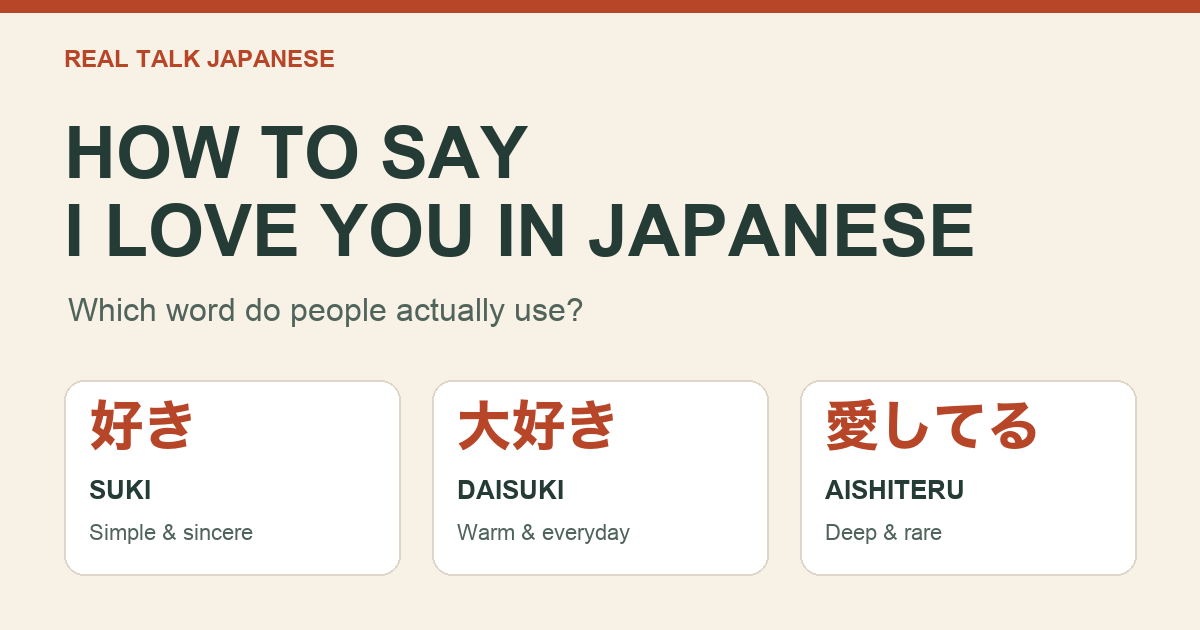
The most natural way to say “I love you” in Japanese is usually 好き (suki) or 大好き (daisuki), not 愛してる (aishiteru). Suki means “I like you” or “I love you,” depending on the relationship. Daisuki adds warmth. Aishiteru is a real phrase, but many people keep it for rare, serious moments.
This guide explains how each phrase sounds to a Japanese listener, how to reply with “I love you too,” and how to say it to a partner, family member, or friend without sounding like a textbook or a drama script.
Quick answer: the “I love you” ladder
| Japanese | Reading | How it feels | Typical use |
|---|---|---|---|
| 好き 好きだよ | suki suki da yo | “I like you / I love you.” Simple and sincere. | Confessions, partners, everyday affection |
| 大好き 大好きだよ | daisuki daisuki da yo | “I really love you.” Warm and open. | Partners, family, close friends, pets, food |
| 愛してる | aishiteru | Deep, heavy, very direct. | Long-term partners, special moments, songs and dramas |
| 愛しています | aishite imasu | The polite form. Can sound formal or scripted. | Letters, speeches, wedding vows |
| 月が綺麗ですね | tsuki ga kirei desu ne | “The moon is beautiful.” A famous indirect hint. | Playful or literary moments, not everyday talk |
If you remember one rule, make it this: start with suki or daisuki. They match how people actually talk. Save aishiteru for a moment you would also call serious in your own language.
Suki (好き): the phrase most confessions use
好き (suki) is technically an adjective meaning “liked” or “favorite.” Its meaning grows with context. Saying you like ramen and saying you like a person use the same word, so the situation does the translation.
In Japan, starting a relationship often involves a clear confession, called 告白 (kokuhaku). The classic version is short:
好きです。付き合ってください。
Suki desu. Tsukiatte kudasai.
“I like you. Please go out with me.”
Notice what is missing: no “I” and no “you.” Japanese drops pronouns when the meaning is clear. Adding 私はあなたが (watashi wa anata ga) makes the sentence sound like a translation exercise.
Between partners, the casual forms do the work:
- 好きだよ (suki da yo) — gentle and reassuring. The よ adds “I want you to know.”
- 好き (suki) — short and soft; common in texts.
- 好きだ (suki da) — blunt and firm. You will hear it in anime confessions, but it can sound intense in real life.
Small endings change the tone a lot. If よ and ね still feel mysterious, read how Japanese sentence endings work.

If suki also means “like,” how do I know whether someone is confessing?

Look at the setting. “I like this cake” is just food talk. When someone stops, faces you, and says 好きです with nothing else attached, that is a confession. Japanese leaves the meaning to the moment.
Daisuki (大好き): warmer, and safer than it looks
大好き (daisuki) literally means “big like.” It is warmer than suki, but also more flexible. People say daisuki to partners, children, parents, best friends, pets, and favorite foods.
That flexibility makes it easy to use. A parent can say 大好きだよ to a child. Two close friends can text 大好き after a good day. A partner can say it many times without it feeling heavy.
いつもありがとう。大好きだよ。
Itsumo arigatō. Daisuki da yo.
“Thanks for always being there. I love you.”
This works for a partner or for family. The thank-you sets the tone, so daisuki reads as affection, not a dramatic announcement.
Daisuki can still be part of a romantic confession. 実はずっと大好きでした (jitsu wa zutto daisuki deshita) — “Actually, I’ve loved you all this time” — is clear and heartfelt.
Aishiteru (愛してる): real, but used sparingly
愛する (aisuru) means “to love” in the deep sense. Its casual form, 愛してる (aishiteru), is what most dictionaries give for “I love you.” That is why learners expect to hear it everywhere.
In daily life, many couples rarely say it out loud. It can feel too weighty for an ordinary evening, a little like reading poetry at the dinner table. You will hear it more in songs, dramas, and big life moments. Some couples do use it regularly, and that is fine; it simply is not the default.
The polite form, 愛しています (aishite imasu), is even more formal. It suits a letter or a speech better than a text message.
So is it wrong to say aishiteru to my Japanese partner?
Not wrong at all. Just know that it lands heavily. Many people start with 大好きだよ, and keep 愛してる for a moment that deserves it. If your partner uses it with you, you can use it back.
How to say “I love you too” in Japanese
Reply with the same level of word, then add も (mo), which means “too.” You can include a pronoun here, because you are contrasting yourself with the speaker.
| They say | You can reply | Reading |
|---|---|---|
| 好きだよ | 私も好きだよ / 僕も好きだよ | Watashi mo suki da yo / Boku mo suki da yo |
| 大好き | 私も大好き / 俺も大好き | Watashi mo daisuki / Ore mo daisuki |
| 愛してる | 私も愛してる | Watashi mo aishiteru |
私 (watashi) is neutral, 僕 (boku) is a softer masculine “I,” and 俺 (ore) is a casual masculine “I.” In real conversation, the shortest reply is often just 私も (watashi mo) or 僕も (boku mo) — “Me too.”
Saying “I love you” without saying it
Japanese often shows love through actions and indirect phrases. These everyday lines carry a lot of feeling:
- 会いたい (aitai) — “I want to see you” / “I miss you.”
- ずっと一緒にいたい (zutto issho ni itai) — “I want to be with you always.”
- 大切だよ (taisetsu da yo) — “You’re precious to me.”
- そばにいてくれてありがとう (soba ni ite kurete arigatō) — “Thank you for being by my side.”
Then there is the famous one: 月が綺麗ですね (tsuki ga kirei desu ne), “The moon is beautiful, isn’t it?” Popular stories say the novelist Natsume Sōseki suggested it as a Japanese way to translate “I love you.” The story is widely repeated, but it has no confirmed written source, so treat it as a beloved legend.
Many Japanese people know the line as a romantic hint. Some will smile at it; others will simply agree that the moon looks nice. A common playful reply is 死んでもいいわ (shindemo ii wa), “I could die happy,” which is also linked to a literary story. Use the pair for fun with someone who knows the reference, not as a first confession.
Should I use tsuki ga kirei desu ne to confess?
Use it as a wink, not as your main message. If the other person misses the hint, you are back where you started. A clear 好きです is braver, and much easier to understand.
Saying it to family and friends
For family, daisuki is the natural choice. Parents say 大好きだよ to children, and adult children may write it in a birthday message. Many families express love through thanks rather than direct words: いつもありがとう (itsumo arigatō), “Thanks for everything, always.” For more ways to show gratitude, see how to say thank you in Japanese.
With friends, 大好き is common in texts and cards, especially among close friends. Suki alone, said face to face, can sound like a romantic confession, so add context: みんなのこと大好き (minna no koto daisuki), “I love you all.”
Common mistakes learners make
- Translating word for word. 私はあなたを愛しています (watashi wa anata o aishite imasu) is grammatical, but it sounds like a language-course example. Drop the pronouns.
- Calling your partner あなた (anata). Using “you” directly can feel distant. Use their name instead.
- Copying anime confessions. Lines that work on screen can sound theatrical in real life. See anime Japanese you should not use in real life.
- Overusing aishiteru. Saying it in every message takes away the weight that makes it special.
If a confession has your heart racing, there is a word for that too: doki doki.
Try it: Write three short messages to the same person: one with 好き, one with 大好き, and one with no love word at all, only 会いたい or ありがとう. Read them aloud and notice how each one changes the mood.
Frequently asked questions
What is the most common way to say I love you in Japanese?
In everyday speech, 好き (suki) and 大好き (daisuki) are the most common. 愛してる (aishiteru) exists, but many people save it for serious moments.
What does daisuki mean?
Daisuki (大好き) means “I really like it” or “I love it.” It is used for people, pets, food, and hobbies. With a partner, 大好きだよ (daisuki da yo) is a warm “I love you.”
What is the difference between suki and daisuki?
Suki is simple and sincere; daisuki is warmer and stronger. Suki is the classic confession word, while daisuki is used more freely with family and friends.
Do Japanese couples say aishiteru?
Some do, but many say it rarely. It feels deep and weighty, so it is common in songs, dramas, letters, and special occasions.
How do you say I love you too in Japanese?
Repeat their phrase with も (mo): 私も好きだよ (watashi mo suki da yo) or 私も大好き (watashi mo daisuki). A quick 私も (watashi mo) also works.
Want to practice saying it with natural rhythm? A Japanese tutor can role-play a confession or a reply with you and point out when you sound stiff.
Written for Real Talk Japanese. References checked October 24, 2026. Dialogues and translations are original teaching examples.