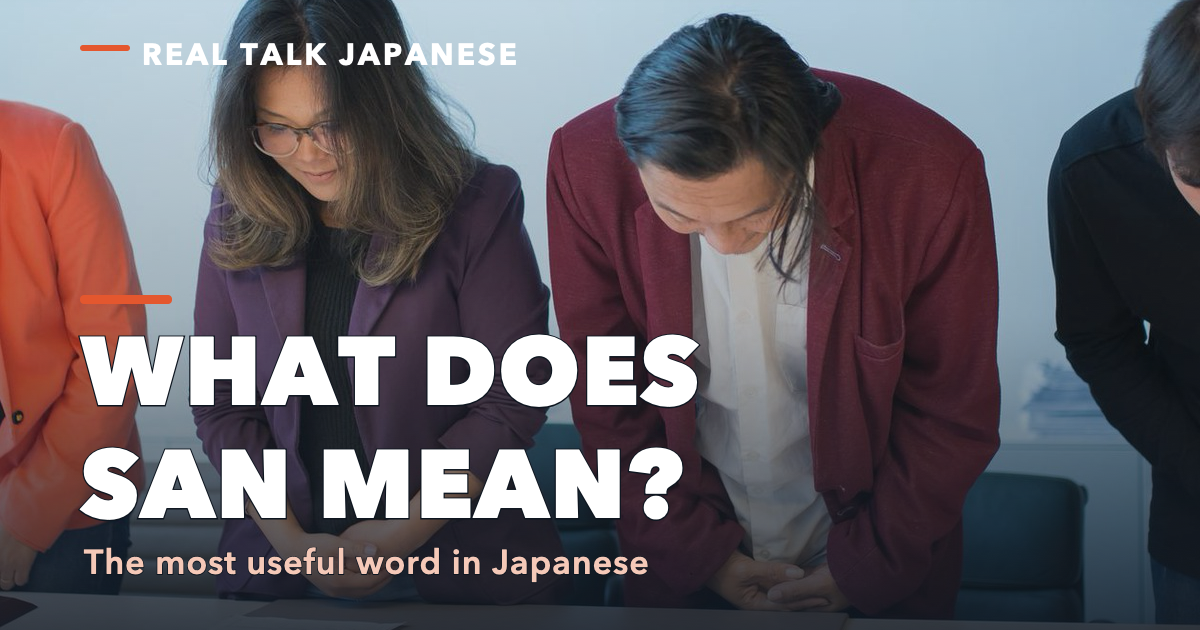
Every textbook gives you the same one-liner: “-san is like Mr. or Ms.”
As a native Japanese speaker, let me tell you why that translation quietly fails you: -san is not a title — it’s a politeness setting. It attaches to people, companies, shops, even elephants. And nobody warns you about this part: san doesn’t only show respect. Sometimes it builds a wall.
Quick Answer
-san (さん) is a neutral politeness marker added after a name (or almost any noun referring to someone). It signals “standard respect, comfortable distance.” It works up, down, and sideways — which is why it’s the default for nearly every relationship in Japan.
Name + san is a useful starting point when you are unsure how to address someone. A friend may also prefer it; the suffix alone does not tell you how close you are.
Why “Mr./Ms.” Is the Wrong Translation
“Mr. Tanaka” in English is formal. But 田中さん (Tanaka-san) covers your bank manager and your coworker at lunch — plus your neighbor, your dentist, and your friend’s mom.
That’s the first mental shift: san isn’t formal. It’s neutral. Real formality is handled by other honorifics and by keigo — I map the whole system in my complete guide to Japanese honorifics. San is a common polite form of address; it does not by itself rule out a close relationship. English has no resting state like this, which is why the translation keeps breaking.
San Attaches to Almost Anything
Here’s where san stops behaving like “Mr.” entirely:
| Target | Example | What it means |
|---|---|---|
| People | 田中さん (Tanaka-san) | standard polite address |
| Companies | トヨタさん (Toyota-san) | “our counterpart Toyota” in business talk |
| Shops | パン屋さん (pan-ya-san) | “the bakery” — sounds warm, not childish |
| Occupations | 運転手さん (untenshu-san) | “driver” — polite way to address a stranger by role |
| Animals (to kids) | ぞうさん (zou-san) | “Mr. Elephant” — nursery register |
The business one surprises learners most. In meetings, people genuinely say ソニーさんはどうお考えですか (“What does Sony-san think?”) — attaching san to a company treats the organization as a person you respect.
This flexibility is why san feels safe: it claims no relationship, just civility.

The Part Textbooks Skip: San Creates Distance
San can create distance, but it is not proof of distance. A change from a familiar nickname to surname + san may sound more formal. To interpret it, consider the setting, tone, and the person’s usual way of addressing you.
- At work: someone who uses your nickname privately may use surname + san in a meeting. That change alone does not mean the friendship has changed.
- Among friends: continuing to use given name + san can be an established habit or preference. Do not assume you have been excluded because others have nicknames.
Using a name without an honorific is called yobisute (呼び捨て). If you would like a different form of address, ask: 「ゆきって呼んでもいいですか?」(Yuki tte yonde mo ii desu ka? — “May I call you Yuki?”). Let the other person choose; dropping san is not a test of friendship.
For the distinction between respect and context-dependent social meaning, see David Y. Oshima’s research on Japanese honorifics, particularly note 13 on situation, relationships, and speaker differences.
The Two Mistakes That Instantly Mark a Beginner
San is nearly impossible to misuse toward others. The classic errors are about yourself:
1. Never put san on your own name
「私は田中さんです」(“I am Tanaka-san”) is the most common learner error I hear. San is respect given, never self-applied — it sounds like “the honorable me.” Just 田中です (Tanaka desu).
2. Never use san for your own family with outsiders
Telling your boss 「お母さんが…」(“my mother-san…”) humbles the wrong side. Say 母 (haha) for your own mother to outsiders — and お母さん for someone else’s mother. Same person, different label depending on who’s speaking. Welcome to Japanese.
Both errors share one root: san isn’t part of the name. It’s a gesture from you to them.
First Name or Last Name?
Both take san, but the default matters:
- Last name + san (田中さん) — the standard for adults and anyone you met after high school
- First name + san (ゆきさん / Yuki-san) — warmer; common for friends-of-friends and international settings
With foreigners, Japanese people usually go first-name + san (ジョンさん) because Western surnames feel unwieldy to us. It’s practical, not intimate.
When San Finally Comes Off
The drop usually happens one of three ways, in my experience:
- Explicit invitation — 「さんはいらないよ」(“you don’t need the san”). Accept it; refusing is oddly cold.
- Nickname replacement — the group starts calling you something shortened, skipping the negotiation entirely.
- Gradual slippage — after enough drinks or years, the san just evaporates one day, and nobody comments.
Until then, keep the san. Dropping it uninvited feels like using someone’s toothbrush — technically possible, socially alarming.
FAQ
What does san mean after a name in Japanese?
It’s a neutral politeness marker, roughly “I address you with standard respect.” Unlike “Mr.” or “Ms.” it applies to any gender, any age, even to companies and shops.
Is it rude to not use san?
With strangers and colleagues, yes — dropping san (yobisute) sounds presumptuous unless you’ve been invited to. Between close friends and family, the bare name is normal and warm.
Do I use san with first names or last names?
Both work. Last name + san is the adult default in Japan; first name + san is friendlier and common with foreigners. Follow whatever the person uses when introducing themselves.
Should I call myself -san?
Never. San is respect directed at others — introducing yourself as “Tanaka-san” sounds like calling yourself “the esteemed Tanaka.” Use your bare name: Tanaka desu. And yes, san is completely gender-neutral, so it covers Mr., Ms., and Mx. at once.
Why do Japanese people still call me san after years of friendship?
It may be habit, politeness, or a preferred way of addressing you. San alone does not establish emotional distance. You can suggest a name you like, without expecting everyone to drop the suffix.
💬 One Honest Tip From a Native
San decisions are made by feel, not flowcharts — and that feel only develops in live conversation, when a real person laughs and says “you can just call me Yuki.” If you don’t have Japanese people to practice with yet, here’s how to find a Japanese tutor online. For the full system, start with the complete guide to Japanese honorifics.
Written by Rei — native Japanese speaker. Audio examples coming soon.
Last updated: July 2026
Practise choosing the right words.
Knowing an honorific is the first step. A tutor can help you practise introductions and decide what fits the relationship.