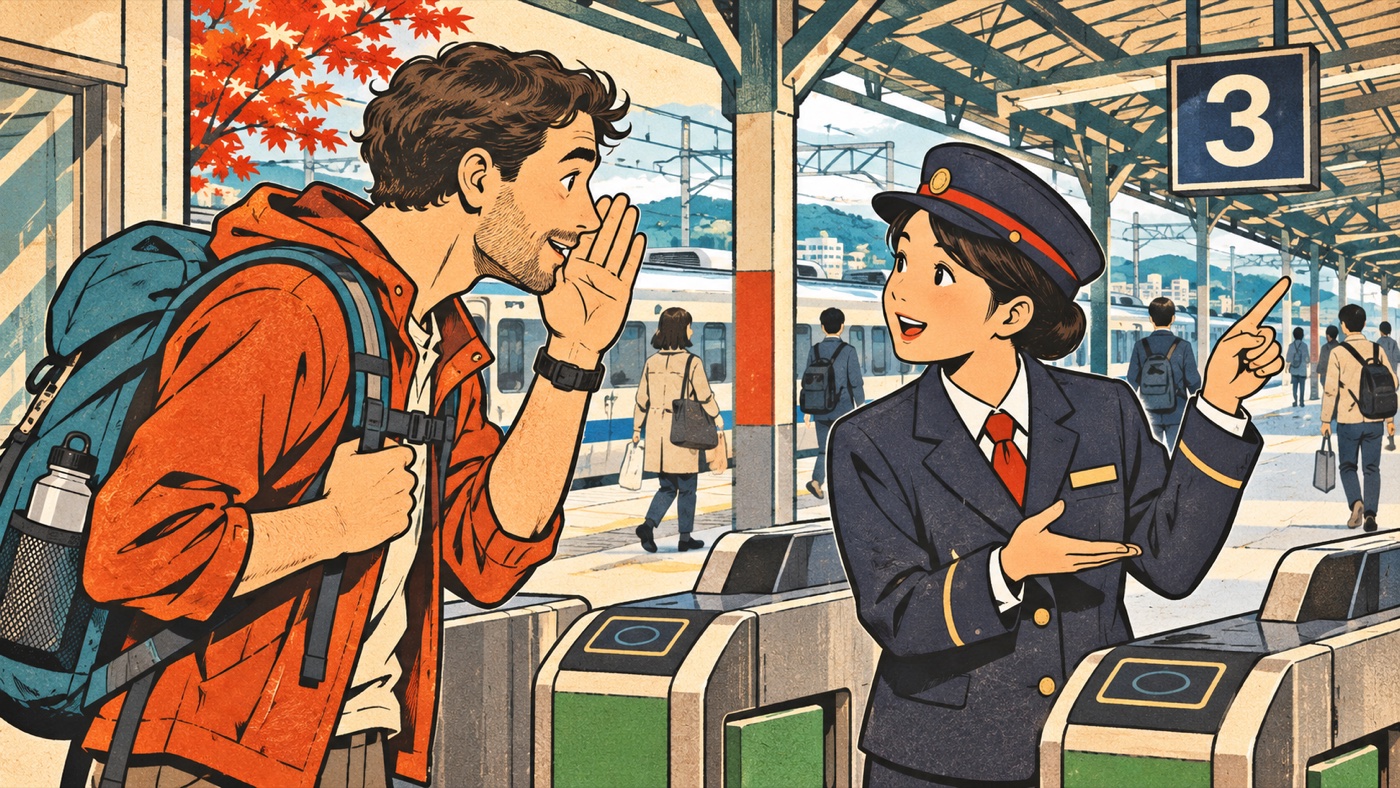
Someone speaks to you in Japanese, and the words fly by. Maybe it’s a cashier, a station attendant, or a new coworker. It happens to every learner, and the fix is simple: a handful of short phrases that let you ask again without freezing up.
In this guide, you’ll learn how to say “Can you repeat that?” in Japanese, how polite each version sounds, and what to say when you missed only one word or just need someone to slow down. Every phrase comes with Japanese script, romaji, and a natural English translation, plus short conversations you can copy and a quick practice quiz at the end.
Quick Answer: “Can You Repeat That?” in Japanese
The most useful phrase to memorize is:
すみません、もう一度お願いします。
Sumimasen, mō ichido onegaishimasu.
“Excuse me, once more, please.”
In hiragana only, it’s written すみません、もういちど おねがいします。
It’s polite enough for shops, hotels, stations, and offices, and short enough to say when you’re nervous. If you remember only one thing from this article, make it this.
The Core Phrases, from Most Polite to Casual
Everything starts with もう一度 (mō ichido, also spelled mou ichido), meaning “one more time.” What changes is the ending, and the ending decides how polite you sound.
| Japanese | Romaji | Meaning | Use with |
|---|---|---|---|
| もう一度言っていただけますか。 | Mō ichido itte itadakemasu ka. | Could you say that again? | Customers, your boss, formal settings |
| もう一度言ってもらえますか。 | Mō ichido itte moraemasu ka. | Can you say that again? | Coworkers, staff, people you just met |
| もう一度お願いします。 | Mō ichido onegaishimasu. | Once more, please. | Almost anyone |
| もう一回言って。 | Mō ikkai itte. | Say it again. | Friends and family |
| え、もう一回? | E, mō ikkai? | Huh, one more time? | Close friends only |
Adding すみません (sumimasen, “excuse me” or “sorry”) at the start makes any of the polite versions feel softer. With friends, you can drop it.
What Does “Mō Ichido Onegaishimasu” Mean?
Here’s the phrase broken down:
- もう (mō): more, again
- 一度 (ichido): one time
- お願いします (onegaishimasu): please, I’d like to ask
Put together, it’s literally “one more time, please.” For pronunciation, hold the “o” in mō for two beats (mo-o), then say i-chi-do with short, even syllables. Japanese leaves out the verb “say” because the situation makes it clear. You can also add the verb for a slightly fuller version: もう一度言ってください (Mō ichido itte kudasai), “Please say it once more.” It’s correct, but kudasai can sound a bit like an instruction, so onegaishimasu or itte itadakemasu ka is usually the smoother choice with strangers.
Mō Ichido vs. Mō Ikkai: What’s the Difference?
Both mean “one more time.” 一度 (ichido) sounds a little more formal and is what you’ll hear from staff and announcements. 一回 (ikkai) is everyday, conversational Japanese. A simple rule for beginners: use mō ichido with people you’d speak politely to, and mō ikkai with friends.
Scene 1: You Didn’t Catch Anything
You’re paying at a convenience store, and the clerk says something fast.
Clerk: ポイントカードはお持ちですか。
Pointo kādo wa omochi desu ka.
Do you have a rewards card?You: すみません、もう一度お願いします。
Sumimasen, mō ichido onegaishimasu.
Sorry, once more, please.Clerk: ポイントカードは、お持ちですか。
Pointo kādo wa, omochi desu ka.
Do you have a rewards card?You: いいえ、ないです。
Iie, nai desu.
No, I don’t.
Clerks hear this all the time, from Japanese customers too. You won’t seem rude.
Scene 2: You Missed Just One Word
When you understood most of the sentence, don’t ask for the whole thing again. Repeat the part you caught and replace the missing word with a question word. This tells the speaker exactly what you need.
Useful question words:
- 何時 (nanji): what time
- どこ (doko): where
- 何番 (nanban): what number
- いくら (ikura): how much
- 何 (nani / nan): what
Coworker: 会議は三時半からです。
Kaigi wa sanji-han kara desu.
The meeting starts at 3:30.You: すみません、何時からですか。
Sumimasen, nanji kara desu ka.
Sorry, from what time?Coworker: 三時半です。
Sanji-han desu.
3:30.
You get a short, clear answer instead of the whole sentence again at the same speed.
Scene 3: “Please Speak Slowly” in Japanese
Sometimes you heard everything, but it was just too fast. Use ゆっくり (yukkuri, slowly).
- もう少しゆっくり話していただけますか。 (Mō sukoshi yukkuri hanashite itadakemasu ka.) Could you speak a little more slowly? (most polite)
- ゆっくりお願いします。 (Yukkuri onegaishimasu.) Slowly, please. (polite and quick)
- もうちょっとゆっくり言って。 (Mō chotto yukkuri itte.) Say it a bit slower. (casual)
Adding もう少し (mō sukoshi, a little more) keeps the request gentle. You’re not saying they talk too fast, just asking for a bit of help.
You can also combine both requests in one breath: もう一度、ゆっくりお願いします。 (Mō ichido, yukkuri onegaishimasu.) “Once more, slowly, please.”
Putting It Together at the Train Station
Train stations are where these phrases earn their keep. Here’s how all three scenes work together in one short exchange.
You: すみません、空港に行きたいんですが。
Sumimasen, kūkō ni ikitai n desu ga.
Excuse me, I’d like to get to the airport.Staff: 五番線の快速に乗って、次の駅で乗り換えてください。
Gobansen no kaisoku ni notte, tsugi no eki de norikaete kudasai.
Take the rapid train on Track 5, then transfer at the next station.You: すみません、何番線ですか。
Sumimasen, nanbansen desu ka.
Sorry, which track?Staff: 五番線です。
Gobansen desu.
Track 5.You: もう少しゆっくりお願いします。
Mō sukoshi yukkuri onegaishimasu.
A little more slowly, please.Staff: 五番線の、快速に、乗ってください。次の駅で、乗り換えです。
Gobansen no, kaisoku ni, notte kudasai. Tsugi no eki de, norikae desu.
Take the rapid train, on Track 5. Transfer, at the next station.You: 五番線の快速ですね。ありがとうございます。
Gobansen no kaisoku desu ne. Arigatō gozaimasu.
The rapid on Track 5, got it. Thank you.
Notice the last line: repeating the key information back with 〜ですね (desu ne) is a natural way to confirm you understood.
How to Say “I Don’t Understand” in Japanese
Sometimes the problem isn’t hearing. You caught every word but still don’t get the meaning. These phrases let you say so clearly.
| Japanese | Romaji | Meaning | Tone |
|---|---|---|---|
| すみません、よくわかりませんでした。 | Sumimasen, yoku wakarimasen deshita. | Sorry, I didn’t quite understand. | Polite, about what was just said |
| わかりません。 | Wakarimasen. | I don’t understand. / I don’t know. | Polite, general |
| 日本語があまりわかりません。 | Nihongo ga amari wakarimasen. | I don’t understand Japanese very well. | Polite |
| わからない。 / わかんない。 | Wakaranai. / Wakannai. | I don’t get it. | Casual, friends only |
Use the past form わかりませんでした (wakarimasen deshita) for something someone just said. Plain wakarimasen on its own can sound like “I don’t know” and end the conversation. For the most formal situations, such as a call with a client, start with 申し訳ありませんが (Mōshiwake arimasen ga, “I’m very sorry, but”) instead of sumimasen.
The best move is to pair understanding phrases with a request: すみません、よくわかりませんでした。もう一度お願いします。 “Sorry, I didn’t quite understand. Once more, please.”
Related Phrases: “Pardon?”, Writing It Down, and English
These phrases pair well with the ones above.
- ちょっと聞き取れませんでした。 (Chotto kikitoremasen deshita.) I couldn’t quite catch that. A polite way to explain why you’re asking again.
- 書いていただけますか。 (Kaite itadakemasu ka.) Could you write it down? Great for addresses, names, and numbers.
- 英語でお願いできますか。 (Eigo de onegai dekimasu ka.) Could you say it in English? Useful when you’re truly stuck.
What about a quick “Pardon?” Japanese speakers often say え? (e?) or はい? (hai?) with rising intonation. These are natural with friends, but with strangers a sharp hai? can sound a little irritated. Stick with sumimasen, mō ichido onegaishimasu until you have a feel for the tone.
Common Mistakes to Avoid
- Saying 何? (nani?) to staff. It means “What?” and sounds blunt outside close friendships.
- Pretending you understood. Nodding along at a station can send you the wrong way. Asking once more is normal and expected.
- Using casual forms at work. Mō ikkai itte is fine with friends, but use itte moraemasu ka or itte itadakemasu ka with coworkers and customers.
Quick Practice
What would you say in each situation?
- A hotel receptionist says something you didn’t catch at all.
- A friend is talking too fast.
- Someone says 「電車は七時十五分に出ます。」 but you missed the time.
- Ask a stranger, as politely as possible, to speak more slowly.
- A clerk tells you a price, but you’d like them to write it down.
Answers
- すみません、もう一度お願いします。 (Sumimasen, mō ichido onegaishimasu.)
- もうちょっとゆっくり言って。 (Mō chotto yukkuri itte.)
- すみません、何時に出ますか。 (Sumimasen, nanji ni demasu ka.) “Sorry, what time does it leave?”
- すみません、もう少しゆっくり話していただけますか。 (Sumimasen, mō sukoshi yukkuri hanashite itadakemasu ka.)
- すみません、書いていただけますか。 (Sumimasen, kaite itadakemasu ka.)
Final Tip
Asking again isn’t a failure. It’s how real conversations keep going, in any language. Pick one phrase today, say it out loud a few times, and the next time Japanese flies past you, you’ll have the words ready.