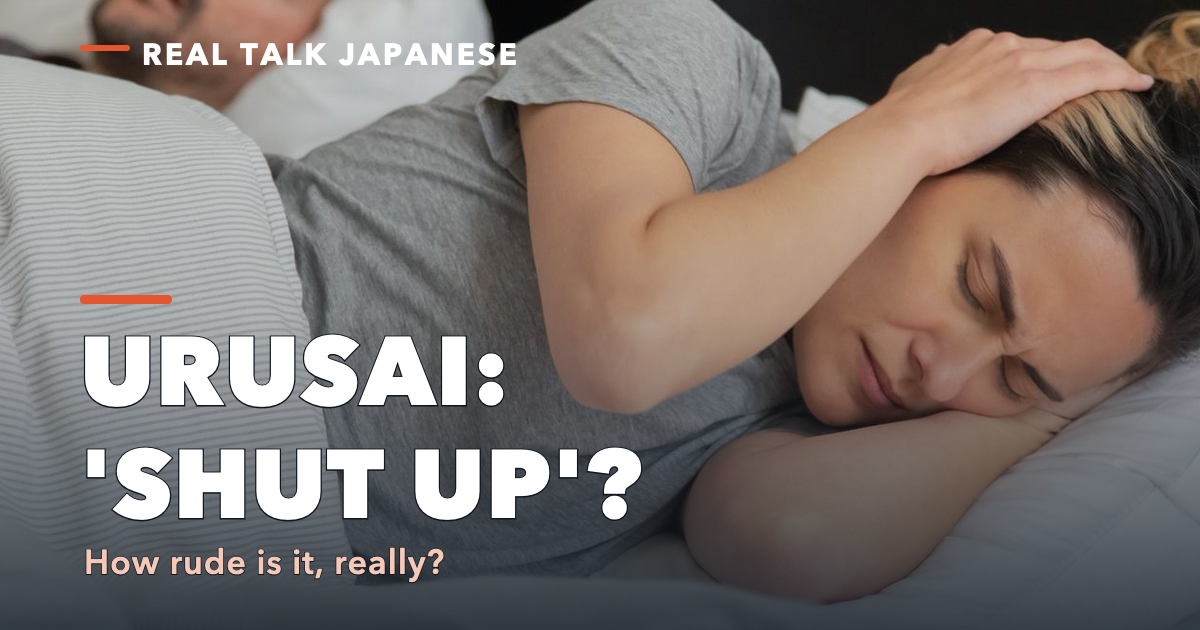
Urusai (うるさい) means “noisy,” “annoying,” or “fussy,” according to the sentence. Said sharply at a person, urusai! can work as “Be quiet!” or “Shut up!” It is also an ordinary adjective used to complain about a sound.
Learn to separate a description, a complaint, and a request. They can involve the same noise but give the listener different information.
Quick answer: more than an anime command
Read うるさい as u-ru-sa-i, with four timing units. You may see 煩い as a kanji spelling, but hiragana is common. The dictionary’s noisy sense includes a sound the speaker finds bothersome; it does not have to be very loud.
Digital Daijisen’s entry also covers persistent complaints and fussiness about a subject. Identify what is bothering the speaker before translating it.
| Pattern | Example | Meaning |
|---|---|---|
| A sound is urusai | 工事の音がうるさい。 Kōji no oto ga urusai. | “The construction noise is bothersome.” |
| Urusai aimed at a person | うるさい! Urusai! | A complaint or demand to stop, often rude. |
| Topic + ni + urusai | コーヒーにうるさい。 Kōhī ni urusai. | “Particular about coffee.” |
Same room, three different ways to speak
Imagine music playing while you are trying to work. These sentences react to the same situation, but only one directly asks for a change:
音楽がうるさいね。
Ongaku ga urusai ne.
“The music is bothersome, isn’t it?”
This shares a complaint. Your friend may agree without knowing whether you want the volume lowered.
うるさい!
Urusai!
“Be quiet!” / “Shut up!”
A sharp standalone complaint can target the person and sound hostile. Being grammatically an adjective does not make it socially neutral.
音楽の音を少し小さくしてもらえる?
Ongaku no oto o sukoshi chiisaku shite moraeru?
“Could you turn the music down a little?”
This names the requested action. With a friend, it can be more useful than a complaint without a next step.
With someone you address politely, use 少し音を小さくしてもらえますか? (sukoshi oto o chiisaku shite moraemasu ka?, “Could you lower the volume a little?”). You can begin with sumimasen; see sumimasen versus gomennasai for its attention-getting use.

If I add desu, does “urusai desu” become a polite request?

It becomes a statement with polite grammar, but it still describes a bothersome sound. Ask for the action you need: lower the volume, close the door, or move the conversation.
The “picky” meaning: topic + ni + urusai
味にうるさい (aji ni urusai) means someone is particular about taste. It can describe knowledgeable standards or tiresome criticism; the surrounding comment explains which.
Use the same person in two different sentences:
ミカはコーヒーにうるさいから、おすすめを聞こう。
Mika wa kōhī ni urusai kara, osusume o kikō.
“Mika is particular about coffee, so let’s ask for a recommendation.”
The consequence frames the standards as useful.
ミカはコーヒーにうるさくて、店を決めるのが大変。
Mika wa kōhī ni urusakute, mise o kimeru no ga taihen.
“Mika is so particular about coffee that choosing a café is difficult.”
Here the speaker complains about the effect. Urusai does not mean that Mika literally makes a loud noise about coffee.
Urusē, ussai, and damare
うるせえ / うるせー (urusē, also written urusee) is a rough variation. うっさい (ussai) clips the expression. These forms can appear in arguments or informal banter, but a laugh does not prove that a listener welcomes them.
黙れ (damare) is an imperative from 黙る (damaru, “to be silent”). It directly commands someone to stop talking. Rather than ranking the words on a fixed rudeness scale, recognize that both sharp urusai and damare can be confrontational.
Anime may repeat a word for comedy or dramatize an argument. Copying the performance is different from making a useful request in daily life. See anime expressions to use carefully.
Useful adjective forms and replies
Urusai is an i-adjective. うるさかった (urusakatta) means “was noisy/bothersome”; うるさくない (urusakunai) means “not noisy/bothersome.” A question such as urusakunai? can ask “Isn’t it noisy?” rather than assert that it is quiet.
If a friend says your music is urusai, you can acknowledge and name the adjustment: ごめん、音を小さくするね (gomen, oto o chiisaku suru ne, “Sorry, I’ll turn it down”). If you do not understand the complaint, ask どの音? (dono oto?, “Which sound?”).
For another common source of confusion, うざい (uzai) is a separate informal word for annoying. Do not produce it by changing urusai’s adjective ending.
Someone says urusai to me. Does that mean we are close enough to tease?
No. It might be a real complaint. Check what bothered them and respond to it. A single expression does not establish permission to tease back.
Specify which noise needs changing
In a room with a fan, music, and a conversation, a complaint of urusai may leave the other person unsure what to adjust. テレビの音だけ、少し下げてもらえる? (terebi no oto dake, sukoshi sagete moraeru?, “Could you lower just the TV volume a little?”) names the source and the action. If the issue is that you cannot hear the conversation, say 話が聞こえにくい (hanashi ga kikoenikui, “It’s hard to hear what you’re saying”). This describes your difficulty without labeling the person annoying. Practice the request with a partner and ask whether they knew exactly what to change.
A response can also offer an alternative: headphones, a different room, or a quieter time. The adjective identifies discomfort; agreeing on the action resolves the interaction for both people.
Practice: name the problem and the action
1. The TV is distracting you. Describe the sound, then ask for lower volume. Compare how much clearer the second sentence is.
2. A coffee enthusiast is kōhī ni urusai. Translate it as “particular about coffee,” then add whether that expertise helps or causes difficulty.
3. Rewrite urusai! as a polite request for quiet: もう少し静かにしてもらえますか? (mō sukoshi shizuka ni shite moraemasu ka?, “Could you be a little quieter?”).
Frequently asked questions
Does urusai mean “shut up”?
It can function that way when directed sharply at someone. In other sentences it describes bothersome noise, annoyance, or fussiness.
Is urusai profanity?
It is an ordinary adjective. It can still be rude or hurtful when aimed at a person.
What does urusee mean?
It is a rough variation of urusai. Its English translation depends on context; do not assume a fixed swear-word equivalent.
Can a quiet sound be urusai?
Yes. A repeated or distracting sound can be bothersome without being very loud.
How do I ask for quiet?
Name the action politely, such as mō sukoshi shizuka ni shite moraemasu ka? A request is clearer than only labeling someone noisy.
Written for Real Talk Japanese. References checked October 14, 2026. Dialogues and translations are original teaching examples.