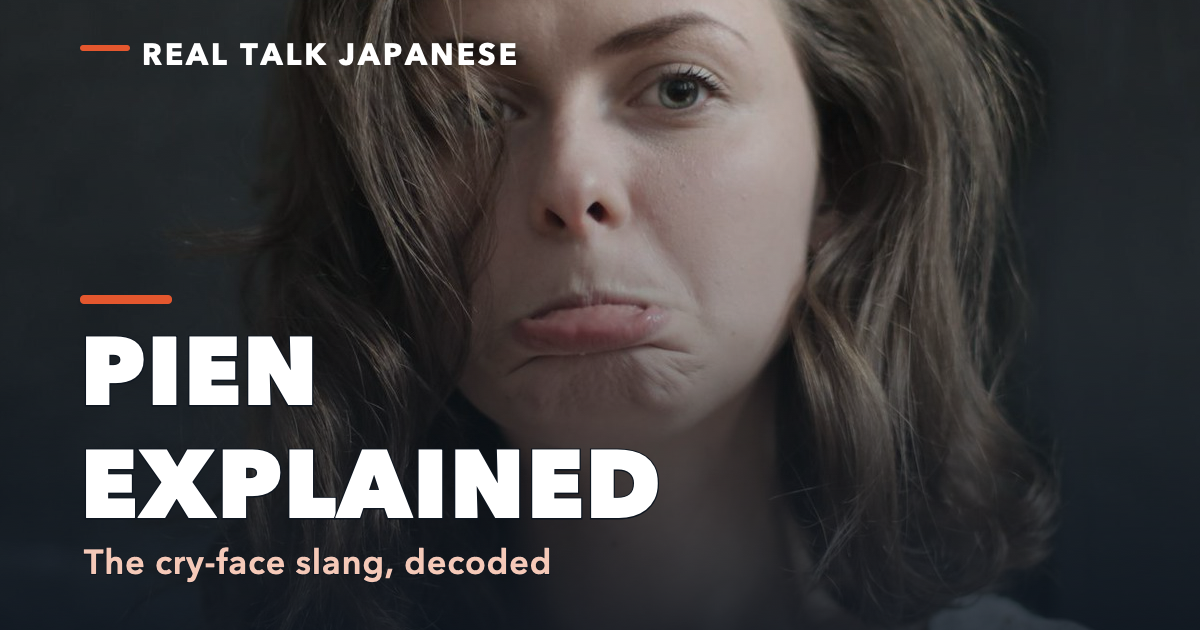
Pien (ぴえん) is an informal Japanese crying-sound expression often used for a small disappointment or an emotionally moved reaction. It may accompany the pleading-face emoji 🥺. Depending on the message, English “aww,” “sniff,” or “I could cry” can fit.
The word can be playful, but you should not use it to decide whether someone’s feelings are real. Read what happened and what they are asking for.
Quick answer: spelling and pronunciation
Write ぴえん, and read it pi-e-n: three timing units, with the final nasal kept as part of the expression. The emoji can help present a pleading or tearful expression, but pien does not require an emoji every time.
Sanseido’s 2020 new-word commentary explains the small crying sound and its uses in messages and speech. That is historical evidence for the word; it is not a measurement of who uses it today.
| Message type | Original example | Possible English rendering |
|---|---|---|
| A minor setback | ケーキ、売り切れだった。ぴえん。 Kēki, urikire datta. Pien. | “The cake was sold out. Aww.” |
| Feeling touched | メッセージありがとう。優しくてぴえん。 Messēji arigatō. Yasashikute pien. | “Thanks for the message. You’re so kind, I could cry.” |
| An isolated reaction | ぴえん🥺 Pien. | A tearful or pleading reaction; details remain unclear. |
Disappointment and being moved
On its own, pien does not specify why someone feels tearful. A missed dessert, a canceled outing, and an unexpectedly kind message create different situations. Translate the whole message rather than always choosing “sad.”
A:楽しみにしてた映画、今日は見られない。ぴえん。
B:残念だね。明日はどう?Tanoshimi ni shiteta eiga, kyō wa mirarenai. Pien.
Zannen da ne. Ashita wa dō?
“I can’t see the movie I was looking forward to today. Aww.”
“That’s a shame. What about tomorrow?”
B acknowledges the setback and offers an alternative. Echoing the crying sound is optional, not the only way to respond.
A:カードを書いてくれたの?優しくてぴえん。
B:喜んでもらえてよかった。Kādo o kaite kureta no? Yasashikute pien.
Yorokonde moraete yokatta.
“You wrote me a card? That’s so kind, I could cry.”
“I’m glad you liked it.”
Here the emotion is appreciation. A translation of “I’m sad” would misrepresent the message.

Does pien mean the person is only pretending to be upset?

It can be a playful way to express a feeling, but the word does not prove the feeling is fake. Respond to what happened, especially if they say they need help.
Pien, paon, and exaggeration
You may encounter ぴえんこえてぱおん (pien koete paon), a playful expression meaning “beyond pien, into paon.” ぱおん (paon) evokes an elephant’s trumpet, exaggerating the crying-sound idea.
This is wordplay, not a numbered severity scale. A person using paon is not reporting a measurable level of distress above someone who used pien. The surrounding sentence can be a joke, a caption, or a real complaint presented playfully.
When translating a joke, you can preserve the sound-word explanation or use a contextually suitable English exaggeration. Translating it mechanically as an animal statement would miss the function.
How to reply without minimizing the situation
For a small disappointment, 残念だったね (zannen datta ne, “That’s a shame”) acknowledges it. For a practical problem, ask what they need. A playful word from the speaker does not automatically invite you to dismiss the problem.
どうしたの?何か手伝える?
Dō shita no? Nanika tetsudaeru?
“What happened? Can I help with anything?”
This asks for information and offers support without claiming to know the other person’s emotional state.
If someone shares serious bad news, use a reply that addresses the event instead of adding pien by reflex. Familiar groups may choose humor, but it is better to let the person’s preferences guide that choice.
For words that clearly ask or reassure, compare daijoubu with complete replies. For a message expressing gratitude, thank-you expressions may be more useful than copying the emoji.
Recognize it without chasing a trend label
Sanseido selected pien as its top new word for 2020. A historical award gives you a date for that recognition, not an expiry date. It cannot establish that every use in 2026 is fashionable, dated, ironic, or limited to one age group.
If you encounter it now, read that message on its own terms. If you want to use it with friends, notice how that specific group writes and ask about unfamiliar expressions. You do not need slang to express ordinary disappointment clearly.
ちょっと残念 (chotto zannen, “a little disappointing”) gives a clearer evaluation; うれしくて泣きそう (ureshikute nakisō, “I’m so happy I could cry”) explicitly states a positive emotion.
Should I avoid pien because someone calls it old slang?
Understand it first. A dated reference can still be meaningful in a current message. For your own reply, choose words that fit your feelings and the person you are speaking with.
A sound word is not a request
If someone writes pien after a missed event, they may want sympathy, another plan, or simply to share the moment. You can ask 別の日に行く? (betsu no hi ni iku?, “Shall we go another day?”) if rescheduling is possible. Do not assume they asked you to solve the problem merely by using the word. Let their next reply guide whether to make a plan or just acknowledge the disappointment.
Practice: replace the sound with a clear sentence
1. Your favorite event is canceled. Say 中止になって残念 (chūshi ni natte zannen, “It’s disappointing that it was canceled”).
2. A friend gives you a thoughtful gift. Say すごくうれしい。ありがとう (sugoku ureshii. Arigatō, “I’m really happy. Thank you”).
3. A message says only pien. Ask what happened instead of assuming whether the feeling is positive, serious, or a joke.
The exercise shows why a clear sentence remains useful even when you understand the slang. You can use a short reaction and the explanation together.
Frequently asked questions
Does pien mean crying?
It imitates a small crying sound and can express disappointment or being emotionally moved. The person need not literally be crying.
Is it always negative?
No. Kindness or happiness can also produce a tearful reaction. Read the cause in the message.
Can people say it aloud?
Yes, the expression has been described in speech as well as messages. Its suitability depends on the setting.
Does the emoji 🥺 always mean pien?
No. It is a pleading-face emoji used in different languages and contexts. Do not assign one Japanese meaning to every use.
Is pien still popular?
This guide does not have a current usage survey. Its documented 2020 recognition does not determine every present-day use.
Written for Real Talk Japanese. References checked October 14, 2026. Dialogues and translations are original teaching examples.