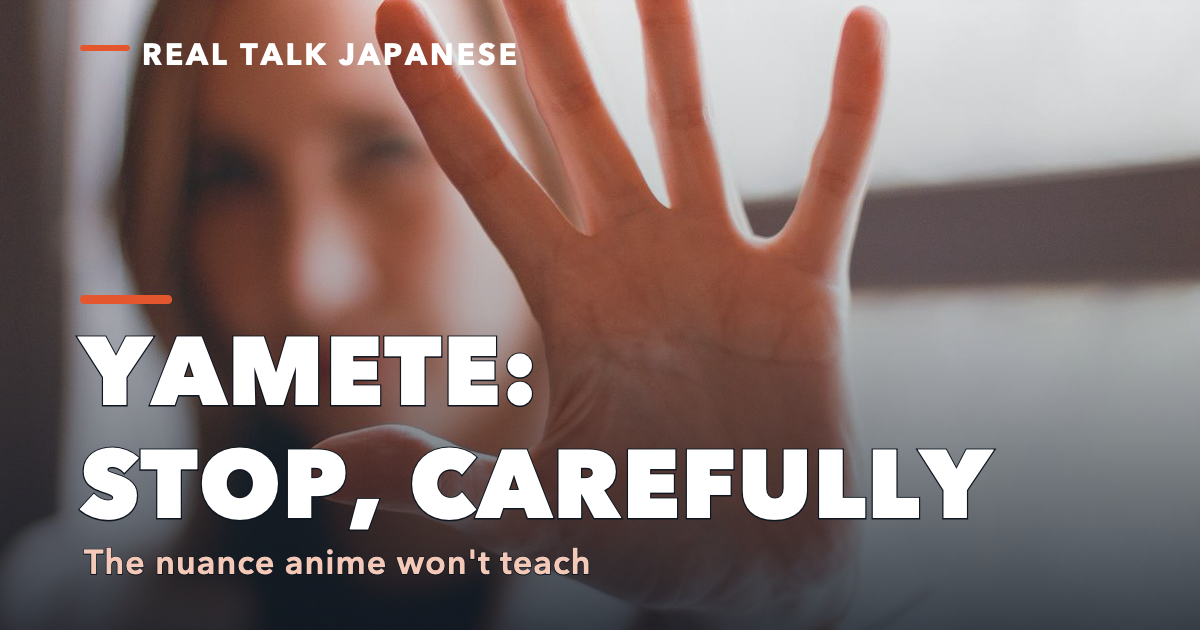
Every dictionary will tell you やめて (yamete) means “stop it.” Correct — and completely insufficient.
As a native Japanese speaker, here’s what the dictionary skips: yamete is one of the most tone-dependent words in Japanese. The same three syllables can be a giggling protest between friends, a firm boundary, or a genuine cry for help — and if you learned the word from anime or, let’s be honest, from certain corners of the internet, your mental model of it is probably miscalibrated.
Let’s fix that.
Quick Answer
やめて (yamete) is the te-form of やめる (yameru, “to stop/quit”), used as a request or demand: “stop (doing that).” Politeness scales with what you attach: yamete (casual), yamete yo (casual + emotion), yamete kudasai (polite), yamero (harsh command). Tone of voice does the rest of the work — and in real life, the most common yamete is light and playful.
The Yamete Family Tree
All the forms you’ll hear come from the verb 止める/辞める (yameru). Here’s the spectrum, from softest to sharpest:
| Form | Reading | Force | Where you’ll hear it |
|---|---|---|---|
| やめてよ〜 | yamete yo~ | playful protest | friends teasing each other |
| やめて | yamete | neutral “stop it” | everyday life, all genders |
| やめてください | yamete kudasai | polite request | strangers, formal settings |
| やめてもらえますか | yamete moraemasu ka | cool, firm | serious boundary-setting |
| やめなさい | yamenasai | parental command | mothers, teachers |
| やめろ | yamero | harsh command | men in confrontations, anime |
| やめろって! | yamero tte! | exasperated | “I SAID stop!” |
Two native-speaker notes on this table. First, やめろ (yamero) is dramatically overrepresented in anime. In real life, most adults go their whole year without barking yamero at anyone — it’s confrontation-grade language. Second, the politest-looking forms can be the coldest. やめていただけますか (yamete itadakemasu ka) delivered flatly is how a Japanese person tells a stranger “you are seriously out of line” while remaining impeccably polite. Politeness and friendliness are different axes.
Anime Yamete vs Real-Life Yamete
This section exists because, for better or worse, most learners meet this word through anime — and anime gives it a very particular flavor.
In anime, yamete is a crisis word. It’s screamed by characters being attacked, sobbed during tragic scenes, or shrieked in over-the-top comedy. The volume is at 11 because anime dialogue is theater: emotions are exaggerated so they read clearly on screen.
And then there’s the meme layer. If you spend time in English-speaking internet spaces, you’ve seen “yamete kudasai” used as a punchline with a suggestive wink, largely because of its association with adult anime content. I want to be direct about this, because it causes real misunderstandings: in Japan, yamete kudasai is an utterly ordinary, G-rated phrase. Children say it on playgrounds. Office workers say it when a colleague teases them. There is nothing inherently suggestive about it — the connotation was manufactured entirely by the export context. Saying it in Japan raises zero eyebrows.
In real life, the most common yamete by far is the light one: ちょっと、やめてよ (chotto, yamete yo) — “quit iiit,” said with a laugh when a friend shows an embarrassing photo of you. In my experience, this playful register accounts for the overwhelming majority of everyday uses. The genuinely distressed yamete exists, of course, but it’s rare precisely because it’s reserved for when things are actually wrong.
Yamete vs Tomete: The Kanji Trap
Here’s a genuinely useful distinction textbooks rush past. The kanji 止める can be read two ways, and they are not interchangeable:
- やめて (yamete) — stop an action or activity. Stop teasing me, stop smoking, stop the meeting
- とめて (tomete) — stop a moving thing. Stop the car, stop the music, stop the machine
If a taxi is passing your destination, screaming やめて! will confuse everyone — you want とめてください (tomete kudasai), “please stop [the car].” Conversely, when someone’s tickling you, とめて sounds like you’re addressing a runaway vehicle. There’s also a third sibling: 辞める (yameru) with a different kanji, meaning to quit a job or position — 仕事を辞めた (shigoto o yameta), “I quit my job.”
One sound, three lanes. Japanese does this to you a lot; this trio is just the first place most learners notice.
How to Say “Stop” and Actually Mean It
Because playful yamete is so common, a real question learners ask me: how do I make it clear I’m serious? Native strategies, in escalating order:
- Drop the smile and the stretch. やめて〜 with a rising sing-song is play. A flat, level やめて with eye contact is not
- Add 本当に (hontou ni) — 本当にやめて, “seriously, stop.” This phrase does heavy lifting in Japanese friendships; it’s the register-switch signal
- Go formal on purpose. Switching to やめてください with someone you’re normally casual with is jarring — which is the point. Sudden politeness reads as “we are no longer joking”
- Name it and leave. 嫌だからやめて (iya dakara yamete) — “I don’t like it, so stop.” Attaching a reason makes it a boundary, not a reaction
That trick in #3 — weaponized politeness — is one of the most Japanese things I can teach you. Distance is the warning.
Related Expressions Worth Knowing
- もういい (mou ii) — “enough already.” Resigned rather than commanding
- いい加減にして (ii kagen ni shite) — “cut it out,” genuinely annoyed. Parent-to-child classic
- やめとけ (yametoke) — “drop it / don’t bother,” advising someone else to abandon a bad idea. Casual, masculine-leaning
- 勘弁して (kanben shite) — “give me a break.” Overlaps with playful yamete
- うるさい (urusai) — “you’re being loud / shut up,” the noisy cousin that deserves its own article
These live in the same emotional neighborhood, and mixing them correctly is what makes your protests sound native rather than subtitled. For more of this neighborhood, my Japanese word meanings and slang maps the casual register word by word.
FAQ
What does yamete mean in Japanese?
Yamete (やめて) means “stop it” or “please stop” — it’s the te-form of yameru (to stop), used as a request. Its force depends entirely on tone: it can be playful between friends, neutral, or a serious demand.
What’s the difference between yamete and yamero?
Yamete is a request; yamero (やめろ) is a blunt command. Yamero is common in anime fights but rare in real life, where it signals genuine confrontation. Most daily situations use yamete or yamete kudasai.
Is yamete kudasai a weird thing to say?
Not at all — it’s the standard polite way to ask someone to stop and is completely neutral in Japan. The suggestive reputation it has in English-speaking meme culture doesn’t exist in Japanese.
Do Japanese people actually scream yamete like in anime?
Rarely. Anime exaggerates for drama. Real-life yamete is usually said at conversation volume, and the most common version is the laughing, playful protest between friends.
How do I politely ask a stranger to stop doing something?
やめてもらえますか (yamete moraemasu ka) or すみません、やめてください (sumimasen, yamete kudasai). Calm, flat delivery is standard — in Japanese, staying formal while displeased is itself the signal.
What’s the difference between yamete and tomete?
Yamete stops an action (teasing, smoking, a habit); tomete stops a moving object (a car, music, a machine). Same kanji 止める, different readings, not interchangeable.
💬 One Honest Tip From a Native
Yamete is a tone word, and tone doesn’t travel through text. You can memorize every form in this article and still misread a playful protest as a real one — or worse, the reverse. The calibration comes from live conversation, where a native can tell you “that delivery sounded angrier than you meant.”
→ Practice tone with a real human: How to Find a Japanese Tutor Online
→ Keep exploring the casual register: Japanese word meanings and slang
Written by Rei — native Japanese speaker. Audio examples coming soon.
Last updated: July 2026
Keep Learning Real Japanese
Reading about words is a start — using them in real conversations is what makes them stick. These guides will help you take the next step:
- Best Apps to Learn Japanese — Tested and Ranked
- italki vs Preply: Which Is Better for Learning Japanese?
Hear the words in context.
Pair these explanations with regular listening. Compare lesson formats and choose a routine that fits your level.