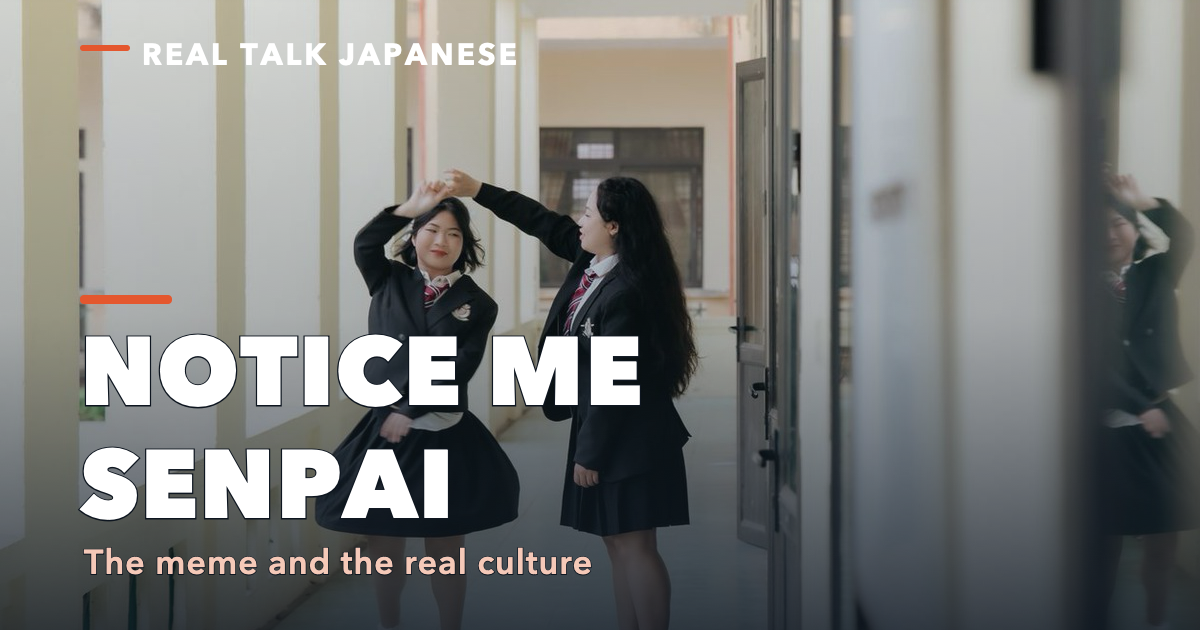
You’ve seen it on T-shirts and captioned over crushing GIFs: “Notice me, senpai!” Search it and you’ll get “it means you want your crush to notice you.”
That’s the meme. But as a native Japanese speaker, I can tell you it’s built on something very real. Senpai (先輩) is a living, everyday word in Japan, said out loud at school and work, tied to one of the deepest structures in Japanese social life. The meme took a sliver of that and turned it into a joke about hopeless crushes. Let me explain both.
Quick Answer
“Notice me, senpai” is an English internet meme expressing the longing to be acknowledged by someone you admire — usually an oblivious crush. It borrows 先輩 (senpai), the real word for a senior at your school or workplace, and plays on the anime trope of a younger student pining after an older one.
The meme is English fandom culture. The word underneath is 100% real Japanese. Keeping those apart is the whole point.
Where “Notice Me Senpai” Came From
The phrase bubbled up out of anime and manga fandom in the early-to-mid 2010s, on Tumblr and image-macro culture. It references a genre staple: a younger student (the kōhai) crushes on an older, cooler, oblivious senpai and spends the story hoping to be seen as more than a kid. Fans distilled that yearning into “notice me, senpai,” and it drifted into a catch-all for “please acknowledge me, person I look up to.” After thousands of reblogs, “senpai” came to mean “crush” for a lot of Western fans — which, in actual Japanese, it absolutely does not.
What Senpai Actually Means
先輩 (senpai) means a person senior to you within a shared institution — someone who entered your school, club, company, or field before you did. That’s it — nothing inherently to do with romance. The counterpart is 後輩 (kōhai), the junior who came in after you. Your classmate one year above you, the coworker who joined six months earlier — all senpai.
Unlike most honorifics, senpai works standalone — you can call your senior just 先輩!with no name, or stack it: 田中先輩 (Tanaka-senpai). That’s a big part of why the meme “works”: you really can shout “senpai!” at a real person in Japan.


Why the Meme Attached to a Real Structure
The senpai–kōhai relationship sits inside Japan’s vertical society (縦社会, tate-shakai). It’s a set of unspoken duties: kōhai show deference, senpai take care of kōhai, and admiration is supposed to flow upward.
That upward-flowing admiration — “I look up to this person ahead of me” — is exactly the shape the meme exploits. It swaps institutional respect for romantic longing, but the direction stays the same. That’s why it clicked: it borrowed a social gravity the word already carries.
Two facts surprise learners: senpai status never expires (someone one year ahead in high school is your senpai for life), and it’s about entry date, not age. Senpai isn’t a crush object; it’s a lifelong social coordinate.
Do Japanese People Say “Notice Me, Senpai”?
Short answer: no. The full English phrase is a Western fandom creation; nobody says 先輩、私に気づいて for real. What is real: saying 先輩 to and about your seniors endlessly, and the romantic senpai–kōhai crush as a fiction genre — common in manga, much rarer in real school life, where these bonds are mostly mentorship. So among anime fans “notice me senpai” lands fine, but to a Japanese person, “senpai” is their coworker, not a heartthrob.
Anime Senpai vs Real Senpai
| Anime / meme version | Real Japan | |
|---|---|---|
| Core meaning | A crush you long for | A senior at school/work |
| Emotion | Romantic yearning | Respect, mentorship, mild obligation |
| “Notice me, senpai” | A real catchphrase | Not said sincerely |
| How often said | Dramatic, charged moments | All day, totally neutral |
| Standalone “Senpai!” | ✅ real | ✅ real (this part’s accurate!) |
| Lifelong & entry-date based | rarely shown | ✅ very real |
The pattern runs through all anime Japanese: the word is real, but the emotional loading is heightened. Real-life senpai is closer to “the third-year who showed me how the club works” than “the upperclassman I can’t stop thinking about.”
How to Say and Write It
“sem-pai” (せんぱい) — the ん before ぱ softens to “m.” The kanji 先輩 is 先 (sen, “before”) + 輩 (pai, “fellow”): “the fellow who came before.” Use it standalone (先輩!) or after a name (田中先輩).
FAQ
What does “notice me senpai” mean?
It’s an English internet meme expressing the desire to be acknowledged by someone you admire — usually an oblivious crush. It borrows the real word 先輩 (senpai, a school/work senior) and plays on the anime trope of a younger student pining after an older one. The phrase is Western fandom culture, not something Japanese people say.
Does senpai mean boyfriend or crush?
No. 先輩 (senpai) just means a person senior to you within a shared institution — someone who entered your school, club, or company before you. It has no built-in romantic meaning; the “crush” association comes entirely from anime storylines and the meme.
Do real Japanese people use the word senpai, and what about kōhai?
Yes, all the time and with no irony. Students call upperclassmen senpai daily; workers call more-senior colleagues senpai. It works standalone (“Senpai!”) or with a name (Tanaka-senpai). The counterpart is 後輩 (kōhai), the junior who joined after you — though we rarely call juniors “kōhai” to their face; they get -kun, -chan, or -san.
Would a Japanese person understand “notice me, senpai”?
Probably — Japanese fans know the meme too. But they’d read it as a joke or quotation, since the catchphrase isn’t native to Japanese. It’s playful among anime fans, not a real-life confession.
💬 One Honest Tip From a Native
The meme stuck because it sits on something real — Japan’s senpai–kōhai world, where “looking up to the person ahead of you” is a daily thing. If that made you curious, the honorific system is where it all connects: senpai, kōhai, san, kun, sama — one web of who-outranks-whom. You can read every rule and still hesitate — is she a senpai, or a peer? — and that only fades through real conversation.
→ See how senpai fits the whole system: The Complete Guide to Japanese Honorifics
→ Which anime words are real and which are fiction? Japanese word meanings and slang
→ Ready to hear senpai used for real? How to Find a Japanese Tutor Online
Written by Rei — native Japanese speaker, born and raised in Japan. Audio examples coming soon.
Last updated: July 2026
Turn what you learned into practice.
Find an app for your next learning goal, or a tutor to help you use these expressions in conversation.