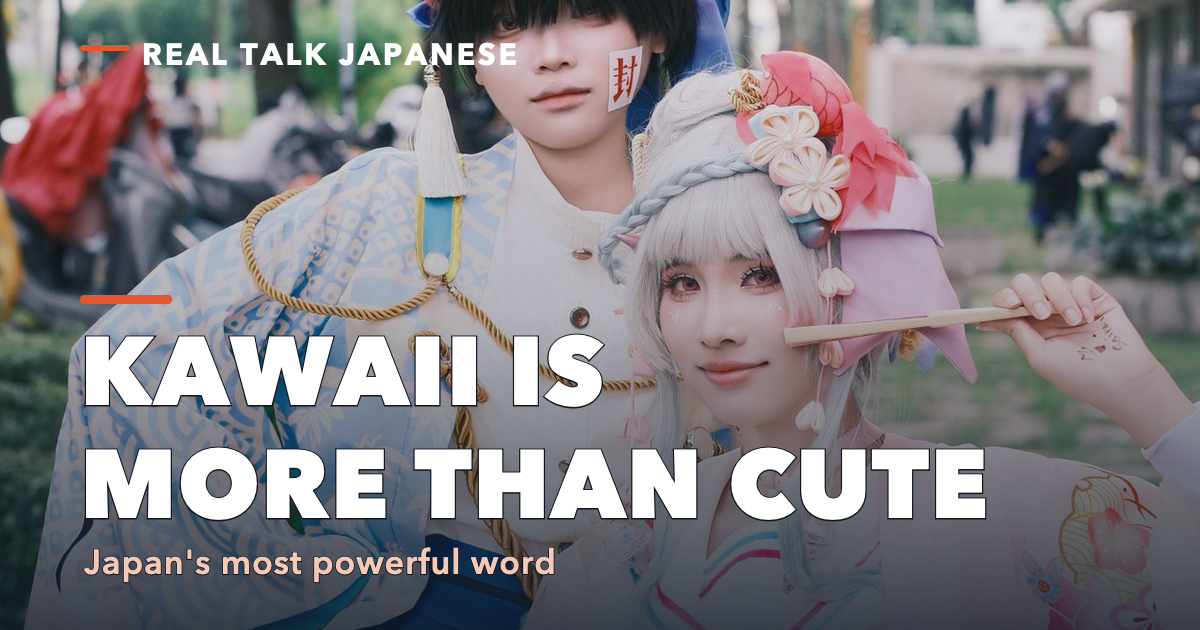
You already know kawaii means “cute.” Every learner does — it might be the first Japanese word you ever absorbed.
But as a native speaker, I can tell you the textbook translation covers maybe half the word. かわいい (kawaii) is used for puppies, yes — but also for grandfathers, horror-movie mascots, someone’s laugh, a well-organized spreadsheet, and things that are objectively ugly. It’s less a word than a social operating system. And it has one evil twin — かわいそう (kawaisou) — that has embarrassed every learner at least once.
Here’s the full picture.
Quick Answer
かわいい (kawaii) literally translates as “cute/adorable,” but functions far more broadly: it can mean charming, endearing, cool (for fashion), lovably pathetic, or simply “I approve of this.” Japanese speakers — especially women, but increasingly everyone — use it as an all-purpose positive reaction. Warning: かわいそう (kawaisou) does NOT mean “seems cute.” It means “pitiful, poor thing.”
Where “Cute” Ends and Kawaii Keeps Going
English “cute” mostly stops at small-and-adorable. Kawaii keeps driving:
- Fashion: そのバッグかわいい (sono baggu kawaii) — said about a sleek black leather bag with zero bunny ears on it. Here kawaii just means “stylish, I love it”
- Adults: うちの部長、かわいいとこあるんだよね — “our department head has a kawaii side.” He’s 58. It means he’s endearingly human — maybe he gets excited about trains
- Behavior: 犬が待ってるのかわいい — the fact that the dog waits is kawaii. Situations can be kawaii, not just things
- Objectively non-cute things: a lumpy homemade cookie, a weird regional mascot, your friend’s terrible doodle — all kawaii, because kawaii can mean “imperfect in a way that makes me feel warmth”
That last one is the deep cultural setting. In my experience, the heart of kawaii isn’t beauty — it’s defenselessness that invites affection. Small things, round things, clumsy things, earnest things. The polished supermodel is 綺麗 (kirei, “beautiful”); the wobbly mascot who trips over its own costume is kawaii. Japan, culturally, is more moved by the second one.
Kawaii vs Kirei: The Distinction Natives Actually Make
| かわいい kawaii | 綺麗 kirei | |
|---|---|---|
| Core feeling | affection, warmth, “aww” | admiration, “wow” |
| Distance | pulls closer | keeps respectful distance |
| Typical targets | small, round, young, endearing | elegant, refined, polished |
| Compliment vibe | friendly, approachable | slightly formal, aesthetic |
Both are compliments, but they aren’t interchangeable. Telling a woman in a formal evening gown かわいい can undersell the moment (kirei fits); calling a fluffy puppy きれい sounds like you’re reviewing its fur at an auction. Rough rule: kirei is for things you look up at; kawaii is for things you want to scoop up.

The Kawaii Extended Universe: Kimokawaii and Friends
Kawaii is so central that Japanese speakers have built compound words to describe its weirder suburbs:
| Word | Formula | Meaning |
|---|---|---|
| キモかわいい kimokawaii | kimoi (gross) + kawaii | gross-cute. Deep-sea fish plushies, certain famous yellow mascots |
| ブサかわ busakawa | busaiku (ugly) + kawaii | ugly-cute. Bulldogs. Entire careers of certain dogs |
| ゆるかわ yurukawa | yurui (loose) + kawaii | loosely-drawn cute. Wobbly regional mascots, simple LINE stickers |
| エロかわ erokawa | ero + kawaii | sexy-cute, a 2000s fashion-magazine word |
| 大人かわいい otona-kawaii | adult + kawaii | grown-up cute — fashion that’s sweet but office-appropriate |
The existence of kimokawaii tells you everything: kawaii is not about meeting a beauty standard, because you can fail the standard and be MORE kawaii for it. English needs a full sentence (“it’s so ugly it’s adorable”); Japanese did it in one word, then monetized it into a plush-toy industry.
These compounds also connect to fan culture — the vocabulary of oshi (推し) and modern fandom leans heavily on the kawaii family, because declaring what you find kawaii is basically declaring your allegiances.
The Trap: Kawaii vs Kawaisou
Now the mistake I’ve watched a dozen learners make. You learn that 〜そう (-sou) means “seems/looks like”: おいしそう = looks delicious. Logical next step: kawai + sou = “looks cute”?
No. かわいそう (kawaisou) is a fixed word meaning “pitiful, poor thing.” あの犬かわいそう means “that poor dog,” not “that dog looks cute.” If you coo かわいそう! at someone’s beloved puppy, you’ve just expressed condolences to a perfectly happy animal.
The historical reason is elegant: kawaii descends from the classical 顔映ゆし (kaohayushi) — roughly “face-flushing” — which drifted through “embarrassing to look at,” then “pitiable,” then “so vulnerable you feel tenderness,” and finally landed on “cute.” Kawaisou branched off at the “pitiable” station and never left. The two words are siblings who inherited different halves of the family emotion.
Want “looks cute”? Say かわいい〜 (just kawaii) or かわいい感じ (kawaii kanji, “a cute feel”).
How to Use Kawaii Naturally
Some quick native mechanics:
- Conjugation — it’s an i-adjective: かわいかった (was cute), かわいくない (not cute), かわいすぎる (too cute — the standard overload reaction)
- Emphasis by stretching — かわいい〜〜! The longer the vowel, the higher the emotion. In text: かわいすぎ or the clipped かわい
- Men and kawaii — old stereotype says it’s a women’s word; modern reality disagrees. Men say kawaii freely about pets, kids, characters, and increasingly fashion. My honest read: among people under 40, it’s fully unisex, though men often reach for かっこいい (kakkoii, “cool”) where women might say kawaii
- As a response — someone shows you their new phone case, their kid’s drawing, their cat: kawaii is the socially correct answer the way “nice!” is in English. Withholding it can read as coldness. Yes, really
That last point is why calling kawaii a “social operating system” isn’t a joke. It greases interactions, signals warmth, and fills silences — a full member of the Japanese word meanings and slang alongside sugoi and yabai.
FAQ
What does kawaii mean in English?
The standard translation is “cute” or “adorable,” but kawaii covers far more: charming, endearing, stylish, lovably imperfect, or simply “I like this.” It’s one of the most-used positive words in the entire language.
What’s the difference between kawaii and kawaisou?
Everything. Kawaii (かわいい) = cute; kawaisou (かわいそう) = pitiful, “poor thing.” Despite looking like “seems cute,” kawaisou expresses pity — mixing them up is a classic learner mistake with maximum embarrassment value.
Can men say kawaii?
Yes. The word skews slightly feminine by stereotype, but modern Japanese men use it constantly for animals, children, characters, and things they find endearing. Nobody under 40 will find it strange.
What does kimokawaii mean?
Kimokawaii (キモかわいい) combines kimoi (“gross”) and kawaii: gross-cute, like deep-sea-creature plushies or deliberately unsettling mascots. Its cousin busakawa (ブサかわ) means ugly-cute. Both prove kawaii isn’t about conventional prettiness.
Is kawaii only for small or childish things?
No. Adults, behaviors, fashion, handwriting, and even elderly couples holding hands get called kawaii. The trigger is warmth and endearment, not size or age — though small and round certainly helps.
Why is kawaii such a big deal in Japanese culture?
Kawaii grew from an aesthetic preference into an industry and a value system — mascots for every town, character goods for every bank. Culturally it reflects affection for the imperfect and vulnerable, which runs deep in Japanese aesthetics.
💬 One Honest Tip From a Native
The word kawaii is easy; the timing is the skill. When to say it, how long to stretch it, when it’s sincere versus social — that’s rhythm you can only absorb from live conversation with natives, preferably ones who’ll laugh warmly when you pity their puppy.
→ Build the rhythm with a native: How to Find a Japanese Tutor Online
→ More all-purpose words decoded: Japanese word meanings and slang
Written by Rei — native Japanese speaker. Audio examples coming soon.
Last updated: July 2026
Turn what you learned into practice.
Find an app for your next learning goal, or a tutor to help you use these expressions in conversation.