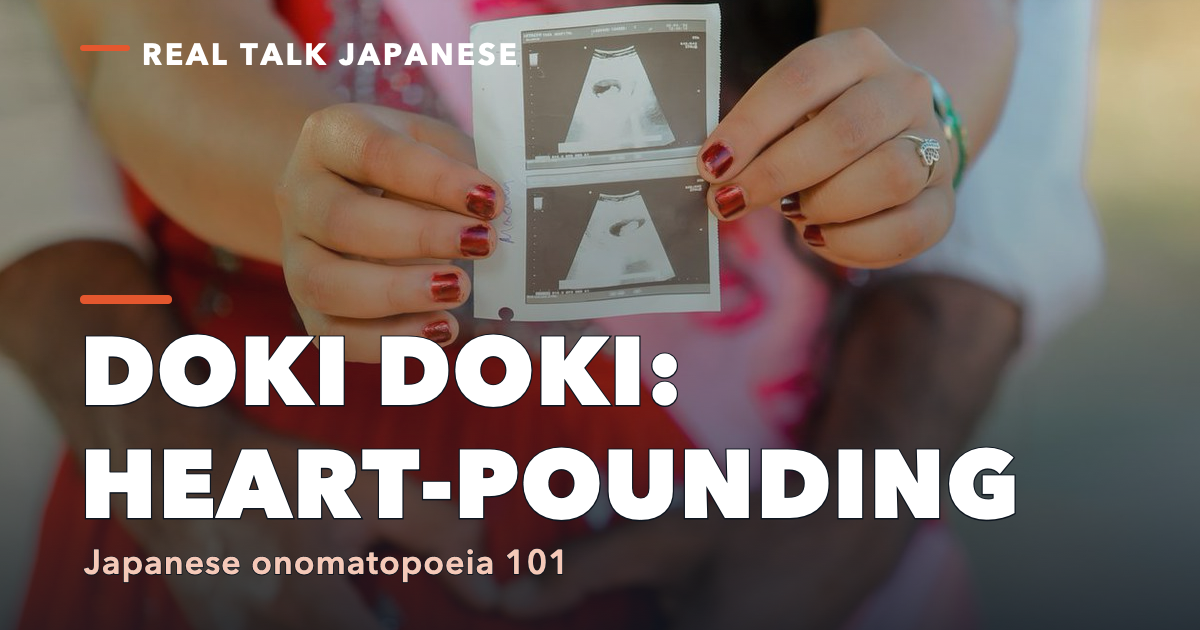
If you got here via a certain psychological-horror visual novel about a literature club: yes, this is that doki doki, and no, the word itself is not sinister.
As a native Japanese speaker, here’s the real answer: ドキドキ (doki doki) is the sound of a pounding heart — Japanese has official vocabulary for that — and it covers everything that makes your pulse spike: crushes, job interviews, roller coasters, and the seconds before you open exam results. It’s also your perfect gateway into one of the most delightful corners of Japanese: a language where sounds are words.
Quick Answer
ドキドキ (doki doki) is onomatopoeia for a rapidly beating heart, used for nervousness, excitement, fear, and romantic flutter. It works as a verb with suru — ドキドキする (doki doki suru, “my heart is pounding / I’m nervous-excited”) — and describes both good and bad pulse-raisers. The romantic association is strong but not exclusive.
A Language Where Sounds Are Words
First, the big picture, because doki doki isn’t an isolated quirk. Japanese has an enormous, grammatically respectable inventory of sound-words — routinely estimated in the thousands, several times what English carries. They split into two families:
- 擬音語 (giongo) — words that imitate actual sounds: ワンワン (wan wan, a dog barking), ザーザー (zaa zaa, pouring rain)
- 擬態語 (gitaigo) — words that “sound like” states or feelings that make no noise at all: キラキラ (kira kira, sparkling), ふわふわ (fuwa fuwa, fluffy)
Doki doki sits right on the border: your heartbeat is technically a sound, but nobody else can hear it — the word describes the feeling of your own percussion section. And this isn’t baby talk or comic-book decoration. Adults use these words in offices, doctors ask patients if their chest goes doki doki, and NHK announcers say them on air. Textbooks treat onomatopoeia as a cute sidebar; in real Japanese, it’s load-bearing vocabulary.
What Doki Doki Actually Covers
The word spans the full range of elevated heart rate, positive and negative:
- Romance: 彼と話すとドキドキする (kare to hanasu to doki doki suru) — “my heart races when I talk to him.” The shoujo-manga classic
- Nerves: 面接前でドキドキしてる (mensetsu mae de doki doki shiteru) — “I’m so nervous before the interview”
- Excitement: 結果発表、ドキドキするね! — “the results announcement — my heart’s pounding!”
- Fear: ホラー映画でずっとドキドキしてた — “the horror movie had my heart hammering the whole time”
English has to choose a lane — “nervous,” “excited,” “my heart’s racing,” “butterflies” — but doki doki refuses to specify why your heart is pounding. That ambiguity is a feature. When someone says ドキドキした after meeting you, the delicious question is which kind.
Grammar is friendly here. Three main patterns: ドキドキする (verb: to be nervous/excited), 胸がドキドキする (mune ga doki doki suru, “my chest is pounding” — the full version), and ドキドキしながら (doki doki shinagara, “while nervous-excited”). You can even use it as a noun-ish thrill: ドキドキ感 (doki doki kan, “that pounding-heart feeling”) — a word Japanese marketing is completely addicted to.
Doki Doki vs Waku Waku vs Hara Hara: The Pulse Family
Doki doki has siblings, and natives pick between them precisely. This table is the cheat sheet:
| Word | Feeling | Heart status | Example moment |
|---|---|---|---|
| ドキドキ doki doki | nervous/excited/smitten | pounding | before a confession or interview |
| ワクワク waku waku | pure positive anticipation | bouncing | night before a trip |
| ハラハラ hara hara | anxious watching | in your throat | watching someone else walk a tightrope |
| ソワソワ sowa sowa | restless, can’t settle | fidgety | waiting for delivery of something big |
| キュン kyun | a sharp pang of “aww/love” | squeezed | puppy tilts its head at you |
The distinctions matter. ワクワク (waku waku) is anticipation with zero fear — kids before a field trip are waku waku. ハラハラ (hara hara) is worry about something you’re watching but can’t control. And キュン (kyun) — the heart-squeeze — got so culturally important it spawned 胸キュン (munekyun, “chest-squeeze moment”) and the slang キュンです (kyun desu, “you just made my heart squeak”), which had a full pop-culture moment a few years back.
My honest tip: if you only memorize two, take doki doki (pounding) and waku waku (bouncing). Between them they cover most of life’s elevated heart rates, and natives combine them — ドキドキワクワク — for “nervous AND thrilled,” like the first day at a new job.
Where You’ll Meet Doki Doki in the Wild
- Anime and manga: written in bold katakana behind blushing characters. Once you notice sound-words in manga panels, you can never unsee them — every scene is captioned with its own soundtrack
- Music: idol lyrics are contractually obligated (I exaggerate, barely) to include doki doki. It’s the genre’s load-bearing emotion
- Variety shows and marketing: ドキドキ体験 (“heart-pounding experiences”) sells haunted houses, first dates, and bungee jumps alike
- Daily conversation: completely standard. A 70-year-old telling her doctor 階段で胸がドキドキする (“my heart pounds on the stairs”) is using the same word as the idol song — one clinical, one kawaii, zero contradiction
That last example is worth underlining: doki doki is not slang. It has no age ceiling, no formality problem short of legal documents, and no expiry date. As onomatopoeia it’s actually safer to use than trendy words from the Japanese word meanings and slang — it will never make you sound dated, only expressive.
How to Start Using Onomatopoeia Without Sounding Silly
Three native-approved steps. First, start with doki doki and waku waku only — they’re frequent, unambiguous, and adults use them daily, so you can’t misfire badly. Second, attach them to yourself before describing others: ドキドキした (“I was nervous”) is always safe, while diagnosing someone else’s heart is more intimate. Third, steal timing from media: every drama episode hands you a dozen situations with their correct sound-word attached — repeat the pairing, not just the word.
One thing I genuinely envy learners: the moment onomatopoeia clicks, Japanese suddenly feels fun in a way grammar drills never showed you. It’s the most playful system in the language, and doki doki is the perfect front door.
FAQ
What does doki doki mean in Japanese?
Doki doki (ドキドキ) is the onomatopoeia for a pounding heart. It expresses nervousness, excitement, fear, or romantic flutter — any situation that raises your pulse — and is used constantly in everyday speech, not just anime.
Is doki doki romantic?
Often, but not exclusively. It’s strongly associated with crushes and confessions in pop culture, yet it’s equally correct for job interviews, horror movies, and exam results. Context supplies the romance; the word only supplies the heartbeat.
How do I use doki doki in a sentence?
Add suru: ドキドキする (doki doki suru, “I’m nervous/excited”), past tense ドキドキした. The fuller form is 胸がドキドキする (mune ga doki doki suru, “my chest is pounding”).
What’s the difference between doki doki and waku waku?
Doki doki is a pounding heart — nerves, thrill, or love, possibly with fear mixed in. Waku waku (ワクワク) is pure happy anticipation with no anxiety at all, like the night before a vacation. They can combine: ドキドキワクワク.
Why is it called Doki Doki Literature Club?
Because the title deliberately sounds like a sweet dating sim — “Heartbeat Literature Club.” In Japanese, doki doki is wholesome and flirty, which is exactly what makes the game’s turn so effective. The word itself carries no dark meaning.
Is doki doki childish to say as an adult?
Not at all. Japanese onomatopoeia is fully adult vocabulary — doctors, newscasters, and grandmothers all say doki doki. Legal contracts aside, you can use it almost anywhere.
💬 One Honest Tip From a Native
Onomatopoeia is the part of Japanese that dictionaries explain worst and conversation teaches best — the meaning IS the vibe, and vibes need a live human to confirm you’ve caught them. Tell a tutor about your week using doki doki and waku waku, and watch how fast this vocabulary becomes yours.
→ Find that human here: How to Find a Japanese Tutor Online
→ More real-life vocabulary: Japanese word meanings and slang
Written by Rei — native Japanese speaker. Audio examples coming soon.
Last updated: July 2026
Hear the words in context.
Pair these explanations with regular listening. Compare lesson formats and choose a routine that fits your level.