Nee-san (姉さん/ねえさん) means “older sister.” Onee-san adds お (o); onee-chan is a more familiar form. Ane (姉/あね) is a standard choice when referring to your own older sister in a more formal conversation. Nee-san is different from nii-san, which refers to an older brother.
The useful question is who you are speaking to. Calling your sister across the room and telling a new acquaintance about her can call for different words—even though she is the same person.
What does nee-san mean?
These four forms belong to the older-sister vocabulary you will encounter in family conversations and Japanese media.
Scroll the table sideways on smaller screens.
| Japanese | Hiragana | Romanization | Meaning and use |
|---|---|---|---|
| 姉さん | ねえさん | nee-san | Older sister; a family form of address or reference |
| お姉さん | おねえさん | onee-san | Older sister; used for your own or someone else’s sister, depending on context |
| お姉ちゃん | おねえちゃん | onee-chan | A more familiar way to say or address “older sister” |
| 姉 | あね | ane | Older sister; a standard choice for referring to your own sister in formal conversation |
Neesan, nee-san, and nee san are different ways of spacing the same romanized word. The same applies to oneesan and onee-san. The hyphen is a reading aid, not another Japanese sound.
Shogakukan’s Digital Daijisen lists the older-sister meaning for 姉さん and explicitly includes both one’s own and another person’s sister under お姉さん. So “onee-san always means someone else’s sister” is too rigid.
Although -san is an honorific, translating this established family word as “Ms. Sister” usually misses its ordinary meaning. “Older sister,” “big sister,” or “sis” may fit better, depending on the sentence.
“Older sister” does not mean “oldest sister.” In a fictional family, imagine that Yui is 26, Aki is 23, and you are 20. Both Yui and Aki are your older sisters; nee-san alone does not identify which one you mean. For a polite introduction, an original example is 姉が二人います。 (Ane ga futari imasu.) — “I have two older sisters.” Use a name or clarify which sister when the listener needs that distinction. These ages illustrate the relationship, not a rule about when to use the word.
Nee-san vs. nii-san: listen for the vowel
The difference is ee versus ii:
- ね・え・さ・ん — nee-san: sustain the Japanese e vowel.
- に・い・さ・ん — nii-san: sustain the Japanese i vowel.
Adding o gives おねえさん, onee-san, and おにいさん, onii-san. Avoid reading nee like the English word “knee”—that pushes you toward the brother word’s ii vowel.
Here is an original practice pair, with the rest of the sentence unchanged:
Scroll the table sideways on smaller screens.
| Japanese | Romanization | English |
|---|---|---|
| 姉さん、ありがとう。 | Nee-san, arigatō. | Thanks, sis. |
| 兄さん、ありがとう。 | Nii-san, arigatō. | Thanks, big brother. |
These are possible family forms, not names every household must use. For the brother vocabulary, see onii-chan, onii-san, and ani.
One sister, three conversations: onee-san or ane?
Imagine that Yui is your older sister. These are three separate practice scenes, all about the same Yui. What changes is the speaker and listener.
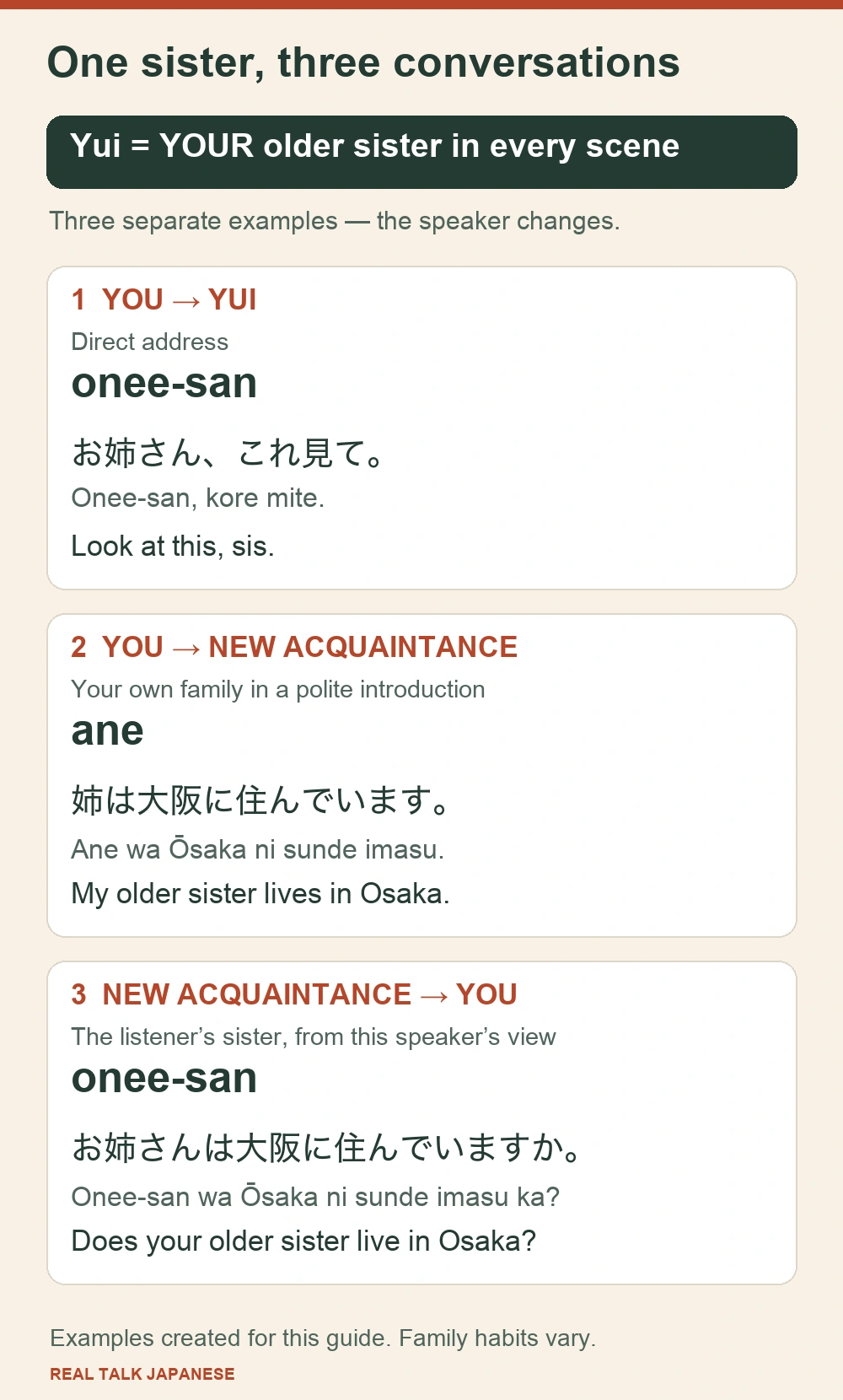
These are examples created for this guide.
1. You are calling Yui directly
お姉さん、これ見て。
Onee-san, kore mite.
Look at this, sis.
Onee-san can work as direct address. Your family may use onee-chan, nee-san, a name, or another familiar form instead. Start with the relationship and the family’s usual wording.
2. You are telling a new acquaintance about Yui
姉は大阪に住んでいます。
Ane wa Ōsaka ni sunde imasu.
My older sister lives in Osaka.
Here you are referring to a member of your own family in a polite introduction. Ane is a useful default. Japan’s Agency for Cultural Affairs explains this distinction between familiar family address and formal reference to your own family in its guide to family terms and uchi/soto.
3. The acquaintance asks you about Yui
お姉さんは大阪に住んでいますか。
Onee-san wa Ōsaka ni sunde imasu ka?
Does your older sister live in Osaka?
Now the acquaintance is speaking. Yui is someone else’s sister from that speaker’s perspective, so onee-san fits. Japanese context supplies “your” here; onee-san is not itself a possessive pronoun.
There is room for variation. The Japan Foundation notes that people also use onee-san for their own older sister in informal conversation. Do not treat every such example as an error. Its Irodori Lesson 17, page 21 explains how setting and speaker affect family terms.
Practice dialogue created for this guide:

If I respect my sister, why would I leave off -san and say ane?

In that introduction, you are choosing a word for your own family in relation to the listener. It does not measure how much you respect her.
So the same sister can be onee-san at home and ane in an introduction?
Yes. Keep track of who is speaking to whom.
How onee-chan changes the tone
Onee-chan (お姉ちゃん) is more familiar than onee-san. That distinction is recorded in Digital Daijisen’s entry for お姉ちゃん.
It can sound affectionate within an established family relationship. It is not a rule that only boys use it, or that adults must stop using it. Family habits and the relationship matter more than a simple age cutoff.
Anime can exaggerate the delivery, but the word itself belongs to ordinary Japanese vocabulary. You do not need to imitate a character’s voice to use a familiar family term. For the suffix in other names and expressions, see what chan means.
Can you call a stranger onee-san?
The dictionary also records onee-san as a familiar way to address a young woman. Recognizing that use is useful; choosing it for every woman you meet is a different matter.
For a beginner getting someone’s attention, すみません — Sumimasen — “Excuse me” is a practical starting point. It lets you make your request without choosing an age-based label. When you know someone’s name or professional title, use the form appropriate to that relationship. The Japanese honorifics guide covers those choices more broadly.
Practice dialogue created for this guide:
At a café, should I call the server onee-san?
Start with sumimasen to get their attention, then make your request. You do not need a family term.
But I might hear someone else say onee-san?
Yes. Knowing what a word means does not make it your default for every situation.
Try it: choose the word for the listener
Choose ane, onee-san, or onee-chan for each situation.
- You are giving a polite self-introduction and saying that your older sister is a teacher.
- You are calling your older sister to dinner. Your family already uses the affectionate form onee-chan.
- You are asking a new acquaintance whether their older sister likes cooking.
Suggested answers:
- Ane: 姉は先生です。— Ane wa sensei desu. — “My older sister is a teacher.” You are referring to your own family.
- Onee-chan: お姉ちゃん、ごはんだよ。— Onee-chan, gohan da yo. — “Sis, dinner’s ready.” You are using the family’s established form of address.
- Onee-san: お姉さんは料理が好きですか。— Onee-san wa ryōri ga suki desu ka? — “Does your older sister like cooking?” You are asking about the listener’s family.
Now change the first scene: you are chatting with a close friend who knows your family. Discuss which family form you might use there. That extra step helps you avoid treating the formal default as the only possible answer.
Quick questions
Does nee-san mean older brother?
No. Nee-san (ねえさん) is the older-sister word; nii-san (にいさん) is the older-brother word. Check the vowel and kana when subtitles or romanization are unclear.
Is nee-san the same as onee-san?
They belong to the same older-sister word family, but onee-san includes the initial お. Both can be family forms. Do not turn that difference into a fixed ranking that overrides the household or conversation.
Are aneki and anego the same word?
No. 姉貴 is aneki; 姉御/姐御 is anego. The dictionary gives each its own entry and context-specific uses. Neither should replace onee-san automatically when you ask about someone’s sister. See the entries for aneki and anego.
Practice the three scenes out loud
With a language partner, keep Yui as the same older sister and switch the speaker: call her directly, introduce her to someone, then let that person ask you about her. You can also review the free Irodori family-language notes linked above.
If you want scheduled feedback, the guide to finding a Japanese tutor online can help you compare lesson options. Ask to practice family terms in changing situations, rather than memorizing a list of English translations.