Omiyage (お土産/おみやげ) means a souvenir or a gift brought back from an outing or trip. You will often encounter it when someone brings something for other people. Temiyage (手土産/てみやげ) focuses on a gift brought when visiting someone. The meanings overlap: omiyage is not limited to food or gifts for others.
A useful starting point is the occasion. Are you returning from a trip, visiting a friend’s home, or choosing something to remember your own travels? That helps you decide what to bring—and what to say when you hand it over.
What does omiyage mean?
Pronounce omiyage as o-mi-ya-ge, with four short beats and no long vowel. In ordinary writing, you will see お土産 as well as おみやげ.
Scroll the table sideways on smaller screens.
| Word and reading | Main situation | Example created for this guide |
|---|---|---|
| お土産(おみやげ)— omiyage | A souvenir; something brought back or brought along as a gift | Cookies you bring back from Kyoto |
| 手土産(てみやげ)— temiyage | A small gift brought when visiting someone | Cookies you take to a friend’s home |
| プレゼント — purezento | A present, such as a birthday gift | Cookies chosen as someone’s birthday present |
The same box of cookies could appear in any of these situations. The occasion helps explain the word; the ingredients do not decide it.
Shogakukan’s dictionary entry for miyage includes both things brought home from an outing and gifts taken on a visit. Its entry for temiyage centers on visiting someone. So “omiyage is only from travel, temiyage is only from a local store” creates a distinction the words do not require.
Omiyage or temiyage? Start with the occasion
Here are three situations to separate before you shop:
- You are returning from a trip and bringing something for coworkers. Omiyage fits this travel-gift context. Check the team’s practice instead of assuming every workplace expects gifts.
- You are visiting a friend’s home. Temiyage describes the gift you bring for the visit. If it is also something from your trip, you can describe it as omiyage.
- You are choosing a keepsake for yourself. Omiyage can still describe that souvenir. Buying something for yourself is not a misuse of the word.
A host’s preferences or a workplace’s no-gift policy matter more than a general etiquette checklist. If someone declines a gift, respect that choice rather than insisting that accepting is required.
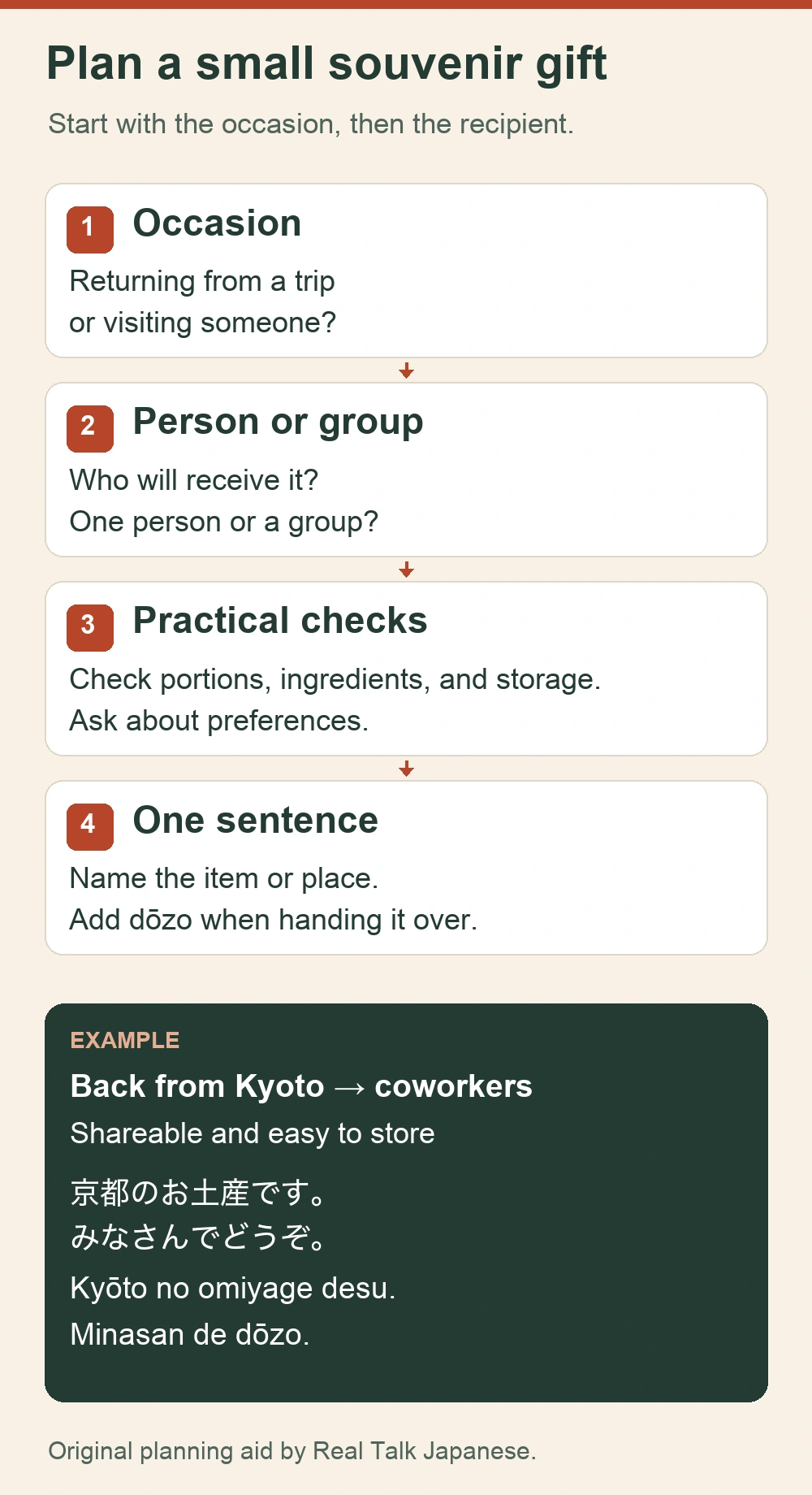
Use this as a planning aid: name the occasion, identify the recipient, check the practical details, and prepare one sentence. You do not need an elaborate speech.
Choose something the recipient can use or share
Think about what happens after you hand over the gift. Will someone need to refrigerate it, divide it, carry it home, or find space for it?
This checklist is an editorial suggestion, not a rule about what all Japanese people want.
Scroll the table sideways on smaller screens.
| Recipient and amount | Practical checks | Handing it over |
|---|---|---|
| Coworkers: check the group size; individual portions may help | Shelf life, ingredients, and workplace storage | Say that it is for the group |
| Host household: choose an amount they can use | Ask about preferences or dietary restrictions; check refrigeration needs | Give it to the host rather than serving it yourself |
| One friend: one useful item may be enough | Size, taste, and whether they actually want it | Briefly explain why you chose it |
Individually wrapped treats can be convenient for sharing, but tea, stationery, or a small craft item can also be options. A gift does not need to be food, expensive, or large to have a clear connection to your visit.
Keep packaging tidy and hand the item over with care. JNTO’s gift-giving guidance in French recommends using both hands. You can follow that gesture without treating every casual exchange as a ceremony.
If you plan to carry food across an international border, check the relevant official customs and quarantine rules before buying it.
What to say when giving omiyage
A short description followed by どうぞ — dōzo, meaning “here you are” in this setting, gives you a practical beginner pattern. The Japan Foundation’s Irodori Lesson 17 teaches a home-visit exchange with this kind of introduction.
The examples below were created for this guide. Use the one that matches your item and recipient.
Name where it came from
京都のお土産です。どうぞ。
きょうとのおみやげです。どうぞ。
Kyōto no omiyage desu. Dōzo.
This is a souvenir gift from Kyoto. Here you are.
Replace Kyoto with the place you actually visited. This works whether you brought tea, sweets, or another item.
Make clear that it is for a group
みなさんでどうぞ。
Minasan de dōzo.
Please share this with everyone.
This is useful for a box intended for several people. It lets the recipient know you are not presenting the whole box as their individual gift.
Introduce something from your hometown
これ、私の町のお菓子です。
これ、わたしのまちのおかしです。
Kore, watashi no machi no okashi desu.
These are sweets from my town.
You do not need a complicated explanation of the product’s history. Name what it is, then answer questions if the recipient asks.
Receive a gift and ask about opening it
ありがとうございます。
Arigatō gozaimasu.
Thank you.今、開けてもいいですか?
いま、あけてもいいですか?
Ima, akete mo ii desu ka?
May I open it now?
For more ways to express gratitude, see how to say thank you in Japanese.
You may encounter the modest gift-giving phrase tsumaranai mono desu ga. You do not need to memorize it before offering a small gift. For this exercise, a truthful item description and dōzo are enough.
A short gift-giving exchange to practice
In this original practice dialogue, Mochi has returned from Kyoto and is giving tea to Shiba-sensei.

京都のお土産です。どうぞ。 — Kyōto no omiyage desu. Dōzo. — This is a souvenir gift from Kyoto. Here you are.

ありがとうございます。今、開けてもいいですか? — Arigatō gozaimasu. Ima, akete mo ii desu ka? — Thank you. May I open it now?
はい、どうぞ。 — Hai, dōzo. — Yes, go ahead.
お茶ですね。ありがとうございます。 — Ocha desu ne. Arigatō gozaimasu. — It’s tea. Thank you.
Someone might open a gift during the visit or leave it for later. Asking about opening it lets the conversation guide what happens; you do not need to infer gratitude from the timing alone.
Try changing the recipient. Keep the Kyoto tea, but imagine it is for the whole office. What could you add?
One answer: 京都のお土産です。みなさんでどうぞ。— Kyōto no omiyage desu. Minasan de dōzo. — “This is a gift from Kyoto. Please share it with everyone.”
If your visit also includes a meal, the Japanese table manners guide covers that separate situation.
Common questions
Is omiyage always food?
No. Sweets are one option, but a souvenir can be a craft item, stationery, or another object. Choose for the recipient and the occasion.
Do I need a gift for every person?
There is no single rule covering every friendship, household, and workplace. A shared gift may suit a group; another situation may not call for a gift at all. Check expectations before buying individual presents.
Can I call something I bought myself omiyage?
Yes. The souvenir meaning includes things brought home from a trip. The word is not restricted to items you give away.
Is temiyage completely different?
No. It focuses on something brought when visiting someone. A travel souvenir given during a home visit can fit both descriptions.
Practice one sentence before your visit
Choose one recipient and one item, then say how you would hand it over. For free listening practice, use the Japan Foundation’s Irodori Lesson 17 audio, starting with track 17-01 alongside the lesson PDF.
You can also switch giver and recipient roles with a language partner. If you want scheduled feedback, the Japanese tutor guide explains how to compare lesson options. Bring this small role-play to the session and practice changing the place, item, and recipient.