You find a jacket you like, but the fitting room has a curtain and no one is standing by it. Hold up the jacket and ask a clerk これ、試着してもいいですか? (Kore, shichaku shite mo ii desu ka?) — “Can I try this on?” An open curtain tells you where the room is. The clerk’s answer tells you whether you can use it.
The word to listen for is 試着 (shichaku) — “trying on clothes.” You can use the same question for a shirt, a jacket, or a pair of jeans. If the first size doesn’t fit, the same conversation can take you to the next size or help you hand the jacket back.
Start with the item in your hand
すみません (sumimasen) — “excuse me” gets the clerk’s attention. Once they turn toward you, point to the item and ask your question. The little pause after これ (kore) — “this” does useful work. You can hold up the jacket, pause, and finish the sentence at your own pace.
A visitor who remembers 試着室 (shichakushitsu) — “fitting room” might ask where it is. That gets directions, which are handy once the clerk knows what you want. If you need permission to try on a display item, ask about trying it on first. Listen for the ending: shichaku is the action. Add shitsu, “room,” and you have the place.
Scroll the table sideways on smaller screens.
| What you need | Say it in Japanese | Romaji | Natural English |
|---|---|---|---|
| Permission for the item you’re holding | これ、試着してもいいですか? | Kore, shichaku shite mo ii desu ka? | Can I try this on? |
| The location of the room | 試着室はどこですか? | Shichakushitsu wa doko desu ka? | Where’s the fitting room? |
| A different size of the same item | これのMサイズはありますか? | Kore no emu saizu wa arimasu ka? | Do you have this in a medium? |
| A moment to decide | 少し考えます。ありがとうございます。 | Sukoshi kangaemasu. Arigatō gozaimasu. | I’ll give it some thought. Thank you. |
I’m holding the shirt. Can I leave out これ (kore, “this”)?
Yes. 試着してもいいですか? (Shichaku shite mo ii desu ka?, “Can I try it on?”) is plenty. If you have three shirts over your arm, show which one you mean.
What the clerk might ask at the curtain
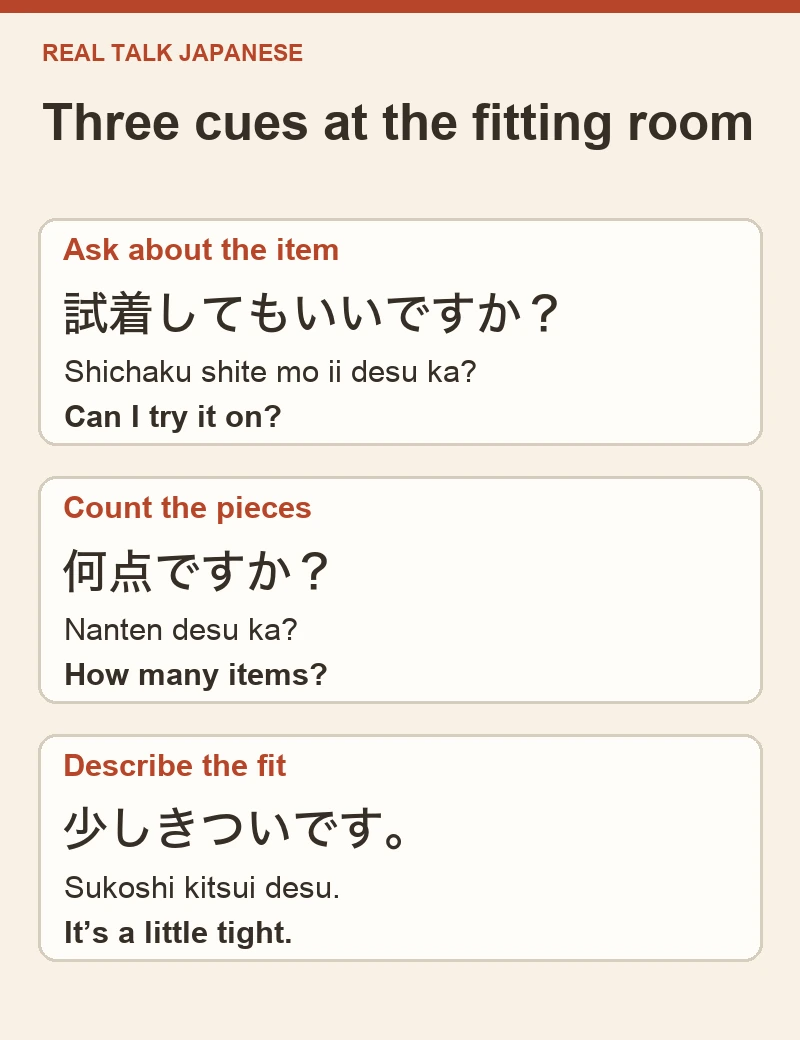
A hand extended toward the room and どうぞ (dōzo) — “go ahead” are your invitation. If you hear 何点ですか? (Nanten desu ka?) — “How many items?”, look at the clothes you brought. The clerk isn’t asking for your size. A jacket and two shirts make three: 3点です。(San-ten desu.) — “Three items.” Holding up three fingers while you answer can help, too.
Here’s a short exchange you can rehearse before you go in:
You: このジャケット、試着してもいいですか? (Kono jaketto, shichaku shite mo ii desu ka?) — “Can I try on this jacket?”
Clerk: はい、どうぞ。試着室はこちらです。 (Hai, dōzo. Shichakushitsu wa kochira desu.) — “Of course. The fitting room is this way.”
You: ありがとうございます。 (Arigatō gozaimasu.) — “Thank you.”
Look at the floor before you step into the booth. A raised platform or a posted instruction can mark a place to take off your shoes. If you’re unsure, point at yours and ask ここで靴を脱ぎますか? (Koko de kutsu o nugimasu ka?) — “Do I take off my shoes here?” Stores have their own layouts and rules. Here are more clues for where to take off your shoes.
Ask for another size from inside the fitting room
The sleeves stop at your wrists, but the shoulders pull when you reach forward. You don’t need the Japanese word for “shoulder seam.” Say 少しきついです。(Sukoshi kitsui desu.) — “It’s a little tight.” Follow it with the change you want: ワンサイズ大きいものはありますか? (Wan saizu ōkii mono wa arimasu ka?) — “Do you have one size up?”
For the other direction, use ワンサイズ小さいものはありますか? (Wan saizu chiisai mono wa arimasu ka?) — “Do you have one size down?” Notice which part stays the same. You’re asking if the store has the size; you don’t need to promise to buy it. If there’s no one outside the booth, get dressed before stepping out to find the clerk with the original item.
The clerk asks いかがですか? (Ikaga desu ka?, “How is it?”). Is that my cue to buy it?
You can simply describe the fit. 丈が少し長いです。(Take ga sukoshi nagai desu.) means “It’s a little long.” That gives the clerk something specific to respond to.
Say what you’ve decided
When the jacket fits and you want to buy it, say これにします。(Kore ni shimasu.) — “I’ll take this one.” If you tried on two sizes, hold up the one you want while you say it. A quick こちらはお返しします。(Kochira wa okaeshi shimasu.) — “I’ll give this one back.” helps keep the other size out of your purchase.
If you’ve decided to pass, 今回はやめておきます。ありがとうございます。(Konkai wa yamete okimasu. Arigatō gozaimasu.) — “I’ll pass this time. Thank you.” is clear and courteous. If you actually want another lap around the store, use the “I’ll give it some thought” line from the table. Hand back the garment or follow the clerk’s directions about where to leave it. You can say thanks without inventing a problem with the jacket. For more ways to finish a purchase or decline an offer, see saying no politely and everyday ways to say thank you.
Practice: which line comes next?
- A clerk is standing beside the fitting room. You know where it is and want to try on the sweater in your hand. Do you ask about shichaku or shichakushitsu?
- You bring a skirt and a sweater. The clerk asks Nanten desu ka? What number should they hear?
- The shirt feels loose. You want to try the next size down. Which word changes in your request?
Answers
- Ask about the action: 試着してもいいですか? (Shichaku shite mo ii desu ka?) — “Can I try it on?”
- 2点です。(Ni-ten desu.) — “Two items.” The number refers to the pieces you brought in.
- Use 小さい (chiisai) — “small”: ワンサイズ小さいものはありますか? (Wan saizu chiisai mono wa arimasu ka?) — “Do you have one size down?”
To practice aloud, pick up a shirt at home. Ask to try it on while you’re holding it; put it down and ask where the fitting room is. That small change of scene gives each word its own job.
Vocabulary reference: The Japan Foundation’s Irodori word list includes the terms for trying on clothes and for the fitting room. The store exchanges above are original practice examples.