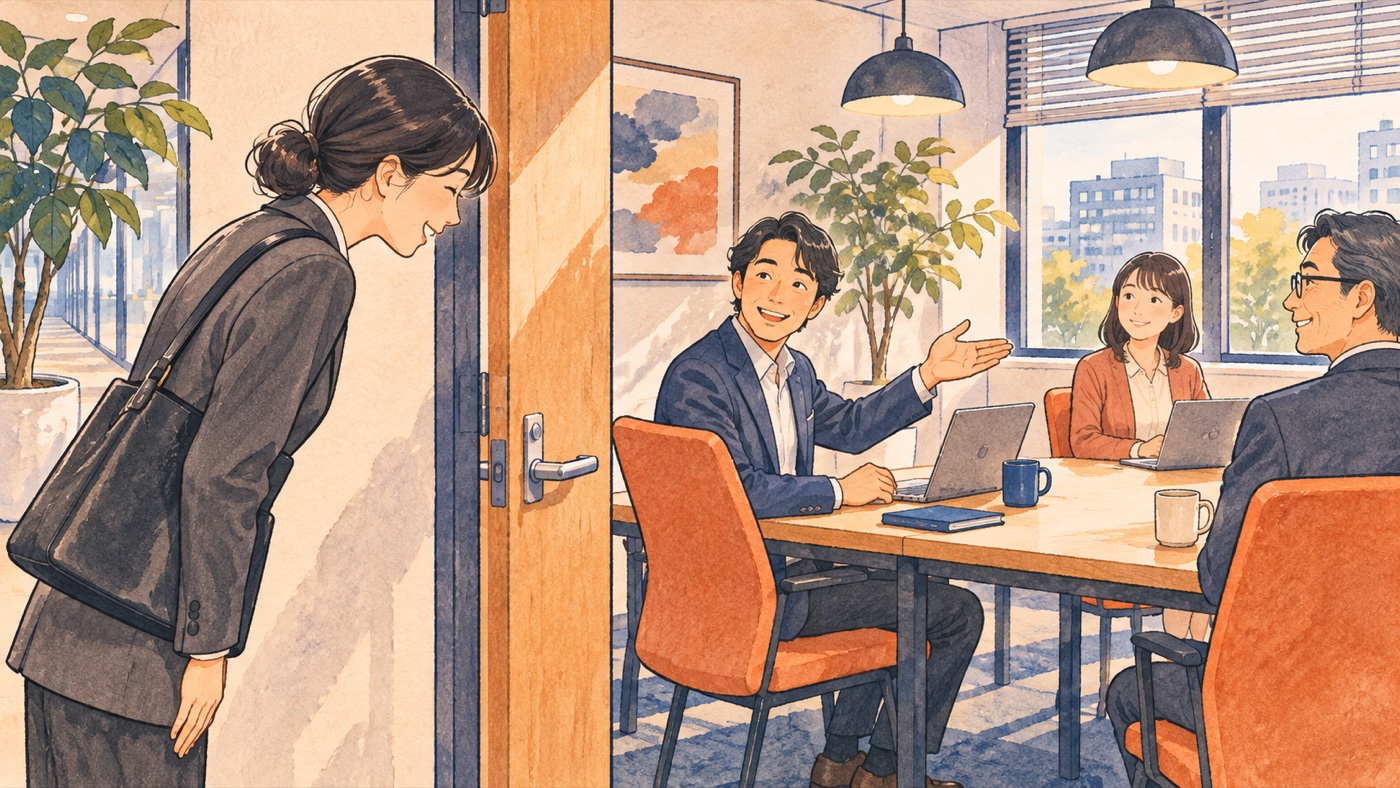
If you work, study, or job-hunt in Japan, you’ll hear 失礼します (shitsurei shimasu) constantly. People say it when they knock on a door, sit down in an interview, hang up the phone, and leave the office. It’s often translated as “excuse me,” but it does a very specific job that sumimasen doesn’t.
This guide explains what shitsurei shimasu means, the five situations where you’ll use it most, and how it changes in forms like osaki ni shitsurei shimasu and shitsurei shimashita. Every phrase comes with Japanese, romaji, and a natural English translation, plus a short quiz at the end.
Quick Answer: What Does Shitsurei Shimasu Mean?
失礼します。
Shitsurei shimasu.
“Excuse me.” / “Pardon me (for coming in / for leaving).”
It’s a polite phrase you say when you enter someone’s space, leave it, or briefly interrupt. In hiragana, it’s しつれいします.
The Literal Meaning
The phrase breaks down like this:
- 失 (shitsu): to lose
- 礼 (rei): manners, courtesy
- します (shimasu): to do
So shitsurei means “a lack of courtesy,” and shitsurei shimasu is literally “I’m going to be rude.” It sounds strange in English, but the idea is polite: you’re acknowledging that entering, leaving, or interrupting puts the other person out a little.
1. Entering a Room
Knock, wait for a reply, then say shitsurei shimasu as you open the door. You’ll hear this at offices, teachers’ rooms, and job interviews. In an interview, people also say it again when they’re invited to sit down.
You: (knock knock) 失礼します。
Shitsurei shimasu.
Excuse me.Interviewer: どうぞ、おかけください。
Dōzo, okake kudasai.
Please, have a seat.You: 失礼します。
Shitsurei shimasu.
Thank you. (literally, “Excuse me.”)
2. Leaving a Room or Someone’s Home
You also say it on the way out. At a meeting or an office, 失礼します or the past form 失礼しました (shitsurei shimashita) both work as you leave. Students often say shitsurei shimashita when leaving a teacher’s office.
When you’re visiting someone’s home and want to signal it’s time to go, use そろそろ失礼します (sorosoro shitsurei shimasu), “I should get going.”
You: じゃあ、そろそろ失礼します。
Jā, sorosoro shitsurei shimasu.
Well, I should get going.Host: また来てくださいね。
Mata kite kudasai ne.
Please come again.You: ありがとうございます。お邪魔しました。
Arigatō gozaimasu. Ojama shimashita.
Thank you for having me.
3. Leaving Work Before Others: Osaki ni Shitsurei Shimasu
お先に失礼します (osaki ni shitsurei shimasu) means “Excuse me for leaving before you.” Say it when you head home while coworkers are still working.
You: お先に失礼します。
Osaki ni shitsurei shimasu.
I’m heading out for the day.Coworker: お疲れさまでした。
Otsukaresama deshita.
Thanks for your hard work today.
The usual reply is otsukaresama deshita. With close coworkers, you’ll also hear the shorter お先です (osaki desu). For the different ways coworkers use this reply, see what otsukaresama means at work.
4. Ending a Phone Call
On business calls, shitsurei shimasu works like “goodbye.” The humbler 失礼いたします (shitsurei itashimasu) is common with clients.
You: それでは、失礼いたします。
Soredewa, shitsurei itashimasu.
Well then, goodbye.
In business, many people wait a moment for the other person to hang up first, especially with clients.
5. Small Interruptions: Chotto Shitsurei Shimasu
ちょっと失礼します (chotto shitsurei shimasu) means “Excuse me for a moment.” Use it when you:
- step away from a meeting to take a call
- reach across someone at a table
- pass in front of someone in a narrow space
It’s softer and more formal than a quick sumimasen.
Shitsurei Shimasu vs. Shitsurei Shimashita vs. Shitsurei Itashimasu
| Japanese | Romaji | Meaning | When to use |
|---|---|---|---|
| 失礼します | Shitsurei shimasu | Excuse me | Entering, leaving, interrupting |
| 失礼しました | Shitsurei shimashita | Excuse me (for having come in) / Sorry about that | Leaving a room, small mistakes |
| 失礼いたします | Shitsurei itashimasu | Excuse me (humble) | Clients, formal calls, customers |
| お先に失礼します | Osaki ni shitsurei shimasu | Excuse me for leaving first | Leaving work |
| 失礼ですが | Shitsurei desu ga | Excuse me, but… | Before a personal question |
Shitsurei shimashita also works as a light “Sorry about that.” For example, if you call the wrong number: あ、失礼しました。 (A, shitsurei shimashita.) “Oh, sorry about that.”
“Shitsurei Desu Ga…”: Asking a Polite Question
失礼ですが (shitsurei desu ga) means “Excuse me, but…” Use it before a question that might feel personal.
- 失礼ですが、お名前は? (Shitsurei desu ga, onamae wa?) Excuse me, but may I ask your name?
- 失礼ですが、どちら様ですか。 (Shitsurei desu ga, dochira-sama desu ka.) Excuse me, but who’s calling?
Shitsurei Shimasu vs. Sumimasen
Both can mean “excuse me,” but they do different jobs.
- すみません (sumimasen): getting someone’s attention, small apologies, and even “thank you.” Use it to call a server or stop someone on the street.
- 失礼します (shitsurei shimasu): entering, leaving, or interrupting in a polite or formal setting.
You wouldn’t call a server with shitsurei shimasu. For a closer look at apologies, see when to use sumimasen and gomennasai.
Careful: “Shitsurei Na!” Means “How Rude!”
The word shitsurei on its own describes rude behavior. 失礼な! (Shitsurei na!) means “How rude!” and 失礼だよ (shitsurei da yo) means “That’s rude.” Listen for the ending: shitsurei na! expresses annoyance, while shitsurei shimasu signals a polite action.
Common Mistakes to Avoid
- Using it for a serious apology. Shitsurei shimashita is for small slips. For a real mistake at work, use 申し訳ありませんでした (mōshiwake arimasen deshita).
- Leaving work silently. When coworkers are still at their desks, osaki ni shitsurei shimasu lets them know you’re heading out.
- Opening the interview door too soon. Knock and wait for an invitation. Say shitsurei shimasu as you enter.
Quick Practice
What would you say?
- You knock on your manager’s door and open it.
- You leave the office while your team is still working.
- You’re ending a call with a client.
- You need to step out of a meeting for a moment.
- You want to politely ask someone’s name.
Answers
- 失礼します。 (Shitsurei shimasu.)
- お先に失礼します。 (Osaki ni shitsurei shimasu.)
- それでは、失礼いたします。 (Soredewa, shitsurei itashimasu.)
- ちょっと失礼します。 (Chotto shitsurei shimasu.)
- 失礼ですが、お名前は? (Shitsurei desu ga, onamae wa?)
Final Tip
Think of shitsurei shimasu as a polite doorway phrase. Whenever you cross into or out of someone’s space, at a door, on the phone, or at the end of the workday, it’s the phrase that makes the move feel smooth.