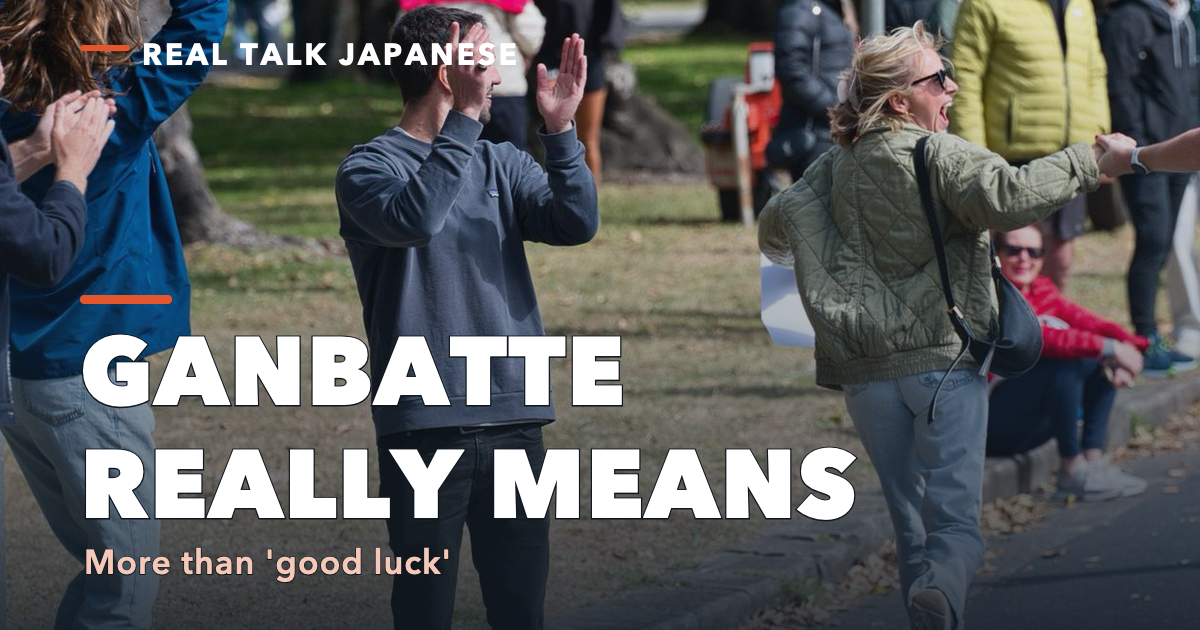
Ganbatte (頑張って / がんばって) means “do your best,” “hang in there,” or “go for it.” Before an exam or interview, “Good luck!” can also be a natural English translation. The right translation depends on what you are encouraging someone to do.
The practical questions are which form to choose, how to reply, and when someone might appreciate an offer of help more than another cheer. All conversations below are original teaching examples.
Quick answer: ganbatte, ganbare, or ganbarou?
The base verb is 頑張る (ganbaru), “to try hard” or “to persevere.” Ganbatte is its te-form, used on its own to encourage someone. Change the ending and you change what the sentence is doing.
| Japanese and reading | What it does | Example setting |
|---|---|---|
| 頑張って — ganbatte | Encourages the listener: “Do your best.” | A friend is about to take an exam. |
| 頑張ってね — ganbatte ne | Adds a friendly conversational ending. | A supportive message to that friend. |
| 頑張ってください — ganbatte kudasai | Uses a polite request form. | Encouraging someone you address politely. |
| 頑張れ — ganbare | A direct imperative: “Go for it!” | Cheering a player during a match. |
| 頑張ろう — ganbarō / ganbarou | “Let’s do our best,” or self-encouragement. | A team gets ready to start. |
| 頑張ります — ganbarimasu | States your intention: “I’ll do my best.” | Replying when someone encourages you. |
These are starting points, not a politeness ranking that works in every relationship. A shouted ganbare at a game and a quiet ganbare to a worried friend can land differently.
Can ganbatte mean “good luck”?
Yes, as a translation of encouragement. Its verb emphasizes effort, but an English speaker saying “Good luck with your interview” is often expressing support too. You do not need to turn either phrase into a claim about who controls the outcome.
Japan’s Ministry of Education lists がんばって! with both “Good luck!” and “Do your best” in its classroom-language guide, Encouraging section. The context determines which English expression works better.
A:明日は面接なんだ。
B:そうなんだ。頑張ってね!Ashita wa mensetsu nan da.
Sō nan da. Ganbatte ne!
“I have an interview tomorrow.”
“Oh, I see. Good luck!”
During a tough practice session, the same encouragement might translate as “Keep going!” With a friend managing a difficult week, “Hang in there” may fit. The Japanese word does not require a different spelling for each English translation.

So is “good luck” a wrong translation?

No. Before an interview it can communicate the same support. “Do your best” helps explain the verb, but you should translate the whole situation.
Pronunciation: ganbatte or gambatte?
The hiragana is がんばって: ga-n-ba-t-te, five timing units. The small っ holds a brief pause before the final te. Do not add an extra vowel and say “gan-ba-tu-te.”
You may see both ganbatte and gambatte. Before the b sound, ん can sound like m; romanization conventions differ in how they represent it. Both spellings point to the same Japanese expression. This guide uses ganbatte.
Ganbare has no small っ, so there is no doubled t pause. Ganbarō ends with a long o; ganbarou is another way to write that length. Listen for the ending before deciding whether someone is cheering you on or proposing a shared effort.
Choose a form for the situation
A friend needs encouragement
明日の試合、頑張ってね。
Ashita no shiai, ganbatte ne.
“Good luck with tomorrow’s game.” The friendly ne fits a personal message. It does not guarantee a gentle tone regardless of delivery.
You are cheering during the game
頑張れ、ミカ!
Ganbare, Mika!
“Go, Mika!” The direct form suits enthusiastic cheering. You do not need to copy a character’s shouting voice in an ordinary conversation.
You are preparing together
明日は一緒に頑張ろう。
Ashita wa issho ni ganbarō.
“Let’s do our best together tomorrow.” Choose this when you share the task. Ganbarō can also be something you say to motivate yourself.
You need a polite expression
頑張ってください (ganbatte kudasai) has polite grammar. But directing a senior colleague to try hard can still feel awkward, depending on your relationship. A statement of support such as 応援しています (ōen shite imasu, “I’m rooting for you”) may fit better when encouragement could sound like an instruction.
For more on what endings contribute, compare Japanese sentence endings. Focus on the relationship and task before adding a polite ending mechanically.
When support is more useful than “try hard”
If someone says they are exhausted, encouragement can be welcome, but it can also sound like pressure to keep going. Their stated needs are a better guide than a rule about what all Japanese people find comforting.
Compare two replies to the same message: 今日は疲れた (kyō wa tsukareta, “I’m tired today”).
- あと少しだね。頑張って。
Ato sukoshi da ne. Ganbatte.
“There’s only a little left. Keep going.” This might fit someone who wants a final push. - 無理しないで。何か手伝おうか?
Muri shinaide. Nanika tetsudaō ka?
“Don’t overdo it. Can I help with anything?” This offers practical support.
You can ask what would help instead of guessing. 少し休もうか? (sukoshi yasumō ka?, “Shall we take a short break?”) proposes rest without requiring them to prove how tired they are.
Should I stop saying ganbatte to a friend who is tired?
Ask what they need. Some people welcome a cheer; others want a break or help with the task. A supportive sentence works best when it responds to what they told you.
How to reply to ganbatte
A simple thank-you is enough. You can also say what you plan to do:
- Casual: ありがとう。頑張るよ。
Arigatō. Ganbaru yo. — “Thanks. I’ll do my best.” - Polite: ありがとうございます。頑張ります。
Arigatō gozaimasu. Ganbarimasu. — “Thank you. I’ll do my best.” - You need help: ありがとう。でも、ちょっと手伝ってもらえる?
Arigatō. Demo, chotto tetsudatte moraeru? — “Thanks. But could you help me a little?”
For more replies, see ways to say thank you in Japanese. After the work is finished, otsukaresama may fit as an acknowledgment of effort, depending on the situation.
Try it: A teammate says ganbatte before your presentation. Choose ganbarimasu to state your intention, or arigatō to thank them. If you are both presenting, 一緒に頑張ろう (issho ni ganbarō, “Let’s do our best together”) brings them into the encouragement.
Frequently asked questions
What does ganbatte kudasai mean?
“Please do your best,” or a polite “Good luck,” depending on context. It is polite in form, but still needs to fit the relationship.
Is ganbare rude?
It is a direct imperative. It works as a cheer, but can sound forceful outside that setting. Use ganbatte as a conversational starting point, then consider whether encouragement is welcome.
How do I say “I’ll do my best”?
Use 頑張ります (ganbarimasu) politely, or 頑張るよ (ganbaru yo) casually. Ganbatte on its own normally addresses someone else.
Is gambatte a different word?
No. It is another romanized spelling of がんばって, reflecting the nasal sound before b.
Can I use ganbatte outside anime?
Yes. Exams, performances, sports, and difficult tasks are ordinary settings for it. Match your delivery to the actual conversation.
For speaking practice, swap roles with a partner: encourage, thank, then ask for help. If you want feedback on tone, our Japanese tutor guide explains how to choose a teacher for conversation practice.
Written for Real Talk Japanese. Language references checked October 14, 2026. Dialogues and translations are original teaching examples.