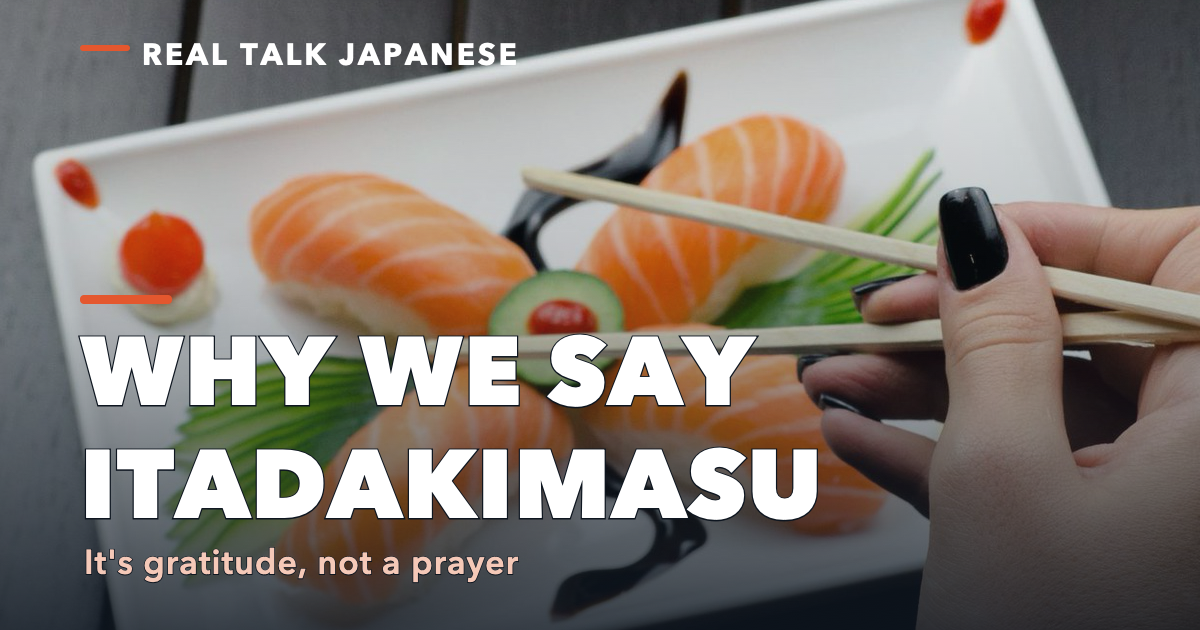
Itadakimasu (いただきます) is the Japanese expression said before eating. It acknowledges receiving the meal and is often translated as “I gratefully receive.” After eating, the matching expression is gochisōsama deshita, “Thank you for the meal.”
You do not need a grand ceremony to use it. This guide explains when to say it, how it differs from “Enjoy your meal,” and what to say when someone offers you food.
Quick answer: before eating, not after
The spelling is いただきます, read i-ta-da-ki-ma-su. In ordinary speech, the final u can be quiet. Say the word as one expression rather than stressing each syllable heavily.
Japan National Tourism Organization’s manners guide identifies it as a phrase before eating and pairs it with a thank-you after the meal. The important distinction is the stage of the meal.
| Expression | When | What you are doing |
|---|---|---|
| いただきます itadakimasu | Before you start eating | Acknowledging the meal you are about to receive. |
| ごちそうさまでした gochisōsama deshita | After you finish | Expressing appreciation for the meal. |
| どうぞ dōzo | When offering something | Inviting the other person to help themselves. |
What itadakimasu literally means
いただく (itadaku) is a humble verb used for receiving, eating, or drinking. Itadakimasu is its polite form. “I humbly receive” explains that grammar, while “Thanks for the food” may convey its practical role more naturally.
The food expression can acknowledge both the people who prepared a meal and the food itself. It does not name a particular god or require a religious declaration. Individuals may give the custom their own significance; avoid assuming that everyone has the same belief.
You will encounter itadaku in other polite expressions too. That does not make every phrase containing it a meal greeting. お菓子をいただきました (okashi o itadakimashita, “I received some sweets”) reports something received. For the broader grammar, see our explanation of keigo.
A simple meal routine
When you are ready to eat, say itadakimasu, then begin. People sometimes bring their palms together and give a small nod. In a group, follow the host’s pace rather than treating the gesture as a rigid test.
If dishes arrive at different times, look for the group’s cue. You can ask before starting:
先に食べてもいいですか?
Saki ni tabete mo ii desu ka?
“May I start eating first?”
This addresses the practical question directly. You do not need to wait until every plate on a restaurant menu has arrived if the group has agreed to start.
For the actions around these greetings, see our Japanese table manners guide, including shared dishes, chopsticks, and how to ask before starting.
You can say it quietly when eating alone too. People’s habits vary, and the phrase does not need an audience. With company, using it is a straightforward way to participate in the meal’s opening.

Should I say itadakimasu every time a server brings another dish?

Normally it marks starting the meal. You can thank the server for a dish without restarting the meal greeting each time. Follow the pace of the people eating with you.
Itadakimasu is different from “bon appétit”
Itadakimasu is spoken by the person receiving or eating the food. “Enjoy your meal” addresses someone else. A cook offering a plate can say どうぞ (dōzo, “Here you are”), or 召し上がってください (meshiagatte kudasai, “Please help yourself / Please enjoy it”).
Compare both sides of the same exchange:
A:どうぞ、食べてください。
B:ありがとうございます。いただきます。Dōzo, tabete kudasai.
Arigatō gozaimasu. Itadakimasu.
“Please go ahead and eat.”
“Thank you. I’ll gratefully accept.”
The person offering the food uses dōzo; the person about to eat uses itadakimasu. A translation like “Let’s eat” can work in a group subtitle, but it does not explain the receiving side of the expression.
After the meal: say what you appreciated
ごちそうさまでした (gochisōsama deshita) closes the meal with thanks. You may also hear the shorter ごちそうさま (gochisōsama) among family or friends. Keep the long vowels in go-chi-sō-sa-ma.
ごちそうさまでした。スープがおいしかったです。
Gochisōsama deshita. Sūpu ga oishikatta desu.
“Thank you for the meal. The soup was delicious.”
A specific comment is useful if you want to thank the cook. The phrase does not guarantee a warm reaction from every person; it simply gives you a clear, appropriate way to express thanks.
If someone paid for your meal, also thank them for treating you. Before eating and after being treated are different moments. Our Japanese thank-you guide compares expressions for different kinds of help.
What if I say itadakimasu and then remember I need a photo?
There is no wording penalty to fix. The useful point is that you are about to eat. Keep the group’s comfort in mind if you pause for a photo.
Receiving a snack is not the same as opening a full meal
If a colleague offers one cookie, ありがとうございます。いただきます (arigatō gozaimasu. Itadakimasu, “Thank you. I’ll have one”) can acknowledge accepting it. If you are saving the cookie for later, you can instead say ありがとうございます。あとでいただきます (arigatō gozaimasu. Ato de itadakimasu, “Thank you. I’ll enjoy it later”). This keeps the verb’s receiving/eating use visible without pretending every snack requires the same group routine. If you cannot accept the food, say that clearly and thank the person for offering it.
If your host says “Please start,” you can follow that invitation. The expression acknowledges eating; it does not require enforcing the same routine on everyone at the table.
Practice: choose the speaker and timing
1. You have just received lunch. What do you say before the first bite? Answer: itadakimasu.
2. You cooked lunch and are handing a plate to a guest. Answer: dōzo invites the guest to eat; the guest can answer itadakimasu.
3. You finished and want to thank your host. Answer: gochisōsama deshita, followed by one thing you enjoyed.
Practice the whole exchange, not just the two greetings. Add an offer, acceptance, and a specific thank-you so each phrase has a clear role.
Frequently asked questions
Is itadakimasu a prayer?
It is a meal expression of gratitude. It does not require a religious belief, although individuals may understand it through their own beliefs.
Can a visitor say it?
Yes. It is a normal expression you can use when eating. Match the group’s volume and timing.
Should I say it when eating alone?
You can. People’s habits vary; you do not need someone to reply.
How do I reply if someone says itadakimasu?
If you are eating too, you can say it yourself. If you are serving, dōzo is an invitation to enjoy the food. There is no compulsory call-and-response.
Do I say it after eating?
Use gochisōsama deshita after the meal. Itadakimasu marks receiving or beginning it.
Try a meal dialogue with a language partner. For individual feedback, see how to choose an online Japanese tutor.
Written for Real Talk Japanese. References checked October 14, 2026. Dialogues and translations are original teaching examples.