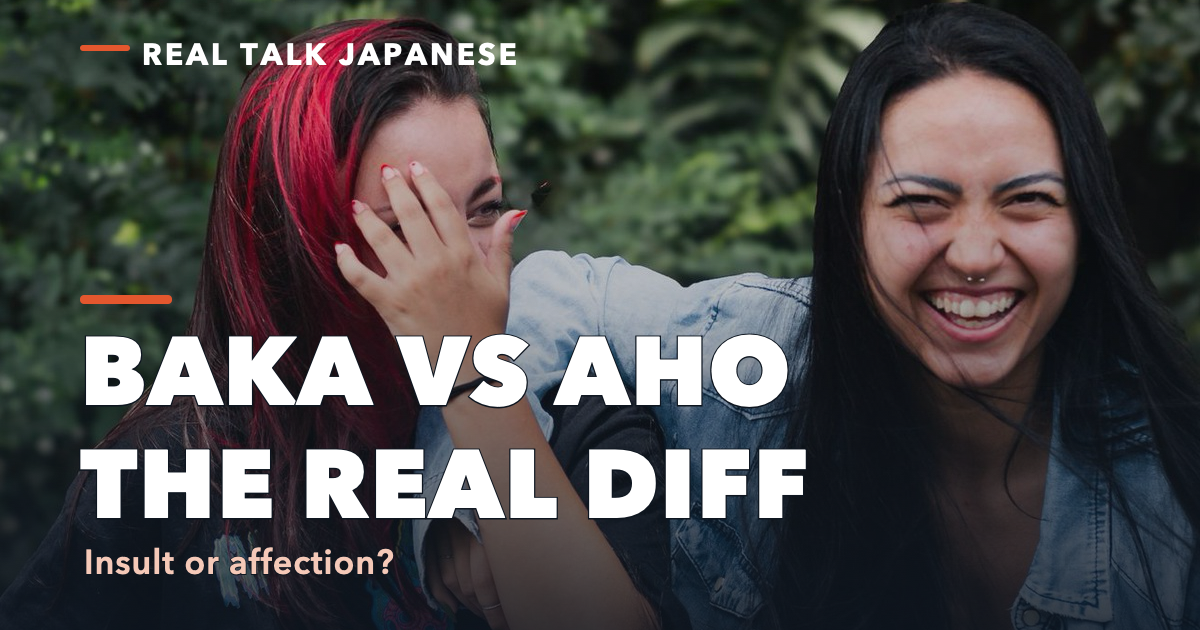
Every anime glossary says the same thing: baka = idiot, stupid. True. Also nearly useless.
As a native Japanese speaker, here’s the answer that actually matters: how insulting バカ (baka) is depends on three dials — region, relationship, and tone. The exact same word can start a fistfight in Osaka, bounce off harmlessly in Tokyo, and function as something dangerously close to “I love you” between a couple. No English word swings that widely.
Let me show you how the dials work.
Quick Answer
バカ/馬鹿 (baka) means “fool, idiot, stupid.” Force ranges from genuinely offensive (aimed seriously at a stranger) to teasing (between friends) to affectionate (バカだなぁ, baka da naa — “you silly thing”). In eastern Japan it’s the everyday soft insult; in western Japan that role belongs to アホ (aho), and baka hits noticeably harder.
The Famous Baka–Aho Map
Japan runs on an east–west insult divide that natives find endlessly entertaining:
| Tokyo / East Japan | Osaka / West Japan | |
|---|---|---|
| バカ baka | light, everyday, half-joking | harsh — sounds seriously contemptuous |
| アホ aho | harsh — sounds cold and cutting | light, everyday, almost friendly |
So the words swap severity depending on which side of the country you’re on. A Tokyo kid hears baka twenty times a day and shrugs; call that same kid aho and it stings, because aho isn’t part of the eastern furniture. Flip it in Osaka: aho is practically punctuation in Kansai comedy — a manzai stand-up routine without アホか! (“are you an idiot?!”) barely counts as manzai — but a flat, serious baka from an Osakan means something went genuinely wrong.
This isn’t just folk wisdom. A famous Japanese TV show (Tantei! Knight Scoop) once ran a nationwide survey mapping where people say baka versus aho, and it became a bestselling book — the divide runs roughly along the old cultural border between eastern and western Japan, with gradient zones and local variants in between: たわけ (tawake) around Nagoya, だら (dara) on the Japan Sea coast, ほんじなし and others scattered through the map. Japan takes its idiot-vocabulary seriously.
For learners the takeaway is simple: notice where you are. The same syllables carry different weights in different cities.
Anime Baka vs Real-Life Baka
You’ve heard it a thousand times: the tsundere’s ばか! (baka!), face red, arms crossed, usually followed by “i-it’s not like I did it for you.” Anime has turned baka into arguably the most famous Japanese word on the internet. But anime usage and street usage differ in specific ways.
In anime, baka is a relationship word. It’s overwhelmingly aimed at people the character is close to — the childhood friend, the love interest, the idiot teammate. It’s shorthand for flustered affection or comedic exasperation, delivered at theatrical volume. あんたバカ? (anta baka?, “are you stupid?”) from Evangelion‘s Asuka is the archetype: contempt on the surface, intimacy underneath.
In real life, that intimate teasing baka absolutely exists — but the frame around it is strict. Friends baka each other over dropped phones and forgotten umbrellas. Couples baka each other constantly. Parents sigh baka ne (baka ne, “you silly”) at kids. What real life does not have is anime’s volume and frequency toward non-intimates. Saying baka to your boss, a shop clerk, or a stranger isn’t quirky — it’s a genuine insult, roughly “are you an imbecile,” and there’s no laugh track to soften it.
In my experience, the reliable rule is: baka is safe exactly as far as your intimacy extends, and not one step further. Anime shows you the intimate zone and edits out the rest of society.

When Baka Becomes Affection
This is the part textbooks refuse to touch. Between people who are genuinely close, baka softens into warmth:
- バカだなぁ (baka da naa) — “you silly thing,” said with a smile. Often what a Japanese partner says instead of something embarrassingly direct like “you’re adorable”
- バカね (baka ne) — soft, typically feminine, fond exasperation
- このバカ! (kono baka!) — “you idiot!” — angry on the surface, but between intimates it usually means “you scared me because I care.” Said to the friend who walked home in a typhoon
- バカップル (bakappuru) — baka + couple: a pair so lovey-dovey in public that observers’ eyes roll. Teasing, not hateful
Why does an insult turn tender? Because in a culture where direct emotional statements can feel too heavy, a soft insult proves closeness — you’re demonstrating the relationship can absorb it. The insult is the intimacy. This is also why you must not open with it: affectionate baka is a privilege you earn, not a greeting.
Baka as an Intensifier (The Usage Nobody Teaches)
Here’s a genuinely useful pattern: baka glued to other words stops meaning “stupid” and starts meaning “absurdly, ridiculously”:
| Expression | Reading | Meaning |
|---|---|---|
| バカうまい | baka umai | ridiculously delicious |
| バカ売れ | baka-ure | selling insanely well |
| バカ高い | baka-takai | absurdly expensive |
| バカ正直 | baka-shoujiki | honest to a fault |
| バカにならない | baka ni naranai | “not to be sneezed at” — costs add up |
| 親バカ | oya-baka | a parent hopelessly besotted with their kid |
親バカ (oya-baka) is my favorite: a “parent-idiot” is someone whose phone contains four thousand photos of one toddler. It’s self-deprecating and completely affectionate — people happily declare 親バカですみません (“sorry, I’m a doting parent”) while showing you photo number 3,847.
And the etymology? The kanji 馬鹿 literally spell “horse-deer,” which is ateji — characters chosen for sound, not meaning. One legend ties it to a Chinese tale of a schemer who called a deer a horse to test who’d dare correct him; another theory derives it from a Sanskrit word for delusion that came in with Buddhism. Nobody knows for certain, which I find fitting for a word this slippery.
The Baka Family: Related Forms
- バカヤロー (baka yarou) — baka + “fellow”: significantly stronger, the angry-drunk-uncle classic. Handle with care
- バカバカしい (bakabakashii) — absurd, ludicrous (about situations, not people)
- バカみたい (baka mitai) — “like an idiot”; often self-directed: 私バカみたい, “I feel like such a fool”
- バカにする (baka ni suru) — to mock, look down on. バカにしないで! — “don’t patronize me!” Extremely common and worth memorizing
- おバカ (o-baka) — with the honorific o-, weirdly cute: TV loves おバカキャラ, lovable-airhead personalities
Notice how much of this family is about situations and self, not attacks on others. Real Japanese uses baka inward and sideways far more than it throws it forward — another thing you’d never guess from Japanese word meanings and slang, or from its angry cousin urusai.
FAQ
What does baka mean in Japanese?
Baka (バカ/馬鹿) means “fool,” “idiot,” or “stupid.” Its actual force ranges from a serious insult to friendly teasing to affection, depending on tone, relationship, and even region of Japan.
Is baka a swear word?
Not in the four-letter sense — Japanese barely has those — but aimed seriously at a stranger or superior it’s genuinely insulting. Between close friends or couples it’s usually teasing or even affectionate.
What’s the difference between baka and aho?
Mostly geography. In Tokyo and eastern Japan, baka is the light everyday word and aho sounds harsh; in Osaka and western Japan it flips — aho is friendly and baka cuts deep. The words trade places across the country.
Why do anime characters say baka so much?
Because anime compresses relationships into catchphrases, and baka is the perfect flustered-affection word — especially for tsundere characters. Real Japanese people use it too, but at lower volume and only inside established relationships.
Can baka be affectionate?
Yes. バカだなぁ (baka da naa) with a smile is closer to “you silly thing” than to any insult, and couples use baka the way English couples use “dork.” The closeness has to already exist, though — affectionate baka can’t be your opening move.
What does baka mean when attached to other words?
As a prefix it means “absurdly”: バカうまい (ridiculously tasty), バカ高い (crazy expensive), バカ売れ (selling like mad). And 親バカ (oya-baka) is a parent adorably obsessed with their own child.
💬 One Honest Tip From a Native
Baka is a trust thermometer: the amount you can use it measures exactly how close you are. That’s not something an app can grade — but a native tutor can tell you in real time whether your baka landed as charming or alarming, and that feedback is how the instinct gets built.
→ Calibrate with a real native: How to Find a Japanese Tutor Online
→ More words with hidden dials: Japanese word meanings and slang
Written by Rei — native Japanese speaker. Audio examples coming soon.
Last updated: July 2026
Keep Learning Real Japanese
Reading about words is a start — using them in real conversations is what makes them stick. These guides will help you take the next step:
- Best Apps to Learn Japanese — Tested and Ranked
- italki vs Preply: Which Is Better for Learning Japanese?
Hear the words in context.
Pair these explanations with regular listening. Compare lesson formats and choose a routine that fits your level.