すみません、駅はどこですか。— Sumimasen, eki wa doko desu ka? — “Excuse me, where is the station?” Now listen for the answer. If you hear 次の信号を右です(つぎのしんごうをみぎです)— Tsugi no shingō o migi desu, the next move is a right turn at the next traffic light.
You do not have to memorize a whole route at once. Listen for the landmark and the action that goes with it. If you catch “right” but miss where to turn, that’s the detail to ask about.
Ask where a place is, or how to get there
Suppose you have an address and a station name on your phone. An attendant at a visitor information desk has time for a question. Which opening do you need?
To ask where the station is:
すみません、駅はどこですか。
すみません、えきはどこですか。
Sumimasen, eki wa doko desu ka?
“Excuse me, where is the station?”
To ask for a route to the same station:
駅へはどう行けばいいですか。
えきへはどういけばいいですか。
Eki e wa dō ikeba ii desu ka?
“How can I get to the station?”
In the second line, the written particle へ is pronounced e. The first question may get a gesture toward a nearby building. The second makes it clearer that you want directions. Neither guarantees a particular answer. If there is more than one station nearby, give its name or point to its label on your map. If you are already inside the station, ask for the exit or ticket gates you need instead of asking where the station is.
Sumimasen works here to get someone’s attention. If you want to compare it with an apology, see sumimasen and gomennasai.
Listen for two pieces: landmark + action
Imagine hearing a string of words while trying to orient your map. Instead of translating the whole sentence in order, pick out a place to act and a movement.
| Landmark you may hear | What to look for |
|---|---|
| 信号(しんごう)— shingō | A traffic light |
| 交差点(こうさてん)— kōsaten | An intersection |
| 角(かど)— kado | A corner |
| Action you may hear | What it tells you |
|---|---|
| まっすぐ行く(まっすぐいく)— massugu iku | Continue straight |
| 右に曲がる(みぎにまがる)— migi ni magaru | Turn right |
| 左に曲がる(ひだりにまがる)— hidari ni magaru | Turn left |
| 渡る(わたる)— wataru | Go across, for example across a bridge |
The Japan Foundation’s Irodori directions lesson has listening practice with landmarks and turns. The route in this guide is a separate, invented exercise.
“On the right” is different from “turn right”
Compare these lines in a single scene:
信号を右に曲がってください。
しんごうをみぎにまがってください。
Shingō o migi ni magatte kudasai.
“Turn right at the traffic light.”図書館は右にあります。
としょかんはみぎにあります。
Toshokan wa migi ni arimasu.
“The library is on the right.”
The first line tells you to change direction. The second tells you where a building is as you walk. If you turn every time you hear migi, you might take an extra turn instead of spotting your destination. Listen for magaru or its form magatte for the turn, and arimasu for the location.
Confirm the step you are unsure about
Repeat the smallest part you missed. “The first light?” is a more useful check than starting the whole conversation again when you already understand the direction.
Original practice dialogue. Here the person giving directions means the second light; this is a listening drill, separate from the map below.

一つ目の信号ですか。 — ひとつめのしんごうですか。 — Hitotsume no shingō desu ka? — “The first traffic light?”

二つ目です。 — ふたつめです。 — Futatsume desu. — “The second one.”
二つ目を右ですね。 — ふたつめをみぎですね。 — Futatsume o migi desu ne. — “Right at the second one, then?”
はい、そうです。 — Hai, sō desu. — “Yes, that’s right.”
If you missed the entire reply, もう一度お願いします(もういちどおねがいします)— Mō ichido onegaishimasu means “Could you say that again, please?”
If a map would help, ask 地図で教えていただけますか(ちずでおしえていただけますか)— Chizu de oshiete itadakemasu ka?: “Could you show me on the map?” You can hold your own screen where the other person can see it, if they’re willing to help. You do not need to hand over your phone.
Try the route: the station or the library?
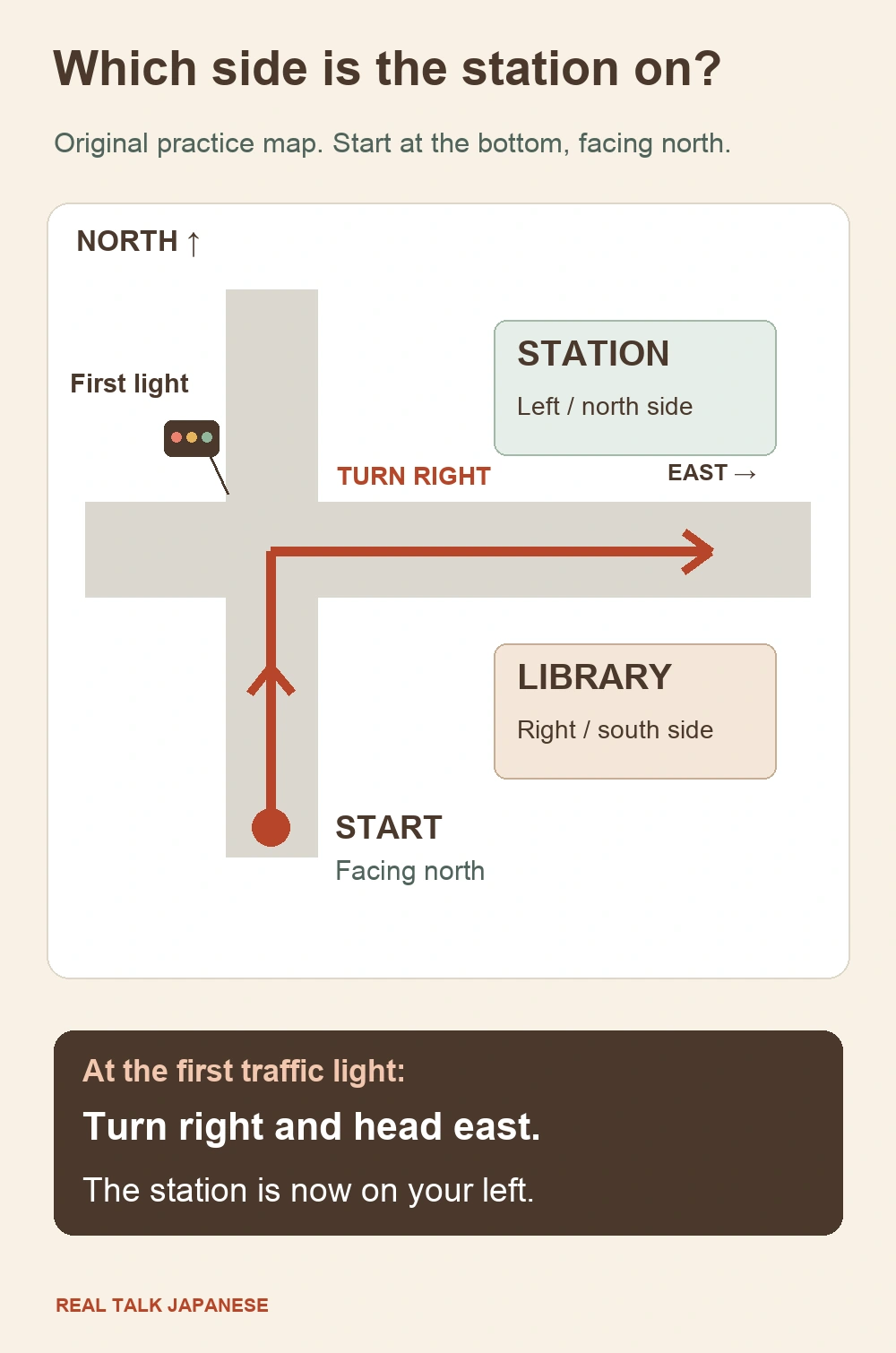
This is an imaginary neighborhood, not a route to a real station. Start at the bottom of the map, facing north. The first intersection ahead has a traffic light. Both destinations are on the street to the east of that intersection.
Read the route aloud, or have a partner read it to you:
この道をまっすぐ行って、一つ目の信号を右に曲がってください。駅は左にあります。
このみちをまっすぐいって、ひとつめのしんごうをみぎにまがってください。えきはひだりにあります。
Kono michi o massugu itte, hitotsume no shingō o migi ni magatte kudasai. Eki wa hidari ni arimasu.
“Go straight along this street and turn right at the first traffic light. The station is on the left.”
Cover the English and trace the route with your finger. Where do you turn? Which building are you looking for, and on which side? Turn right at the first light. Once you are heading east, the station is on your left, on the north side of the street. The library is opposite it on your right.
Original map-check dialogue:
I turned right and found the library on my right. Did I miss the station?
Look across the street. The turn was migi, right. The next sentence said eki wa hidari ni arimasu: the station is on the left.
So I change the direction I’m facing first. Then I use that new direction to tell left from right.
Exactly. Keep the first turn and try saying where the library is instead.
One answer: 図書館は右にあります。— Toshokan wa migi ni arimasu. — “The library is on the right.” The turn stays the same; only the destination and the side change.
What if you still don’t understand?
You can thank the person and check your map again. There is no need to nod as if you know where to go. If you can find an information desk or station staff, show the place name and ask about the next step. For a simple way to close the exchange, ありがとうございます — Arigatō gozaimasu is “Thank you.” The guide to saying thank you in Japanese has other examples.
For free listening practice, choose Lesson 6 from the Irodori Elementary 1 audio and downloads, or use the Japanese consulate in Boston’s directions lesson. With a friend, switch the station and library labels without moving the streets, then give the revised directions aloud. If you prefer guided practice, the Japanese tutor guide can help you choose lessons where you listen, check an uncertain turn, and respond.