Tadaima (ただいま) means “I’m home” or “I’m back” when someone returns. The person welcoming them says okaeri (おかえり) or okaerinasai (おかえりなさい), “Welcome back.” But hear tadaima on a station announcement and the meaning changes: there it can mean “right now.” No one is asking passengers to say okaeri.
Imagine coming home to a housemate. You unlock the door and say tadaima; from the kitchen, they answer okaeri. Tomorrow you can switch places and switch words.
At the door: who says what?
Imagine that Mochi has gone out to buy bread. Shiba-sensei stays home. When Mochi returns, the first line announces an arrival; the second acknowledges it. That direction matters more than either person’s age, gender, or role in the household.
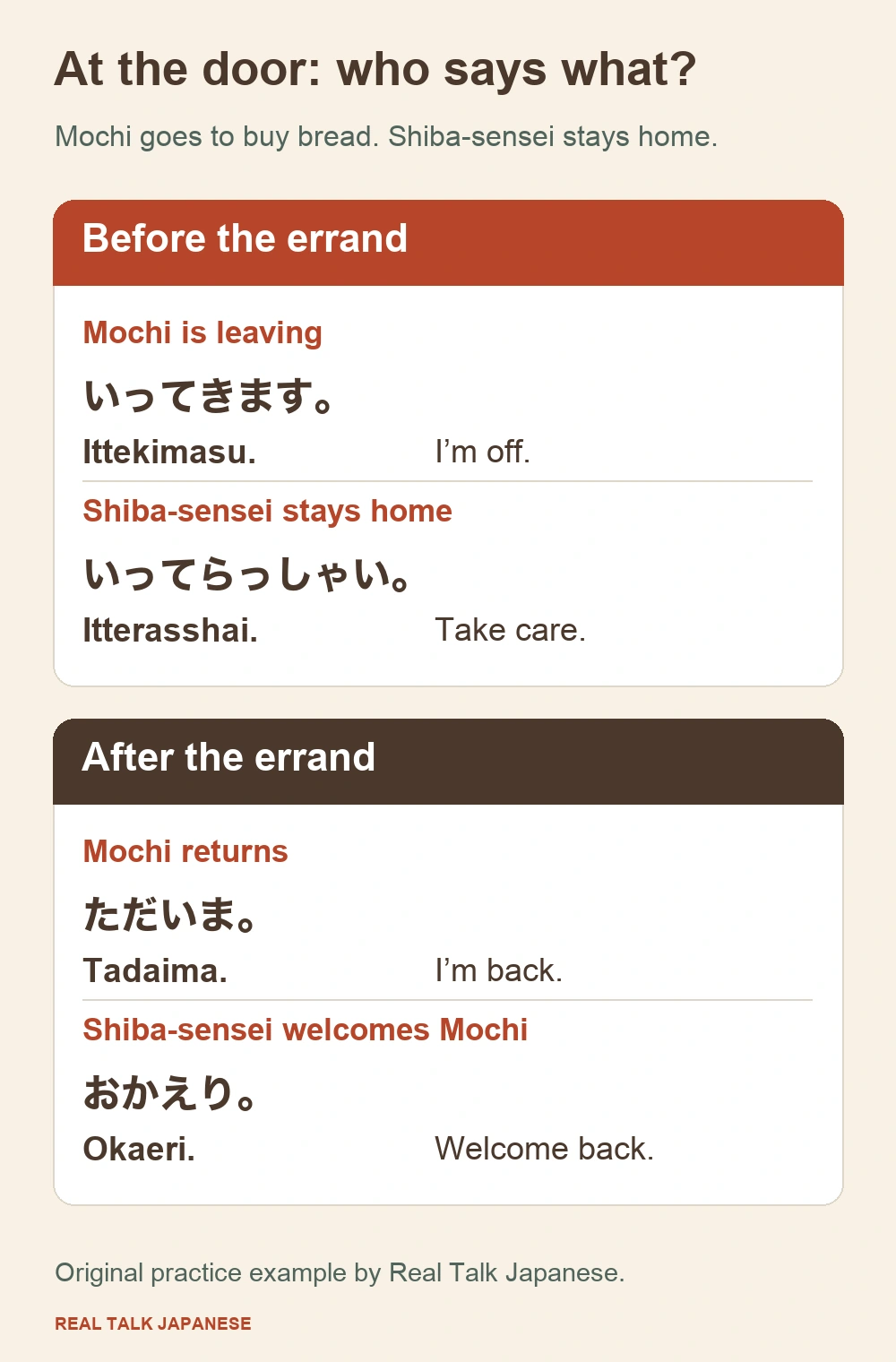
Mochi, walking in with the bread:
ただいま。
Tadaima.
“I’m back.”
Shiba-sensei, hearing the door:
お帰り。/お帰りなさい。
おかえり。/おかえりなさい。
Okaeri. / Okaerinasai.
“Welcome back.”
The shorter okaeri works in a familiar exchange. The longer version can also be a warm greeting at home; it does not mean the speaker feels distant. If you are staying with a family, listen to how people address each other rather than deciding that the longest form must be best for every person.
How do you answer okaeri? If you just said tadaima, you have already done your part of the exchange. There is no compulsory third line. You can take off your shoes, hold up the bread, or continue with whatever you actually want to say.
Here is that doorway moment as an original practice dialogue:

ただいま。パン、買ってきたよ。 — Tadaima. Pan, katte kita yo. — “I’m back. I got the bread.”

おかえり。ありがとう。 — Okaeri. Arigatō. — “Welcome back. Thanks.”
In this exchange, the thanks is for buying bread. It isn’t part of the greeting itself.
On the way out: a different exchange
Rewind to the moment before Mochi bought the bread. The speaker is going away with the expectation of returning. The person staying behind sends them off.
| Person leaving | Person staying |
|---|---|
| 行ってきます。— いってきます。— Ittekimasu. | 行ってらっしゃい。— いってらっしゃい。— Itterasshai. |
| “I’m off” or “See you later.” | “See you later” or “Take care.” |
English speakers might say “See you later” on either side of the door. Japanese has separate lines for the person who leaves and the person who sees them off. The Japan Foundation Sydney’s greeting notes describe this pair alongside tadaima and okaerinasai.
Try the four lines with the same partner. Go out to buy bread; come back with it. Then let your partner go instead. If changing roles makes you hesitate, mime opening the door: are you announcing your own movement, or responding to theirs?
What if you’re visiting someone else’s home?
For a first visit, you are entering as a guest rather than announcing your return to your own space. A useful expression as you enter is お邪魔します(おじゃまします)— Ojama shimasu. “Thank you for having me” conveys its function in this setting.
Meeting someone inside a store for the first time is different again. Walking through a doorway alone does not make tadaima a general “hello.” Look for the idea of coming back.
Why a train announcement uses tadaima too
Read the whole line before choosing a translation:
ただいま、電車が遅れています。
ただいま、でんしゃがおくれています。
Tadaima, densha ga okurete imasu.
“The train is currently running late.”
This is an announcement-style example written for practice, not a recording from an actual railway. The speaker is reporting what is happening now. Replying “Welcome back” would miss both the audience and the message.
Shogakukan’s Digital Daijisen entry for 只今 connects the homecoming greeting to an expression meaning that someone has just returned. It also records time senses covering the present, the very recent past, and the very near future. The rest of the sentence determines which English wording fits.
Take a return to work after an errand:
ただいま戻りました。
ただいまもどりました。
Tadaima modorimashita.
“I’ve just returned.”
Here the verb modorimashita tells you that the return has already happened. The line can fit a workplace, but each workplace has its own habits. If you are comparing expressions coworkers use to acknowledge each other more broadly, see when to say otsukaresama.
In a shop, you might instead hear ただいま確認します(ただいまかくにんします)— Tadaima kakunin shimasu: “I’ll check right away.” The person is about to check something for you. No homecoming is involved.
Hear the rest of the sentence
Here’s a second original practice scene. Mochi and Shiba-sensei are listening to the station announcement above.
I heard tadaima first. Should I expect someone to answer okaeri?
Listen past the pause: densha ga okurete imasu. The speaker is reporting a train delay.
So it answers “When is this happening?” Here, the answer is “right now.”
Exactly. At home, the first line announced your arrival. Here, tadaima tells us when the train is delayed.
A pause after tadaima is not enough on its own. At home, an arriving person might add another sentence about the bread. On a loudspeaker, the announcement may pause before the update. Ask two questions: Who is speaking to whom? What comes next? If you want to hear the word before trying the examples, the TKG learner’s dictionary has audio examples.
Try three situations without looking back
- Your roommate walks in and calls tadaima. You’re already in the kitchen. What do you say?
- You are about to leave your shared apartment for class. Which member of the going-out pair is yours?
- A shop employee says tadaima kakunin shimasu. Have they just come home, or are they offering to do something?
Answers: In the kitchen, okaeri or okaerinasai welcomes your roommate back. On the way to class, ittekimasu is your line; the person staying can reply itterasshai. In the shop, the employee is offering to check something right away.
Friends can use the return-and-welcome pair when the situation fits; the words do not require a particular family relationship. Someone who lives alone might say tadaima out of habit, or say nothing. There is no missing half of a required ceremony when nobody replies.
For more short exchanges, try the casual Japanese phrases guide. For a free practice round, read the bread scene aloud and switch who went shopping. If you work with a teacher, ask them to mix homecoming lines with shop and station examples so you have to listen for context. The Japanese tutor guide can help you choose a conversation practice format.