In Japan, you take your shoes off when you step up from the entryway into someone’s home. That entryway is the 玄関 (genkan), and its floor is usually a step lower than the rest of the house. Shoes stay on the low part. Socks or slippers go on the raised part.
The same idea shows up in other places, too: traditional inns, some temple halls, restaurants with tatami seating, schools, and even clothing-store fitting rooms. The clue is almost always the same. When the floor steps up, your shoes come off.
The genkan: one step that divides outside from inside
Think of the genkan as a small piece of the outdoors inside the front door. You can stand there in shoes, put down your bag, and take your shoes off. The raised floor beyond it is indoors.
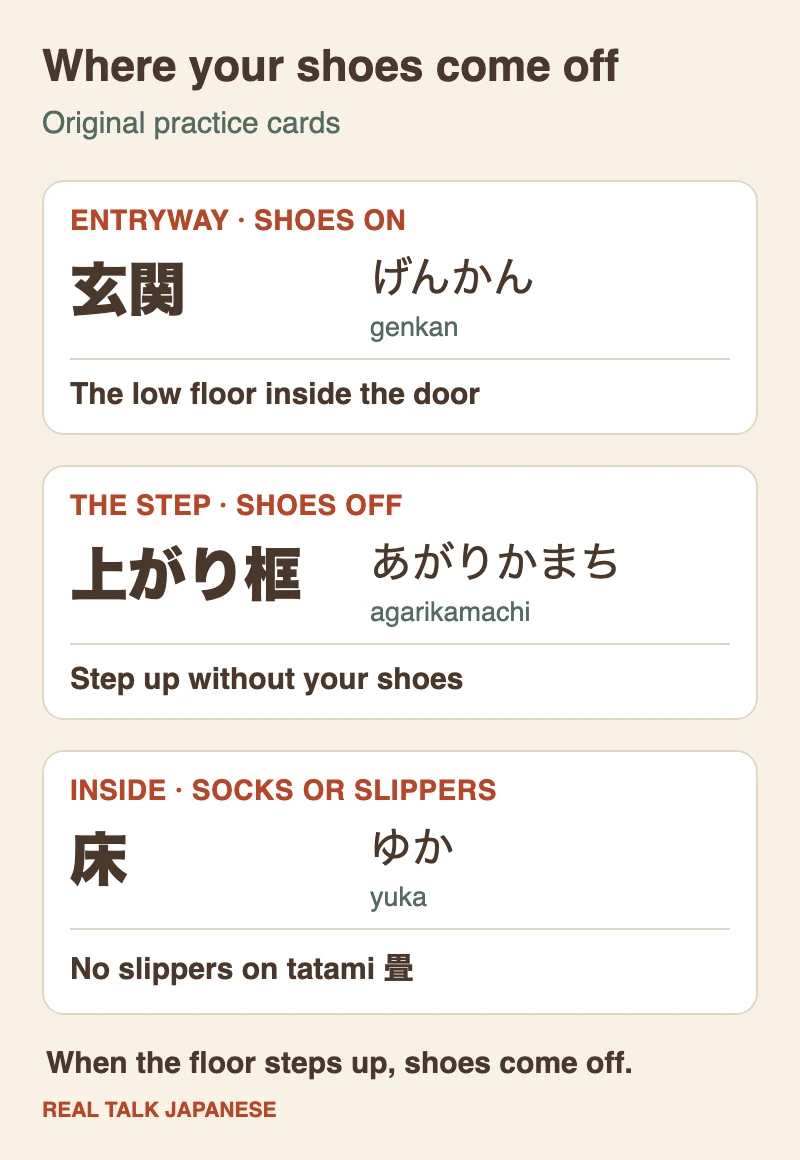
The edge of that step has a name, 上がり框 (agarikamachi), but you don’t need to remember it. What matters is that you don’t step onto the raised floor while you’re still wearing outdoor shoes.
At the door, step by step
Here’s the whole sequence at a friend’s home:
- Greet your host and say お邪魔します (ojama shimasu) as you come in. For what the phrase means, see Ojama Shimasu Meaning.
- Take your shoes off while standing on the low floor. Try not to put a socked foot down on the genkan floor, because that’s the dirty part.
- Step up onto the raised floor.
- Tidy your shoes. Many people turn them so the toes point toward the door, or set them neatly to one side. Some hosts will do this for you or tell you not to bother. If they do, let it go.
- Put on slippers if your host offers them.
When you leave, do it in reverse: step down into your shoes, and say お邪魔しました (ojama shimashita).
Slippers: where they go, and where they don’t
Many homes offer guest slippers for wooden floors and hallways. They don’t go everywhere.
Scroll the table sideways on smaller screens.
| Room | Slippers? | What to do |
|---|---|---|
| Hallways, kitchen, living room with wood floors | Usually yes | Wear the guest slippers |
| Tatami room 畳 (tatami) | No | Step out of the slippers at the edge and walk in socks |
| Toilet | Often a separate pair | Switch into the toilet slippers, then switch back |
Tatami mats are made of woven rush and are easy to scuff, which is why slippers stay off them. For the toilet slippers and the toilet itself, see How to Use a Japanese Toilet.
Other places where shoes come off
You won’t take your shoes off at most shops, offices, or Western-style hotels. These places are different:
Scroll the table sideways on smaller screens.
| Place | What you’ll see | What to do |
|---|---|---|
| 旅館 (ryokan), traditional inns | A genkan at the entrance or at your room | Leave shoes where staff show you; slippers are often provided |
| Temple halls | Shoe racks or plastic bags at the entrance | Take shoes off before the step and carry or store them |
| Restaurants with 座敷 (zashiki) tatami seating | A raised tatami area | Take shoes off before stepping up |
| Schools | Shoe lockers by the entrance | Students change into indoor shoes, 上履き (uwabaki) |
| Fitting rooms in clothing stores | A small raised floor inside the booth | Step out of your shoes before stepping in |
Rules differ from place to place. When you’re not sure, look at the floor and at what other people are doing.
Signs and words to recognize
A few written words tell you what to do before anyone says anything.
土足禁止 (dosoku kinshi) — “No outdoor shoes.” 土足 means wearing outdoor shoes indoors.
靴を脱いでください (kutsu o nuide kudasai) — “Please take off your shoes.”
下駄箱 (getabako) or 靴箱 (kutsubako) — a shoe cabinet or shoe locker.
If you’re not sure, ask:
ここで靴を脱ぎますか。
ここでくつをぬぎますか。
Koko de kutsu o nugimasu ka?
“Do I take my shoes off here?”
And for slippers:
スリッパはどこで脱げばいいですか。
スリッパはどこでぬげばいいですか。
Surippa wa doko de nugeba ii desu ka?
“Where should I take off the slippers?”
Here’s a short original practice dialogue at a friend’s front door:

どうぞ、上がって。 — Dōzo, agatte. — “Come on in.”

お邪魔します。靴はここで脱げばいいですか。 — Ojama shimasu. Kutsu wa koko de nugeba ii desu ka? — “Thanks for having me. Should I take my shoes off here?”
うん。スリッパ、どうぞ。 — Un. Surippa, dōzo. — “Yes. Here are some slippers.”
Notice 上がって (agatte), literally “come up.” Inviting someone in is describing the step up into the house.
A few practical tips
- Wear shoes you can take off easily. Long laces and tall boots slow you down at every genkan.
- Check your socks. You’ll be walking around in them.
- Don’t step on the genkan floor in socks if you can help it, and don’t walk onto the raised floor in shoes.
- Bringing a gift? Hand it over once you’re inside. See Omiyage Meaning.
Quick questions
Is it rude to keep my shoes on in a Japanese home? Yes. In homes, taking shoes off is expected, and walking in with shoes on would surprise your host.
Can I walk around in socks, or do I need slippers? Socks are fine in most homes. Slippers are offered for comfort, not required.
Do I take my shoes off at a hotel? At most Western-style hotels, no. At a ryokan, usually yes, either at the entrance or at the door of your room.