Most Japanese toilets work like any toilet you know: sit, use it, flush. The control panel only adds optional washing and comfort features, and you can ignore it completely. If you do want to try it, find 止 (tome) — “stop” first. That one button ends any spray, so nothing on the panel can trap you.
The panel is usually on an arm beside the seat or on the wall. Labels differ by maker. In 2017, Japan’s toilet manufacturers agreed on shared picture symbols for the main functions (article in Japanese) and began adding them to new models, so many newer panels look alike.
Read the panel: the four buttons that matter
You don’t need to learn every button. These four cover almost every visit.
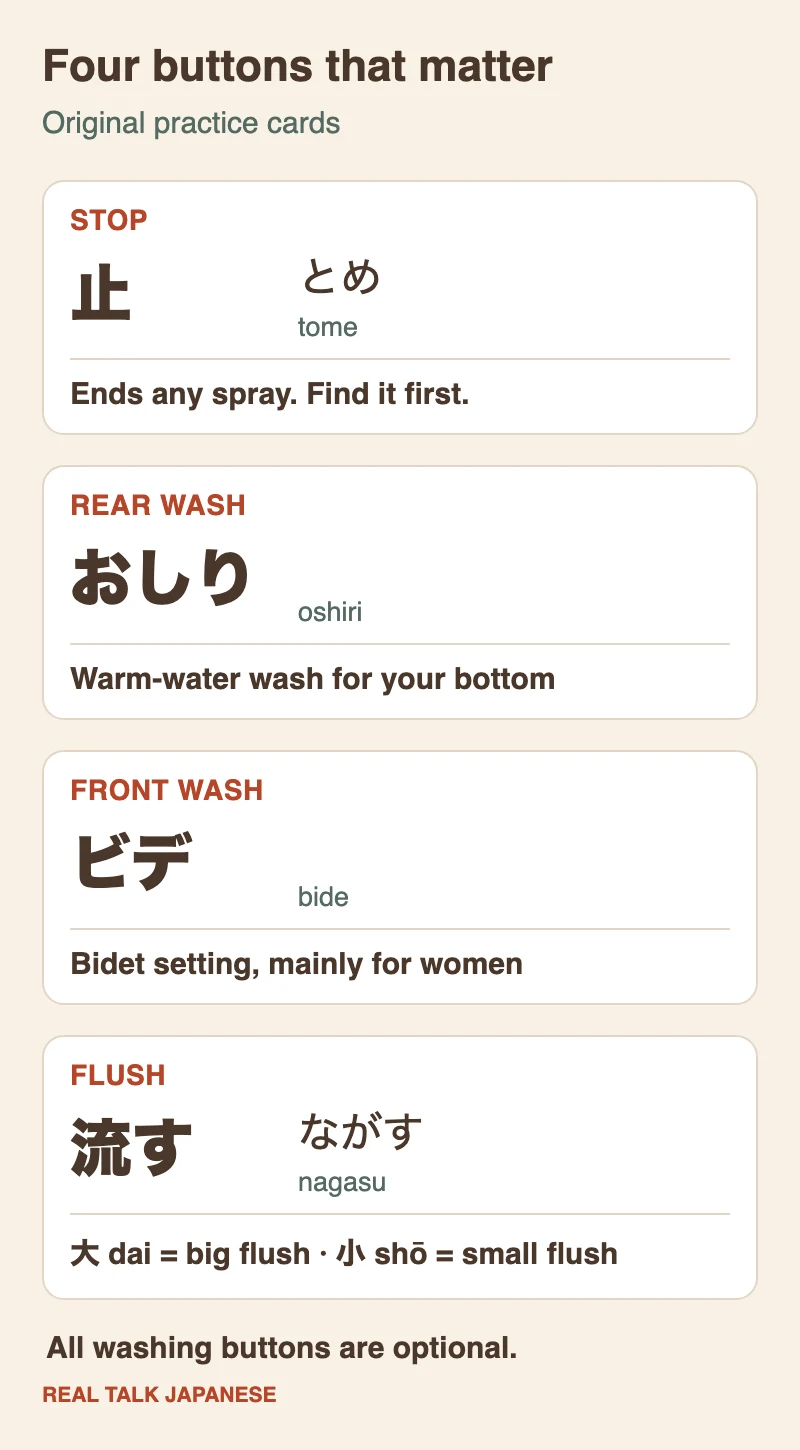
止 — stop. It’s often colored orange or red and placed where it’s easy to reach. Press it any time.
おしり — rear wash. A small nozzle extends and sprays warm water. Oshiri is the everyday word for “bottom.”
ビデ — front wash. The bidet setting, designed mainly for women.
流す — flush. Some toilets flush with a lever instead. When you see 大 (dai) and 小 (shō), they mean a big flush and a small flush.
The full list of labels
Not every toilet has every button. This table lists the labels you’re most likely to see.
Scroll the table sideways on smaller screens.
| Label | Reading | What it does |
|---|---|---|
| 止 | tome | Stops the spray or any running function |
| おしり | oshiri | Rear wash |
| ビデ | bide | Front wash (bidet) |
| 乾燥 | kansō | Warm-air dryer |
| 水勢 | suisei | Water pressure, usually with 強 (tsuyoi, stronger) and 弱 (yowai, weaker) |
| 便座 | benza | Seat temperature |
| 脱臭 | dasshū | Deodorizer |
| 流す 大/小 | nagasu dai / shō | Flush: big / small |
| 音 | oto | A flushing sound to cover noise |
The 2017 shared symbols cover eight functions: lid open and close, seat open and close, big flush, small flush, rear wash, front wash, dry, and stop. When a panel has no text at all, these are the pictures to look for.
Before you press a wash button
A few habits make the first try painless.
- Sit down first. Many models only spray while someone is sitting on the seat.
- Find 止 before anything else. Know where your exit is.
- Start with the pressure low. If the panel shows 水勢, press 弱 until the setting is at its lowest.
- Stop before you stand up. Press 止, then use toilet paper as usual.
If something surprises you, press 止. That’s the whole safety plan.
Flushing: lever, button, or sensor
Japanese toilets flush in several ways, sometimes in the same building:
- A lever on the tank, often with 大 and 小 marked on each side.
- A button on the wall panel marked 流す, 大, or 小.
- A sensor that flushes automatically when you stand up or wave a hand near it.
Toilet paper goes into the toilet bowl and gets flushed. Sanitary products go in the small bin provided in the stall, not into the toilet.
In public toilets: the sound button and the red button
Two buttons in public restrooms confuse visitors more than the toilet itself.
The sound button. Many women’s restrooms have a button marked 音 or with a musical-note symbol. It plays the sound of flushing water so other people don’t hear you. Using it is optional.
The red call button. A red button or pull cord, often labeled 呼出 (yobidashi) or 非常 (hijō), calls staff for help in an emergency. It is not a flush button. If you press it by mistake, staff may come to check on you, so it’s fine to explain that it was an accident:
すみません、間違えて押しました。
すみません、まちがえておしました。
Sumimasen, machigaete oshimashita.
“Sorry, I pressed it by mistake.”
You may also meet a 和式 (washiki), a Japanese-style squat toilet, in older stations and parks. Squat facing the raised hood at one end. Many restrooms mark which stalls are 洋式 (yōshiki), Western-style, on the door or on a sign outside.
In someone’s home: the toilet slippers
In some Japanese homes, a separate pair of slippers waits just inside the toilet door. Step out of your house slippers, wear the toilet slippers inside, and switch back when you leave. Walking out into the hallway still wearing them is the classic visitor’s mistake. It’s more likely to make your host smile than to offend anyone.
For what to say when you arrive at and leave someone’s home, see Ojama Shimasu Meaning.
Asking where the toilet is
Two words mean “toilet.” トイレ (toire) is the everyday word. お手洗い (otearai), literally “hand-washing place,” sounds a little more polite and works anywhere.
トイレはどこですか。
Toire wa doko desu ka?
“Where is the toilet?”
In a shop, a café, or someone’s home, ask to use it:
お手洗いをお借りしてもいいですか。
おてあらいをおかりしてもいいですか。
Otearai o okari shite mo ii desu ka?
“May I use your restroom?”
The verb 借りる (kariru) means “to borrow.” Japanese often treats using someone’s restroom as borrowing it. If you want more phrases for finding places, see How to Ask for Directions in Japanese.
Here’s a short original practice dialogue:

すみません、お手洗いをお借りしてもいいですか。 — Sumimasen, otearai o okari shite mo ii desu ka? — “Excuse me, may I use your restroom?”

どうぞ。廊下の右側です。 — Dōzo. Rōka no migigawa desu. — “Go ahead. It’s on the right side of the hallway.”
ありがとうございます。 — Arigatō gozaimasu. — “Thank you.”
Quick questions
Do I have to use the washing functions? No. They’re optional. You can use the toilet without touching the panel.
Is the water from the nozzle clean? The nozzle uses fresh water from the water supply, not water from the bowl. Many models also rinse the nozzle before and after each use.
What if the panel is only in Japanese? Look for the picture symbols, and remember 止. If you can’t find the flush, look for a lever, a wall button marked 流す, or a sensor.
For more about everyday Japanese at home, at stores, and at the table, see the Real Conversation & Culture articles.