For a first onsen visit, check the facility’s rules, undress in the changing area, wash and rinse before soaking, then remove excess water before returning to the changing area. Shared Japanese baths usually do not allow swimwear, but some facilities have different arrangements. Ask about the specific bath you will use.
You do not need to memorize every possible custom. A clear picture of where your clothes, soap, towel, and phone belong—and a few questions for reception—will help you prepare.
Before you go: check the bath’s own rules
Look at the facility’s current visitor information or contact reception. General onsen advice cannot confirm admission to a particular bath.
| Check | What to ask or look for |
|---|---|
| Tattoos and admission | Are tattoos permitted in the bath you want to use? Are there conditions? |
| Private bathing | Is a bath available for private use? Does it need a separate reservation? |
| Access and schedule | Can you visit without an overnight stay? Which entrance and opening times apply? |
| Towels and supplies | Are towels provided, rented, or sold? What should you bring? |
Tattoo policies vary. Do not assume that a cover sticker is accepted, or that a private reservation automatically overrides the policy. JNTO’s onsen guide advises checking tattoo rules beforehand.
At the entrance, read the signs rather than relying on curtain colors. Ask staff if you cannot tell which area to enter.
Shiba-sensei’s tip: Save your facility’s instructions before you arrive. A generic checklist is a starting point; reception can clarify the details.
The bathing sequence: what goes where
The four zones below are an original learning diagram, not a floor plan of an actual facility.
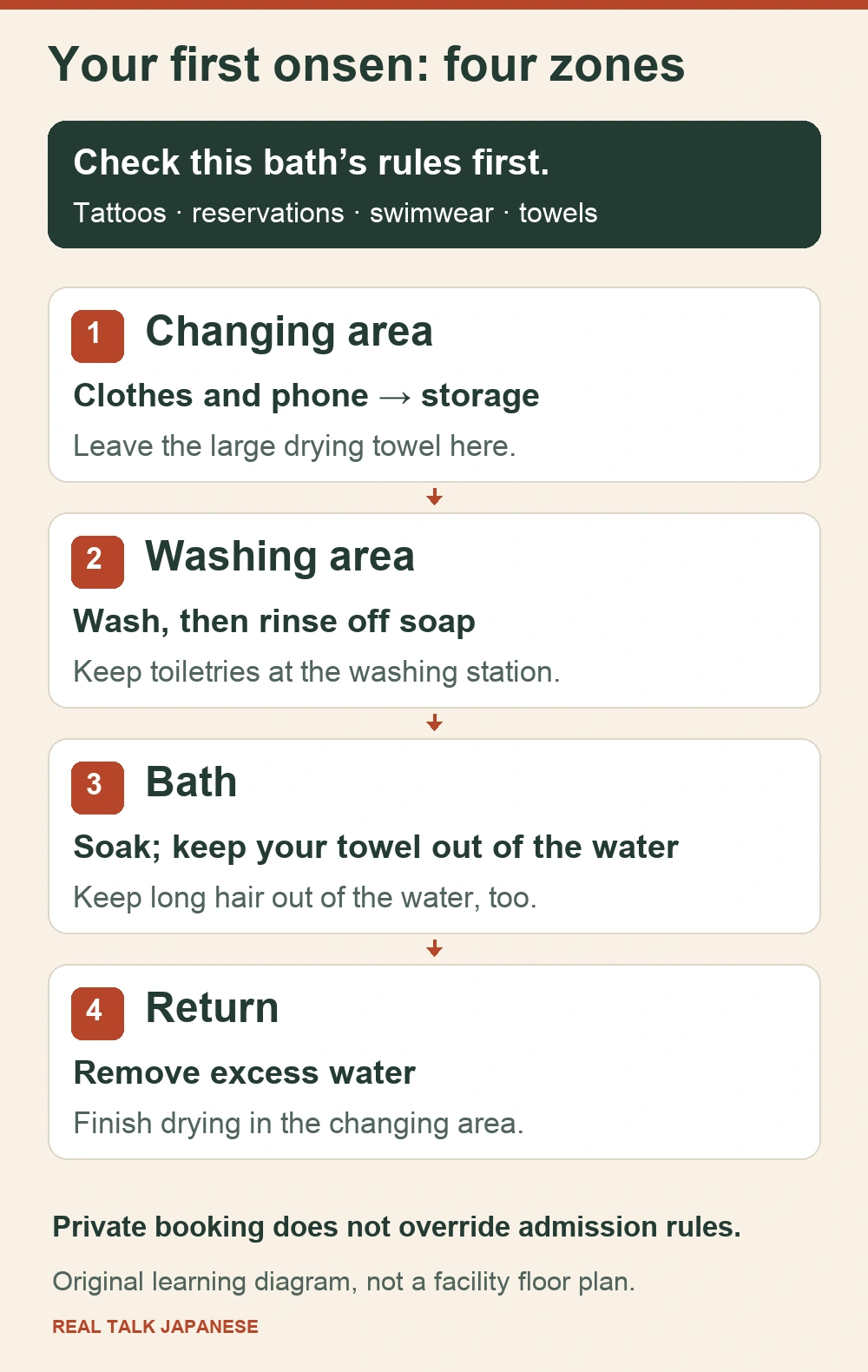
1. Changing area: store clothes and belongings
Use the provided storage and follow the signs about shoes and slippers. Leave your large drying towel here. Keep your phone stored away in shared changing and bathing areas; do not photograph other bathers. Follow any additional camera rules posted by the facility.
In a typical shared bath, you remove your clothes here. If you have booked a different kind of bathing area, follow its stated clothing rules.
2. Washing area: wash and rinse
Use the washing station before entering the communal tub. Wash your body and rinse soap and shampoo off thoroughly. Keep toiletries at the washing area rather than taking them into the bath.
3. Bath: soak without the towel in the water
Keep your small towel and long hair out of the bathwater. A towel on your head is one option, not a requirement. Put it somewhere suitable outside the water, following the facility’s setup.
4. Return: avoid dripping through the changing area
Before crossing back, remove excess water from your body with your small towel. Finish drying with your larger towel in the changing area, then dress.
The washing sequence and small-versus-large towel distinction are also described in the Hokkaido District Transport Bureau’s onsen guide. Facility instructions take priority over a general diagram.
Shiba-sensei’s tip: Think in locations: soap belongs at the washing station, clothes stay in storage, and the small towel stays out of the tub.
Towels, hair, and shared space
The tub is for soaking after washing. Keep towels and hair clear of the water, do not swim or splash, and speak quietly. Give other bathers personal space rather than staring or watching how they undress. These are shared-space considerations, not a test of how “Japanese” you can act. JNTO’s bathing guidance.
After using a washing station, rinse away suds and leave the stool and bucket ready for the next person. Do not use your possessions to reserve a station while you soak. For a visual reminder to rinse away soap, keep towels out of the water, and avoid swimming, see page 2 of the local Misasa Onsen bathing-etiquette leaflet.
If you are unsure where something belongs, pause and ask. You can fix a small misunderstanding without turning it into a dramatic apology.
Public, private, and hotel baths can differ
The word “hotel” does not tell you whether you will bathe alone. Check which arrangement you are actually booking.
Shared bath
You use the changing and bathing spaces with other visitors. Confirm access, opening times, and the appropriate entrance. A hotel’s large communal bath is still a shared bath.
Bath reserved for private use
Ask about the reservation length, who can use it together, what supplies are included, and any conditions on tattoos or clothing. “Private” describes the booking arrangement; it does not answer every policy question.
Bath attached to your room
Check that your room booking includes the bath you want and read its instructions. Do not assume that a room photo describes every room category at the property.
Shiba-sensei’s tip: Write down the bath’s exact name when asking questions. “Can I use this bath?” is easier to answer when staff know which one you mean.
Simple Japanese to ask before entering
These are original practice phrases for reception or a booking inquiry. Show the written sentence if speaking it is difficult. Start with すみません — Sumimasen — “Excuse me.” Our sumimasen and gomennasai guide explains why that opening fits a request for attention.
Can I rent a towel?
タオルは借りられますか?
タオルはかりられますか?
Taoru wa kariraremasu ka?
Can I borrow or rent a towel?
Ask at reception before changing. If it is a paid rental, confirm the price there.
Is there a private bath?
貸切風呂はありますか?
かしきりぶろはありますか?
Kashikiri-buro wa arimasu ka?
Is there a bath available for private use?
This asks about availability of the facility, not whether a particular time slot is free.
Do I need a reservation?
予約が必要ですか?
よやくがひつようですか?
Yoyaku ga hitsuyō desu ka?
Is a reservation required?
Use this after specifying which bath you want.
Can I use the bath if I have a tattoo?
タトゥーがあっても利用できますか?
タトゥーがあってもりようできますか?
Tatū ga atte mo riyō dekimasu ka?
Can I use the facility if I have a tattoo?
Ask before paying or making a reservation. Follow up on any conditions instead of assuming that a general “yes” applies to every bath at the property.
Does this bath require swimwear?
このお風呂は水着が必要ですか?
このおふろはみずぎがひつようですか?
Kono ofuro wa mizugi ga hitsuyō desu ka?
Does this bath require swimwear?
This is useful when a facility has several bathing areas with different rules.
Original practice dialogue:
Could I just point at the entrance and ask, “Daijōbu?”

That may leave staff guessing. Are you asking about the opening time, tattoos, or swimwear?
I want to know whether I need a reservation.
Then name the bath and ask, “Yoyaku ga hitsuyō desu ka?”
For more on why context matters, see the different meanings of daijōbu.
Common questions
Can I wear a swimsuit?
Usually not in a conventional shared onsen bath. Check the exact facility and area, since exceptions exist; do not decide from the word “onsen” alone.
Can I take my small towel into the bathing area?
Yes, in the usual arrangement—but keep it out of the bathwater. The larger drying towel stays in the changing area.
Are tattoos always prohibited?
No single answer applies to every facility. Check the current policy, including any restrictions on a private bath or cover sheets, before booking.
Should I shower after soaking?
Follow the bath’s posted instructions or ask staff. Avoid treating “always rinse” or “never rinse” as a rule for every spring and visitor.
If you feel unwell while bathing, get out safely and ask staff for help.
A one-minute rehearsal before you arrive
Try these three questions without looking back:
- Where will you leave your phone?
- Where does your small towel go while you soak?
- What should you confirm before booking a private bath?
Answers: Store the phone away; keep the towel outside the water; confirm the booking conditions and any policy that affects your visit, rather than assuming “private” means unrestricted.
Now say one question for reception out loud. A travel companion or language partner can play the staff member. If you want scheduled feedback, the Japanese tutor guide can help you compare practice options. Ask to rehearse a specific inquiry and a follow-up question.