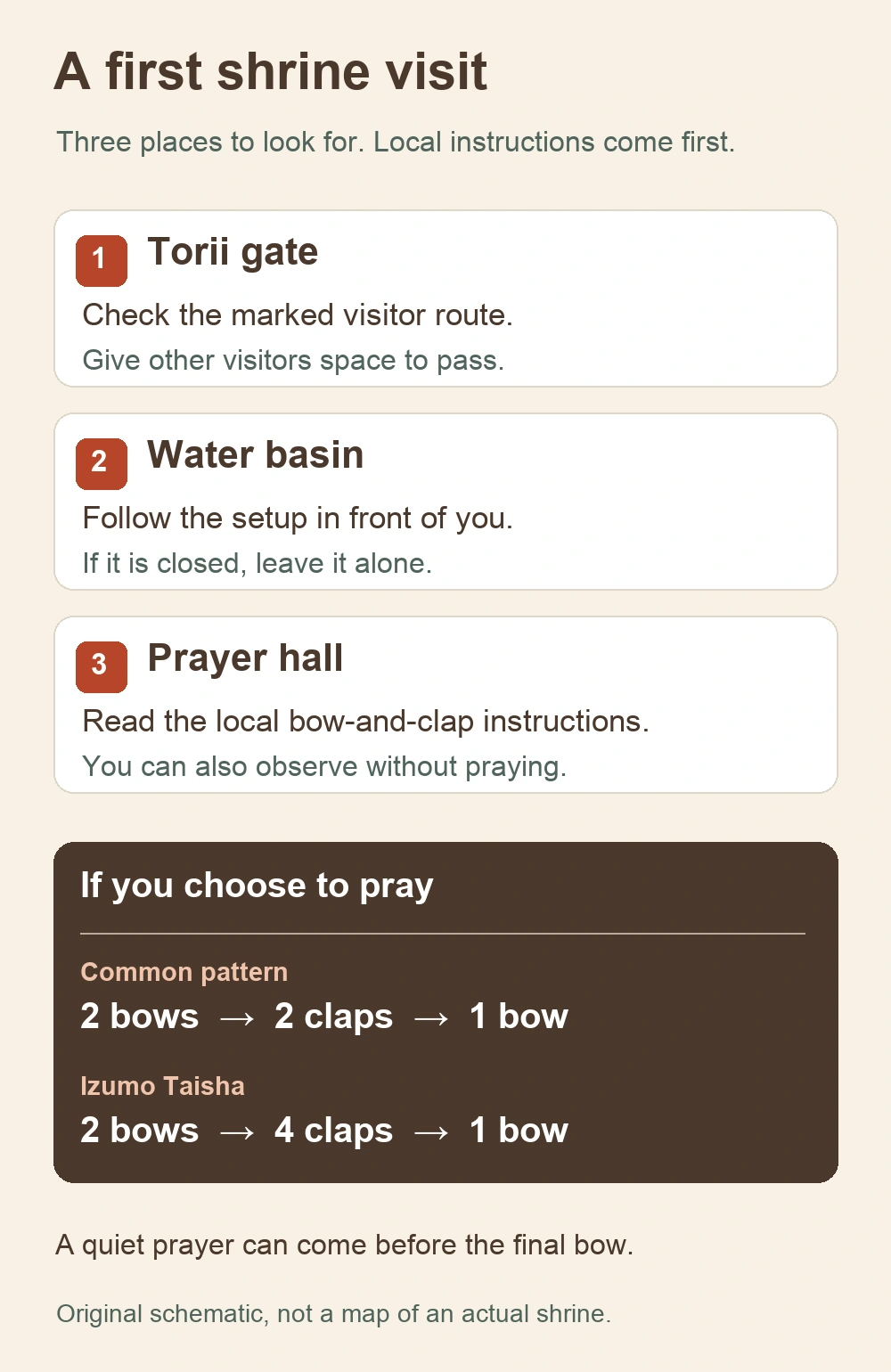
On a first visit to a Japanese Shinto shrine, look for three places: the torii gate, the water basin, and the prayer hall. A common way to pay your respects is to bow twice, clap twice, pray quietly, and bow once. Read the shrine’s own instructions first: at Izumo Taisha, for example, the custom is four claps.
You can visit respectfully without taking part in an act of worship. If you prefer to observe, stand somewhere that leaves other people a clear path to pray. A Shinto shrine (jinja) and a Buddhist temple (tera) have different traditions; the shrine clapping pattern is not a routine to repeat at a temple. The Japan Foundation introduces the distinction in Irodori, Elementary 1, Lesson 6.
At the gate: look, pause, and follow the signs
A 鳥居(とりい)— torii marks the entrance to sacred space. You may see people pause and give a slight bow before passing through. The 参道(さんどう)— sandō is the approach, and the 拝殿(はいでん)— haiden is the prayer hall. Use the marked visitor route. An open door or a gap beside a rope is not an invitation to go inside. Jinja Honcho’s guide to entering a shrine.
A first visit goes more smoothly if you look up from your phone at each transition. Is this the public approach? Is a ceremony taking place? Is there a sign asking visitors not to take photographs? You can step aside to read without stopping in the middle of a line.
What should you wear? Check the shrine’s visitor information if clothing is a concern, especially for a ceremony rather than an ordinary visit. For an ordinary visit, posted guidance is more useful than a supposed list of colors to avoid.
At the water basin: follow the setup you see
The ritual cleansing before approaching the prayer hall is called 手水(てみず)— temizu. Where a ladle is provided, the sequence is:
- Hold the ladle in your right hand and pour water over your left hand.
- Switch hands and rinse your right hand.
- Hold the ladle in your right hand again. Pour a little water into your left palm and use your palm to rinse your mouth.
- Let the used water fall outside the basin of clean water. Rinse your left hand again and return the ladle.
Your mouth does not touch the ladle. This is a rinse, not an instruction to drink the water. Jinja Honcho’s illustrated explanation.
You may see a different setup. Meiji Jingu’s own visitor instructions, for instance, show visitors washing their hands, using water cupped in their hands to rinse their mouths, and washing their hands again. Follow the arrangement in front of you. If a basin is closed, leave it alone; you do not need to look for a ladle behind a barrier.
At the prayer hall: two bows, two claps, one bow
Once you reach the worship area, leave room for the person ahead to finish. If you wish, you can place a coin in the offering box. No particular coin is a requirement for the ordinary sequence. If there is a bell available for visitors to ring, follow the local instructions for it.
At a shrine using the common pattern, face the hall, bow deeply twice, bring your hands together and clap twice. Keep your hands together for a quiet prayer if you wish, then finish with one deep bow. Meiji Jingu shows the common bow-and-clap pattern here.
When the sign says four claps
At Izumo Taisha, the shrine itself specifies two bows, four claps, and one bow for an ordinary visit. You have not misread the sign just because it differs from a general guidebook. See Izumo Taisha’s instructions (Japanese) for the sequence and the Tokyo Shrine Association’s explanation for the reading of 四拍手.
Original learning dialogue:

I practiced two claps at home. Here the notice says 四拍手. Am I at the wrong building?

Read the number: 四 is four, and 拍手(はくしゅ, hakushu)means clapping. Check the shrine’s instructions; four is the usual number at Izumo Taisha.
If I’m unsure, can I just watch without joining in?
Yes. Stand clear of people paying their respects and take your time reading the sign.
A few questions you may actually need
Start with すみません — sumimasen — “excuse me” when asking a staff member for help. If a sign already prohibits something, follow it; a question is useful when the rule or location is unclear.
Ask about a photo in a particular spot
ここで写真を撮ってもいいですか。
ここでしゃしんをとってもいいですか。
Koko de shashin o totte mo ii desu ka?
“May I take a photo here?”
The word koko means “here.” Permission for a view on the approach does not extend to a different room or someone else’s prayer. If no staff member is available and the rule is unclear, leave the camera away.
Ask where visitors pray
拝殿はどこですか。
はいでんはどこですか。
Haiden wa doko desu ka?
“Where is the prayer hall?”
This asks for a destination. It does not ask for permission to enter the building. Follow the direction to the public worship area rather than opening a door to find your way.
Recognize two useful notices
| Notice | Reading and meaning |
|---|---|
| 撮影禁止 | さつえいきんし — satsuei kinshi — no photography or filming |
| 立入禁止 | たちいりきんし — tachiiri kinshi — no entry |
Original sign-reading practice:
The sign says 立入禁止. Is that the one about turning off the flash?
It’s the one about entry. Stay outside that area even if you don’t plan to take a photo.
And 撮影禁止 means I should put the camera away, not just switch it to silent.
Exactly. Identify the action before the shared word 禁止(きんし, kinshi), “prohibited.”
Rehearse your first visit
Imagine a small shrine with a temporary notice at its basin, a board near the hall, and a separate reception counter. This is an invented scene for practice.
- The basin is closed. Do you move the sign so you can complete the rinse? Leave the sign where it is and use the posted visitor route.
- The board gives a four-clap sequence. Do you substitute the two claps you learned earlier? If you choose to pray, use what this shrine requests. Observing without joining the prayer is also an option.
- Afterward, you’d like to ask about a goshuin. Do you walk through an open door beside the hall? Look for a marked reception counter or ask staff where to go. The goshuin etiquette guide explains that separate part of a visit. If you encounter a paper fortune instead, see what omikuji means.
For a free practice round, have a friend point to one of the two notices and explain it without using a camera or crossing any boundary. Then switch roles and ask where the hall is. If you’re already planning lessons, the Japanese tutor guide can help you find a format for practicing visitor questions and listening to replies.