To order food in Japanese, name the item—or point and say これ (kore, “this”)—add a quantity if needed, and finish with お願いします (onegaishimasu) or ください (kudasai). Then listen for choices such as size or takeout. If you miss the question, ask the staff member to repeat it.
You can build a useful restaurant conversation from a few short replies. This guide focuses on placing and confirming an order, with original practice examples you can adapt to a menu.
The basic order: item + quantity + please
Start with one steady pattern: item + を (o) + quantity + お願いします. The quantity can be left out when you are simply pointing to an item.
Point to a menu item
これをお願いします。
これをおねがいします。
Kore o onegaishimasu.
I’d like this, please.
Point clearly so the staff member can tell which item you mean.
Order one dish
カレーを一つお願いします。
カレーをひとつおねがいします。
Karē o hitotsu onegaishimasu.
One curry, please.
Order two drinks
お茶を二つお願いします。
おちゃをふたつおねがいします。
Ocha o futatsu onegaishimasu.
Two teas, please.
You may hear the particle を omitted in conversation. Keeping it in this practice pattern gives you a consistent sentence to build. The Japan Foundation teaches both onegaishimasu and kudasai for ordering in Irodori Starter Lesson 6.
Scroll the table sideways on smaller screens.
| Amount | For items in this practice | For people |
|---|---|---|
| One | 一つ — hitotsu | 一人 — hitori |
| Two | 二つ — futatsu | 二人 — futari |
| Three | 三つ — mittsu | 三人 — sannin |
These item forms are a useful beginner option, not the only counters Japanese uses. Keep the number of diners separate from the number of dishes.
Shiba-sensei’s tip: Two people do not automatically mean two of every item. Plan the food and drinks as separate quantities.
Follow the conversation from the door to your order
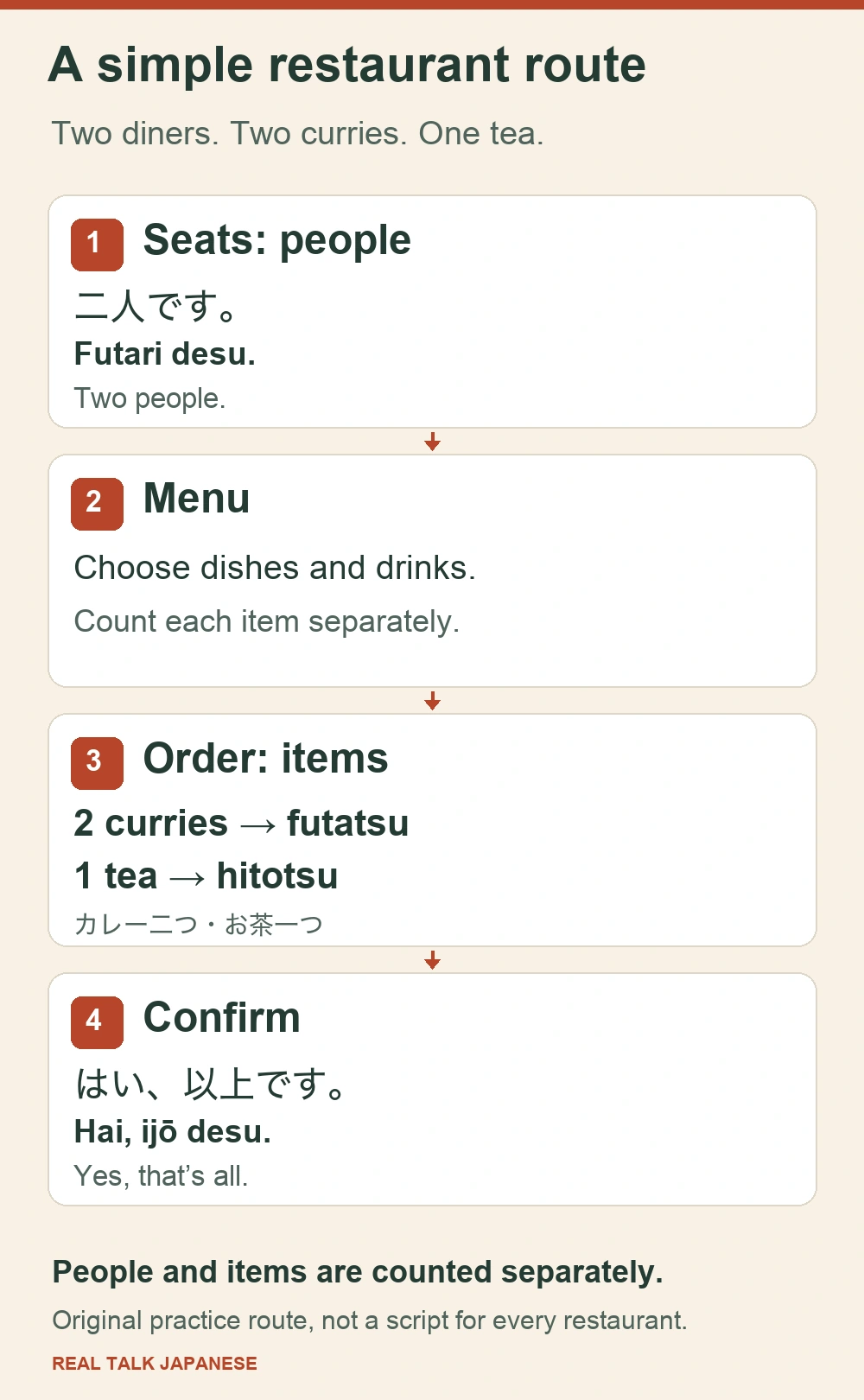
This original practice route is for a restaurant where staff seat you and take your order. Other restaurants may use a counter, ticket machine, or tablet.
At the door: how many people?
Staff may ask:
何名様ですか?
なんめいさまですか?
Nanmei-sama desu ka?
How many people?
You can reply:
二人です。
ふたりです。
Futari desu.
Two people.
You may also hear いらっしゃいませ — Irasshaimase, the staff’s welcome. You do not need to repeat it back as your own greeting.
With the menu: are you ready?
Staff may ask:
ご注文はお決まりですか?
ごちゅうもんはおきまりですか?
Gochūmon wa okimari desu ka?
Have you decided on your order?
If ready, place your order. If not, say:
もう少し待ってください。
もうすこしまってください。
Mō sukoshi matte kudasai.
Please give me a little more time.
After ordering: is that everything?
Staff may ask:
以上でよろしいですか?
いじょうでよろしいですか?
Ijō de yoroshii desu ka?
Will that be all?
You can reply:
はい、以上です。
はい、いじょうです。
Hai, ijō desu.
Yes, that’s all.
These are examples, not a script every restaurant follows word for word. The Kochi dining communication sheet shows related staff questions about party size, ordering, and payment.
Listen for the choice, not every word
A follow-up question may be asking you to select one detail. Look for the choice instead of assuming you must understand every honorific ending.
Scroll the table sideways on smaller screens.
| Choice to listen for | Words you may hear | A possible reply |
|---|---|---|
| Hot or iced | ホット/アイス — hotto / aisu | アイスでお願いします。— Aisu de onegaishimasu. — Iced, please. |
| Size | サイズ — saizu; S, M, L | Mサイズでお願いします。— Emu saizu de onegaishimasu. — Medium, please. |
| Eat here or takeout | 店内/持ち帰り — tennai / mochikaeri | 店内でお願いします。— Tennai de onegaishimasu. — For here, please. |
For takeout, the matching reply is:
持ち帰りでお願いします。
もちかえりでおねがいします。
Mochikaeri de onegaishimasu.
To go, please.
The size labels in the table are examples. Use the options shown on that menu. At a ticket machine or tablet, follow the displayed ordering steps; a spoken request does not replace submitting the order there.
Shiba-sensei’s tip: If you recognize “size” but miss the choices, ask again. Guessing a whole reply is harder to fix than clarifying one detail.
If you need more time or did not catch the reply
You can pause the conversation without pretending to understand.
Ask for a repeat
もう一度お願いします。
もういちどおねがいします。
Mō ichido onegaishimasu.
Could you say that again, please?
Ask the speaker to slow down
ゆっくりお願いします。
ゆっくりおねがいします。
Yukkuri onegaishimasu.
Slowly, please.
Asking for repetition is a skill in its own right. Irodori Starter Lesson 2 provides listening practice for these situations.
Ask about an English menu
英語のメニューはありますか?
えいごのメニューはありますか?
Eigo no menyū wa arimasu ka?
Do you have an English menu?
An English menu may not be available. You can still point to a clearly identified item and confirm the quantity. To get a staff member’s attention first, see how to use sumimasen rather than gomennasai.
Original practice dialogue: Mochi is the customer; Shiba-sensei plays a café staff member.

アイスティーを一つお願いします。 — Aisu tī o hitotsu onegaishimasu. — One iced tea, please.

サイズはSとM、どちらにしますか? — Saizu wa esu to emu, dochira ni shimasu ka? — Which size would you like, small or medium?
もう一度お願いします。 — Mō ichido onegaishimasu. — Could you say that again, please?
Sサイズですか? Mサイズですか? — Esu saizu desu ka? Emu saizu desu ka? — Small or medium?
Mサイズでお願いします。 — Emu saizu de onegaishimasu. — Medium, please.
One full practice order
Use this imaginary menu, created for the exercise:
- カレー — karē — curry
- サラダ — sarada — salad
- お茶 — ocha — tea
Two people arrive. Together, they want two curries and one tea. Their order could be:
- 二人です。 — Futari desu. — “Two people.” Say this when asked about party size.
- カレーを二つと、お茶を一つお願いします。 — Karē o futatsu to, ocha o hitotsu onegaishimasu. — “Two curries and one tea, please.” Say this when ordering.
- はい、以上です。 — Hai, ijō desu. — “Yes, that’s all.” Say this when asked whether the order is complete.
Your turn: Change the scene to one person ordering one curry and one salad.
One answer: 一人です。— Hitori desu. — “One person.” Then: カレーを一つと、サラダを一つお願いします。— Karē o hitotsu to, sarada o hitotsu onegaishimasu. — “One curry and one salad, please.”
Shiba-sensei’s tip: Before speaking, write two small notes: “people” and “items.” This keeps hitori/futari separate from hitotsu/futatsu.
Finishing your meal and common questions
How do I ask for the check?
お会計をお願いします。— Okaikei o onegaishimasu. — “The check, please.” Follow the restaurant’s instructions about where to pay. For eating and payment customs, continue to the Japanese table manners guide.
Is kudasai rude when ordering?
No. It can be used in a polite food order. Onegaishimasu is another useful request form; you do not need to treat every restaurant sentence as a contest to choose the most formal wording.
Can these phrases handle dietary restrictions?
The basic ordering pattern does not establish whether a dish meets your needs. Tell the restaurant specifically what you cannot eat and confirm whether it can accommodate that requirement. Simply requesting removal of one ingredient does not confirm the whole preparation is suitable.
Practice both sides of the conversation
Read one order aloud, then have a partner change the size or takeout question. For free listening practice, use Lesson 6 on the Japan Foundation’s Irodori Starter materials page.
If you want scheduled feedback, the Japanese tutor guide can help you compare lessons. Ask to practice ordering, hearing an unexpected question, and asking again—not just reciting the opening line.