Ojama shimasu (お邪魔します/おじゃまします) is what a guest can say when entering someone’s home after being invited in. “Thank you for having me” often sounds more natural in English than the literal idea of intruding. When the visit is over, the guest can say ojama shimashita (お邪魔しました) on the way out.
The phrase acknowledges that you are entering another person’s space. It is neither an admission that you have done something wrong nor a question asking permission to enter. Wait for the invitation first.
Who says it, and when?
Imagine Mochi has arranged to visit Shiba-sensei’s apartment to play a board game. Mochi rings the bell. Shiba-sensei opens the door and says hello. Although they’re at the entrance, ojama shimasu isn’t a password that Mochi has to say as soon as the door opens. Listen for the invitation:
どうぞ、上がってください。
どうぞ、あがってください。
Dōzo, agatte kudasai.
“Please, come on in.”
Now Mochi can say お邪魔します — Ojama shimasu as a guest entering the apartment. Here, “Thank you for having me” makes sense: Shiba-sensei has just welcomed Mochi inside. The greeting acknowledges that welcome. A host may say いらっしゃい — Irasshai (“Welcome”), use the guest’s name, or continue the conversation. There’s no set reply that must follow ojama shimasu.
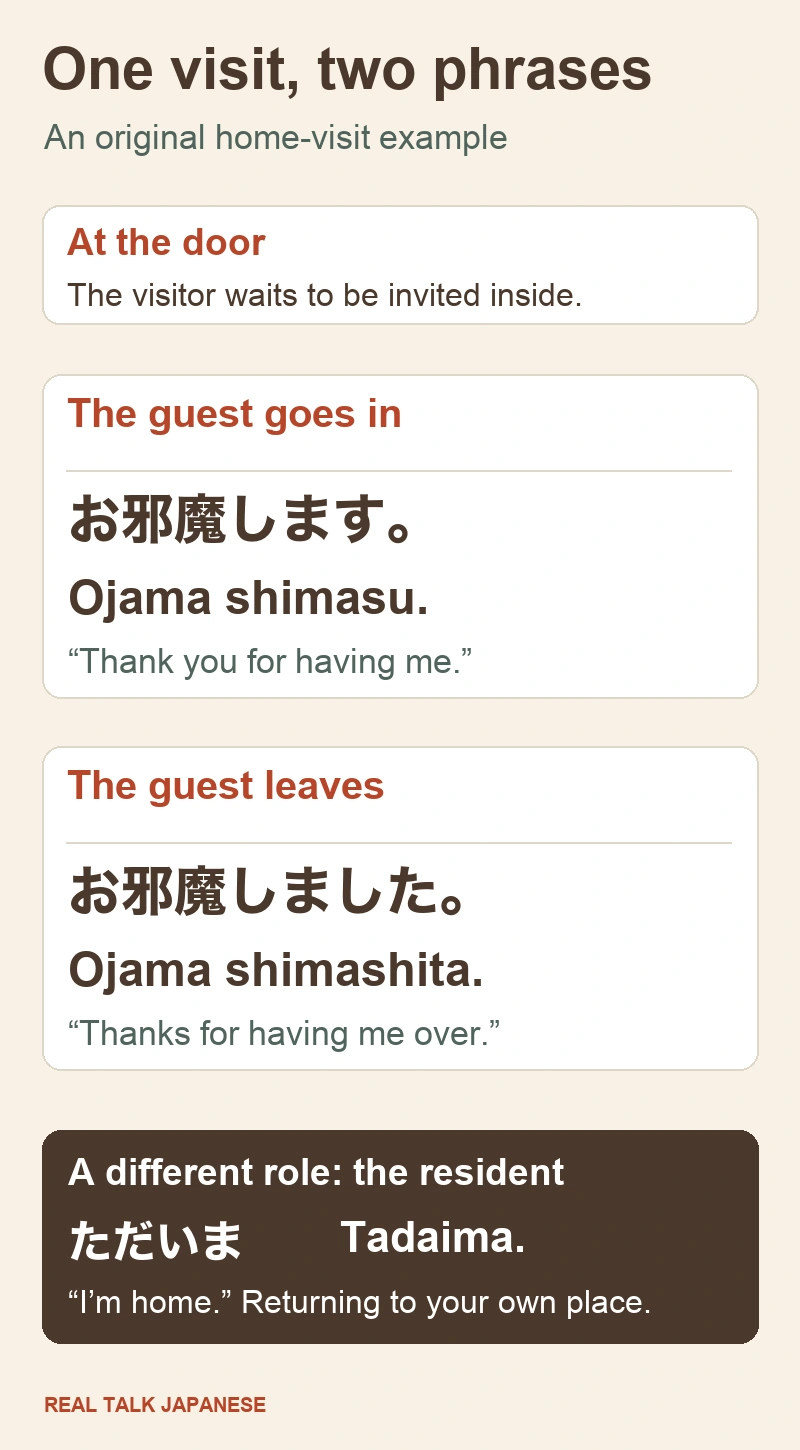
If you’re delivering a book and your friend chats with you at the door without inviting you inside, the situation is different. Greet them and hand over the book; the doorway by itself doesn’t call for a guest’s entering phrase. The 玄関(げんかん)— genkan is the entrance area. You don’t have to find a particular spot on its floor to say the words correctly.
The same visit, two verb endings
The guest’s role stays the same through the evening. The verb ending changes because the visit moves from something you are beginning to something you have finished.
| At the beginning | At the end |
|---|---|
| お邪魔します。 | お邪魔しました。 |
| おじゃまします。 | おじゃましました。 |
| Ojama shimasu. | Ojama shimashita. |
| “Thank you for having me.” | “Thanks for having me over.” |
To practice the sounds, try o-ja-ma shi-ma-su and then o-ja-ma shi-ma-shi-ta. Say the two forms slowly, listening for the final -ta in the second. The spaces and hyphens here are pronunciation aids, not part of the Japanese spelling.
The expression refers to imposing on someone’s space or time. In the board-game scene, “I’m sorry I disturbed you” in English might make it sound as though the evening went badly. That’s not what Mochi needs to convey. The ordinary leaving phrase can close a visit that both people enjoyed. Japan Society’s short home-visit lesson introduces the entering and leaving forms together.
If you want to thank the host more explicitly on the way out, you could say:
今日はありがとうございました。お邪魔しました。
きょうはありがとうございました。おじゃましました。
Kyō wa arigatō gozaimashita. Ojama shimashita.
“Thank you for having me over today.”
That English line conveys both parts of the farewell together. The first Japanese sentence explicitly thanks the host; the second marks the end of the visit. Nor does a guest have to deliver both sentences every time. Choose the part that fits what you want to say.
Visitor, returning resident, or someone interrupting?
Three speakers can all be standing at a door and still need three different expressions.
- An invited guest steps into a friend’s apartment: お邪魔します — Ojama shimasu. The person is starting a visit.
- A resident returns to that apartment after work: ただいま — Tadaima. The person is announcing their return; someone inside may say okaeri, “Welcome back.” See the tadaima and okaeri guide for that exchange.
- A colleague enters a meeting already in progress: 失礼します(しつれいします)— Shitsurei shimasu, “Excuse me,” can acknowledge the interruption. Follow the particular setting and invitation.
English “excuse me” can cover many situations. That does not make ojama shimasu the phrase to use whenever you enter a shop, get someone’s attention, or accidentally step on a foot. If you are actually apologizing for a specific mistake, a home-visit greeting by itself does not explain what happened.
If you’ve brought a small gift, the greeting and offering it are two separate moments. Say your entering line when invited in. When you actually hand over the gift, you can name what it is. The omiyage and temiyage guide gives examples for that part of a visit.
Practice an arrival and departure
These are original teaching dialogues. In the first, Shiba-sensei is hosting the game night and Mochi is arriving.

いらっしゃい。どうぞ、中へ。 — いらっしゃい。どうぞ、なかへ。 — Irasshai. Dōzo, naka e. — “Welcome! Come on in.”

お邪魔します。ゲームを持ってきました。 — おじゃまします。ゲームをもってきました。 — Ojama shimasu. Gēmu o motte kimashita. — “Thanks for having me. I brought the game.”
Switch roles for the second: this time Mochi hosted, and Shiba-sensei is leaving after the last round.
今日は楽しかったです。お邪魔しました。 — きょうはたのしかったです。おじゃましました。 — Kyō wa tanoshikatta desu. Ojama shimashita. — “I had fun today. Thanks for having me over.”
また遊びに来てくださいね。 — またあそびにきてくださいね。 — Mata asobi ni kite kudasai ne. — “Please come over again.”
Mochi’s reply is an invitation they want to extend. A host who isn’t making future plans can simply thank the guest for coming. There’s no need to schedule another visit as part of the goodbye.
Pick the line that fits
- A friend has opened the door and invited you in for the first time. Which ending fits?
- You have finished your tea and are leaving the same friend’s home. Do you say shimasu again?
- You come back to your own apartment and greet your roommate. Does going through the same kind of door make you a guest?
Answers: At arrival, ojama shimasu. At departure, ojama shimashita. At home with your roommate, tadaima can fit because you are coming back, not starting a visit.
For a free listening exercise, try the Japan Foundation’s Irodori Elementary 1, Lesson 17 and its lesson audio. Listen for which person speaks when the guest arrives, then when the guest leaves. With a partner, repeat the game-night exchanges and trade roles. If you prefer a teacher for conversation practice, the Japanese tutor guide explains how to choose a lesson format.